Kecksburg UFO Files: What the NASA Court Case Reveals
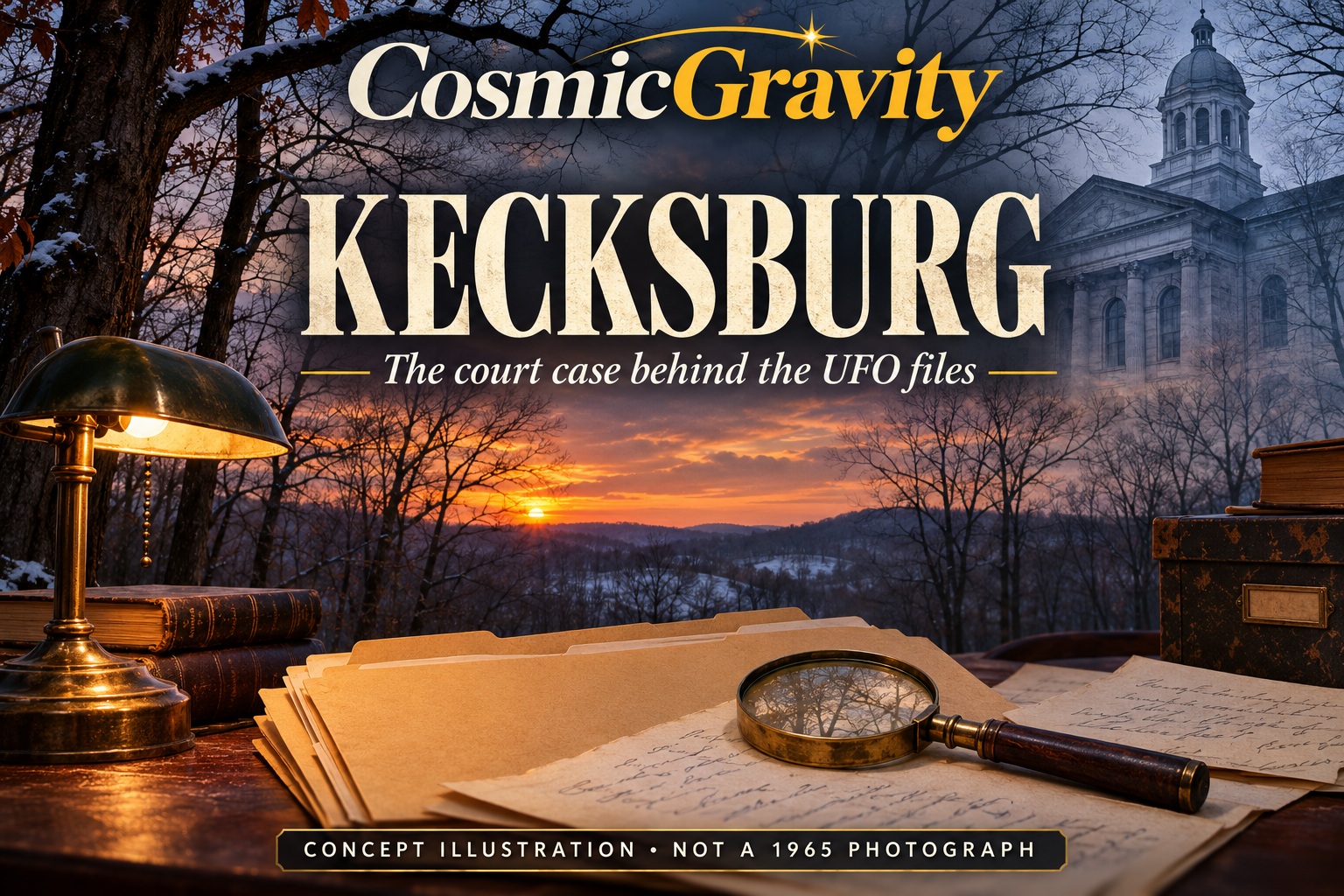
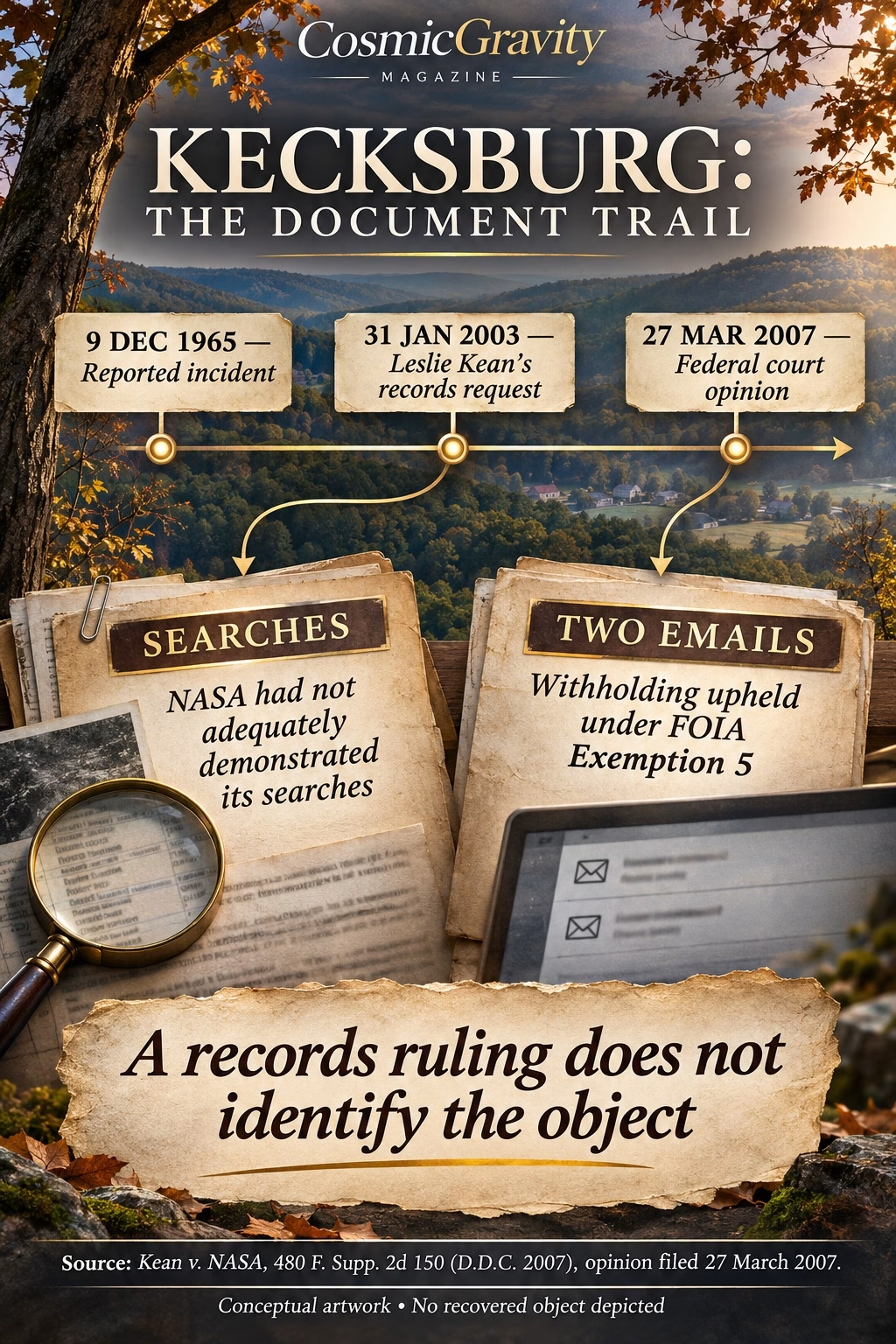
The Kecksburg UFO files include a document that deserves more attention than another dramatic retelling: a federal court opinion. It records a real dispute over NASA’s search for information about the reported incident of 9 December 1965. It also shows why a ruling about government records cannot be treated as a verdict on what came down near the Pennsylvania community.
That distinction makes the story more interesting. An agency’s answer can deserve scrutiny even when the event that prompted the request remains contested. The paper trail has its own evidence, chronology and unanswered questions.
The request behind the Kecksburg UFO files
Leslie Kean submitted her records request on 31 January 2003. The court’s opinion in Kean v. NASA describes a request encompassing the Kecksburg incident, the 1962–1967 “Fragology Files”, Project Moon Dust, Richard M. Schulherr and Cosmos 96. The case reached the US District Court for the District of Columbia.
These search subjects help explain the breadth of the investigation. A request can follow several possible leads without demonstrating that each lead describes the same physical event. The appearance of a satellite name in correspondence is therefore a reason to examine the associated records, rather than an identification by itself.
What the court found in March 2007
Judge Emmet G. Sullivan’s opinion, filed on 27 March 2007, says NASA admitted that its first two searches were inadequate. The court also found that the agency had not sufficiently demonstrated the adequacy of its later searches. Many descriptions lacked the detail needed to show which records, methods and search terms staff had used.
The ruling directed the parties to propose search and documentation procedures. It did not determine that a spacecraft had been recovered. In its conclusion, the court allowed that some searches might have been adequate but poorly documented, leaving that part of the decision open to further proceedings.
For a reader, the practical point is simple: “we searched” and “here is a search another person can evaluate” are different kinds of answers. The second lets someone assess whether an obvious lead was followed or a relevant collection overlooked.
The two emails in the Kecksburg UFO files dispute
The outcome was mixed. The court upheld withholding two disputed emails under FOIA Exemption 5, accepting their deliberative character. That finding and the criticism of the search documentation belong to the same opinion. Leaving either out changes the impression a reader takes away.
A withheld email does not come with a blank cheque for imagining its contents. Equally, a permitted withholding does not erase deficiencies elsewhere in the response. Each finding has to be read in relation to the particular question the court considered.
Why “no records” needs context
A records search can fail for several reasons: the relevant record may never have existed, it may no longer survive, the description may not match the catalogue, or the search may have missed it. Those possibilities call for different follow-up evidence. Treating them as interchangeable makes the investigation harder.
NASA’s current FOIA guidance explains the importance of describing the records sought. Its description of the agency’s records offices also shows why organisational location matters: records can sit with different centres or programmes. Today’s arrangement should not be projected backwards as an exact map of the 2003 process.
The agency’s legacy Kecksburg-related search material illustrates another trap. It includes bibliographic references and search subjects. An entry pointing towards a publication is a lead to read, not proof that NASA independently verified every claim in that publication.
Three questions worth keeping separate
First, what did people report in 1965? Second, what records did public bodies create or retain? Third, what can those records establish about the event? The questions overlap, but an answer to one does not automatically settle the others.
A witness account needs its own source and context. A search declaration needs an account of how the search worked. An identification needs physical, observational or documentary evidence that connects the proposed explanation to the event. Filing the material under “UFO” supplies none of those connections on its own.
Our UFO and UAP case atlas provides the wider historical setting. For another example of documents requiring careful interpretation, see our Roswell evidence guide. These cases have different records; a resemblance between their public stories does not make their evidence interchangeable.
What remains useful about the Kecksburg UFO files
The court record offers a grounded way into a disputed story. Readers can examine a dated decision, follow its reasoning and see what it actually addressed. That is more useful than turning either an administrative failure or a missing document into a complete explanation of the original incident.
The durable lesson is about traceability. When an answer depends on a search, the search itself needs evidence. The mystery of an event and the accountability of an institution can both deserve attention without being collapsed into a single claim.
Research checked 3 November 2026. This historical records explainer discusses the specific March 2007 opinion, not a newly issued ruling or a complete account of every later proceeding. Original graphics are conceptual.
latest video



news via inbox
Subscribe to our Cosmic newsletter to get notified when we have new articles.