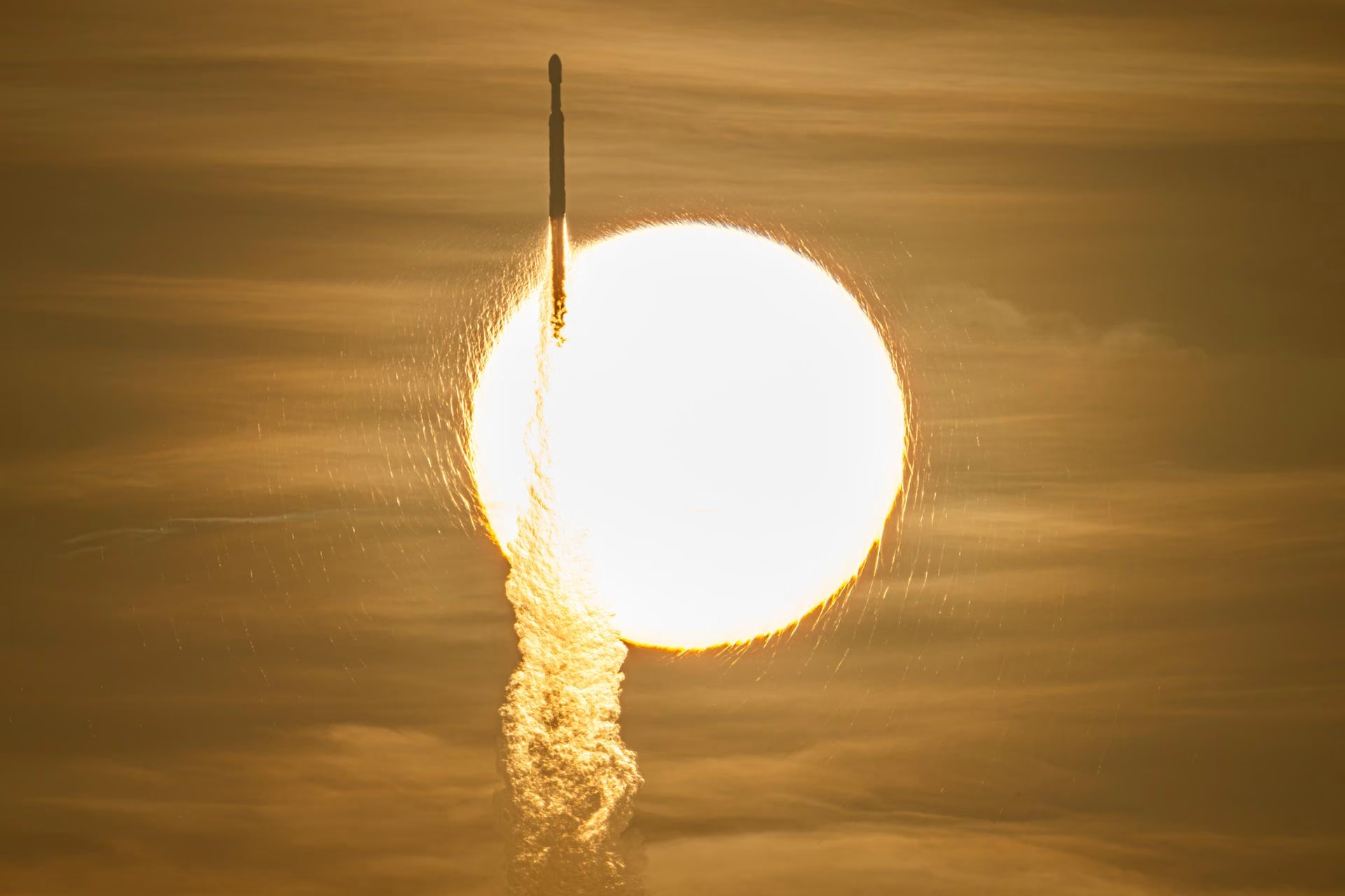
Where Does Gold Come From? Inside the Cosmic Origin of Gold
The gold in a wedding ring is older than Earth. Long before our planet existed, its atoms were assembled in one of the most violent environments in the Universe. They were then scattered through space, mixed into the cloud that formed the Solar System, buried inside a young molten Earth and—only much later—concentrated into veins and river deposits that humans could find.
The short answer
Gold is not made inside Earth. Most gold nuclei were forged by rapid neutron capture—the r-process—during rare cosmic catastrophes. Neutron-star mergers are a confirmed production site for heavy r-process material. Magnetar giant flares and unusual stellar explosions may also have contributed, especially early in cosmic history. Earth inherited that material and geology later concentrated a tiny fraction into mineable deposits.
Why ordinary stellar fusion cannot make much gold
Stars manufacture many of the elements around us. Hydrogen fuses into helium; massive stars can continue through carbon, oxygen, silicon and other stages until their cores become rich in iron-group nuclei. That familiar story is important, but it does not take us all the way to gold.
Gold has 79 protons. Building nuclei that heavy by ordinary fusion is energetically unfavourable once the chain reaches the iron region. Instead of releasing energy, further fusion generally requires an input of energy. Nature therefore needs a different route—one that supplies an extraordinary flood of free neutrons.
The r-process: a nuclear race against decay
The “r” in r-process stands for rapid. In an environment packed with neutrons, a seed nucleus captures neutrons faster than unstable isotopes can decay. It is pushed far from the stable part of the nuclear chart. When the neutron bombardment ends, a chain of beta decays converts some neutrons into protons, leaving stable or long-lived heavy elements behind.
This process can produce gold, platinum, uranium and many other nuclei heavier than iron. The physics is well established. The harder question has always been where the Universe creates the required conditions often enough to explain the chemical abundances astronomers measure.
The breakthrough: GW170817
On 17 August 2017, LIGO and Virgo detected gravitational waves from two neutron stars spiralling together. Telescopes then watched the same event—GW170817—across the electromagnetic spectrum. It was the first time a neutron-star merger had been observed through both gravitational waves and light.
The rapidly changing optical and infrared glow matched a kilonova: radioactive, neutron-rich debris expanding away from the merger. LIGO modelling placed the dynamically ejected mass roughly between one-thousandth and one-hundredth of the Sun’s mass, with additional material potentially escaping later in winds. The event demonstrated that mergers can eject enough r-process material to make a major contribution to the cosmic inventory of heavy elements.
There is an important precision here. Astronomers did not scoop up a piece of gold from GW170817. Individual spectral fingerprints in kilonova ejecta are extremely difficult to disentangle. The European Southern Observatory later identified strontium in the GW170817 data—the first direct identification of a freshly made heavy element in a neutron-star merger. The overall light and abundance patterns strongly support production of heavier r-process material, including gold, but the exact gold yield remains model-dependent.
Webb added another piece of evidence
In 2023, the James Webb Space Telescope followed the exceptionally bright gamma-ray burst GRB 230307A. Its infrared spectrum revealed tellurium in a kilonova associated with a compact-object merger. Tellurium lies close to the second abundance peak of the r-process, and the event also showed signs of lanthanide-rich ejecta.
Together, GW170817 and GRB 230307A turned a long-standing theoretical picture into an observational one: compact-object mergers really do create and disperse heavy nuclei across a broad mass range.
But neutron-star mergers may not be the whole story
A simple “all gold comes from colliding neutron stars” headline creates another problem. Some extremely old stars contain r-process elements even though neutron-star binaries may need time to form, survive two supernovae and finally merge. At least some heavy-element production therefore had to occur early.
Rare magnetically driven supernovae, collapsars and other unusual stellar explosions remain under investigation. A 2025 study using archival NASA and ESA data added a particularly interesting candidate: giant flares from magnetars, neutron stars with immense magnetic fields. The authors found that an unexplained signal following the 2004 flare from SGR 1806-20 was consistent with radioactive decay from freshly produced r-process nuclei. Their estimate suggests magnetar giant flares could contribute up to about ten percent of the Milky Way’s elements heavier than iron.
That is promising evidence, not a final census. Only a handful of giant magnetar flares have been observed, and the inferred element yield depends on models. The honest answer in 2026 is therefore plural: neutron-star mergers are confirmed heavy-element factories, while magnetar flares and certain rare supernova-like events may help explain the earliest material.
How cosmic gold became Earth’s gold
The Solar System formed about 4.6 billion years ago from gas and dust enriched by earlier generations of stars. Gold atoms were already present in that material. As dust grains, rocks and planetesimals collided, they became part of the growing Earth.
The young planet heated, melted and separated into layers. Gold is siderophile—it has an affinity for metallic iron—so a large share followed iron toward the core. This is why the accessible crust contains so little gold compared with the planet as a whole.
Researchers have long proposed that later meteorite impacts replenished the mantle with highly siderophile elements after core formation, a stage known as the “late veneer.” The broad idea remains influential, but the details are debated. High-pressure experiments indicate that the behaviour of gold during core formation is more complicated than a simple all-or-nothing plunge, and different highly siderophile elements do not necessarily partition in the same way.
What we mine today is therefore not a sample of one cosmic explosion or one meteorite. It is the surviving, mixed result of stellar nucleosynthesis, Solar System formation, planetary differentiation, impacts and billions of years of geology.
Earth concentrates gold; it does not create it
Gold is scarce in average crustal rock. A workable deposit needs natural processes to collect dispersed atoms into a much smaller volume. Hot, chemically active fluids are especially effective.
Water circulating deep through fractured rock can dissolve and transport gold in sulfur-bearing chemical complexes. As pressure, temperature, acidity or rock chemistry changes, the metal precipitates—often with quartz and sulfide minerals. Major faults provide pathways, while mountain building, metamorphism and magma can supply heat and fluids.
Weathering then breaks exposed gold-bearing rock apart. Because metallic gold is dense and resistant to corrosion, flowing water can sort and concentrate grains and nuggets in river gravels. These secondary accumulations are called placer deposits. The gold rush image of a prospector’s pan captures only the final chapter of a journey that began before the Sun existed.
The journey of a gold atom
Rapid neutron capture builds a heavy nucleus during a rare cosmic catastrophe.
Expanding ejecta mix gold and other heavy elements into interstellar gas and dust.
An enriched molecular cloud collapses to form the Sun, asteroids and planets.
Much of Earth’s gold follows iron inward as the young planet differentiates.
Hydrothermal fluids, faults, uplift and erosion create veins and placer deposits.
Mining and recycling move the same ancient atoms through technology, jewellery and finance.
Can humans manufacture gold?
In principle, yes. Nuclear reactors and particle accelerators can change the number of protons in a nucleus and create gold isotopes from other elements. In practice, the process produces tiny quantities, often including radioactive isotopes, at a cost vastly greater than the metal’s value. Alchemy became possible only after nuclear physics arrived—and it still makes no economic sense.
Frequently asked questions
Did gold form in the Big Bang?
No. Big Bang nucleosynthesis mainly produced hydrogen and helium, with small amounts of lithium. Gold required later generations of stars and neutron-rich events.
Does all gold come from neutron-star collisions?
Probably not. Mergers are confirmed producers of heavy r-process material, but magnetar flares and rare types of stellar explosions may also contribute. Their relative shares remain an active research question.
Why is gold found in quartz veins?
Hot fluids can transport both dissolved silica and gold through fractures. When conditions change, quartz and gold-bearing minerals may precipitate in the same vein system.
Is new gold still being made?
Yes. Rare mergers and other neutron-rich cosmic events continue to occur. The gold they create is dispersed through space and may eventually become part of future stars and planets.
Sources and further reading
- NASA Science — Where Does Gold Come From? NASA Data Has Clues
- LIGO Scientific Collaboration — The kilonova and r-process aftermath of GW170817
- European Southern Observatory — First identification of a heavy element born from a neutron-star collision
- ESA/Webb — Tellurium detected in a compact-object merger
- U.S. Geological Survey — Gold and the geology of deposits
- U.S. Geological Survey — Orogenic gold mineral systems
Editorial note: This article distinguishes direct observations—such as gravitational waves, kilonova light and identified strontium or tellurium—from model-based estimates of how much gold each event produces. It was reviewed under the CosmicGravity Editorial Policy & Fact-Checking Standards.


latest video


news via inbox
Subscribe to our Cosmic newsletter to get notified when we have new articles.