The Roswell Incident: Crash Sites, Witnesses and the Evidence
Roswell Incident: A Complete Investigation of the 1947 Case
The Roswell incident began with scattered debris and a military announcement. The story that followed grew to include extraordinary materials, several alleged crash sites, bodies, secret flights and a continuing argument over what the records actually establish.
On 8 July 1947, an Army airfield in New Mexico announced that it had recovered a flying disc. Within hours, a senior command in Texas offered a very different explanation: the material belonged to a balloon and its radar reflector. That reversal is the hard historical centre of Roswell. Almost everything that makes the case famous today has to be placed around it carefully.
The familiar version is wonderfully direct. A strange craft falls in the desert. Soldiers retrieve it. Witnesses are silenced. The evidence disappears. Yet the surviving record is less tidy and, in several ways, more interesting. The debris field was on a ranch near Corona, far from Roswell itself. The date of discovery is disputed. Important witnesses disagreed about the material. Accounts of bodies and additional recovery locations entered the public narrative much later.
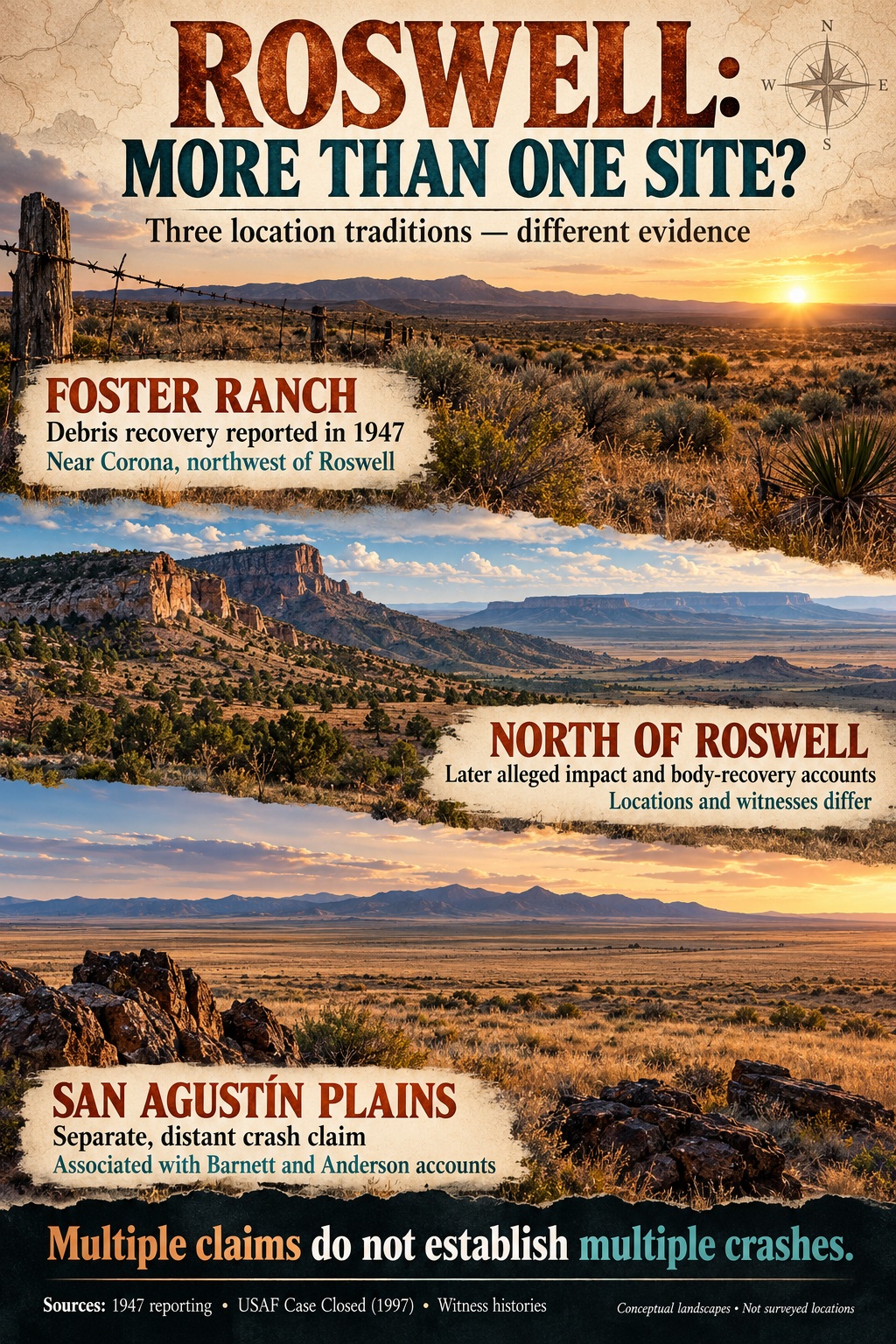
There is indeed more than one alleged Roswell crash site. This guide gives those locations the attention they deserve: the Foster Ranch debris field, the various impact or body-recovery locations described north of Roswell, and the separate San Agustín Plains story. They are not interchangeable. A reader who combines them into one scene can accidentally give a late, secondhand account the documentary standing of a 1947 newspaper report.
None of that makes the original military announcement imaginary. Nor does it make every witness dishonest. It means the full story requires two parallel chronologies: what happened or was reported in 1947, and what people subsequently said about it. Following both reveals why Roswell remains powerful, where the strongest disagreements lie, and what a genuinely decisive discovery would need to contain.
Research review: 29 October 2026. This is an evergreen investigation of public records and attributed testimony. Quotations are kept brief; links lead to the original reports, archival collections and identified interviews. Illustrations are distinguished from documentary images throughout.
Before the Roswell incident: a country looking at the sky
Roswell did not happen in an informational vacuum. During the summer of 1947, American newspapers were already following reports of unusual objects in the sky. Kenneth Arnold’s sighting near Mount Rainier on 24 June became the most influential early story. Reports spread rapidly, and the expression “flying saucer” acquired a life beyond the details of Arnold’s own description.
That atmosphere matters when reading the Army’s announcement. “Flying disc” was an attention-grabbing contemporary category, not a laboratory identification of an extraterrestrial vehicle. Different people used it for different possibilities: unfamiliar aircraft, secret weapons, optical effects, misidentified ordinary objects and something more exotic. A newspaper headline containing the phrase cannot, by itself, tell us which interpretation the writer or officer had established.
New Mexico was an especially fertile setting for uncertainty. The region contained military airfields, weapons development facilities, rocket experiments and balloon research. The first atomic test had occurred in the state only two years earlier. Real secrecy was part of the landscape. People who suspected that the military might conceal an experimental project were not inventing the existence of classified research.
But the presence of secrecy does not identify the secret. A programme designed to monitor distant nuclear tests and a programme holding a recovered spacecraft would both involve restricted information. They would leave very different technical and administrative traces. Roswell’s central problem is to distinguish those possibilities through the record, rather than treating the general existence of military secrecy as the answer.
The airfield and the people in command
Roswell Army Air Field was home to the 509th Bomb Group, a unit with a distinctive atomic mission. Colonel William Blanchard commanded the group. Major Jesse A. Marcel served as an intelligence officer. Lieutenant Walter G. Haut handled public information. These were real people with documented positions, not characters created by a later television programme.
The service terminology also deserves care. In July 1947, the organisation involved was the United States Army Air Forces. The independent United States Air Force came into existence later that year. Calling the original recovery an operation of the modern Air Force is common shorthand, but it can blur which offices existed and which chain of command operated at the time.
The unit’s importance is often offered as proof that its officers could not have mistaken balloon equipment for something unusual. Their experience certainly makes the mistake worth explaining. It does not eliminate the possibility. Expertise in intelligence, operations or atomic security does not automatically confer detailed familiarity with every research payload, every kind of damaged radar target or every experimental balloon assembly.
Equally, “they were confused” should be a conclusion supported by the material and circumstances, not an excuse that prevents investigation. The initial announcement is unusual enough to require explanation. A serious account should neither dismiss the officers as fools nor treat their positions as a substitute for physical identification.
Mac Brazel finds something on the Foster Ranch
William W. “Mac” Brazel managed the Foster Ranch in Lincoln County, near Corona. He was not the owner of a ranch in the centre of Roswell. The land associated with his discovery lay roughly 75 miles northwest of the city, according to the geographical summary in the Air Force’s later report. Roswell became the name of the case because it was the military and communications centre through which the story reached the world.
The basic sequence is well supported at a broad level. Brazel encountered scattered material, took an interest in what it might be, brought the matter to the authorities in Roswell, and guided military personnel to the area. Sheriff George Wilcox became involved. Marcel and counterintelligence officer Sheridan Cavitt are central to the later recovery accounts. Beyond that outline, seemingly simple details become surprisingly difficult.
The discovery date is not as settled as the anniversary suggests
In the Roswell Daily Record interview published on 9 July, Brazel placed the discovery on 14 June, when he and his son Vernon encountered the material. He described collecting some on 4 July and reporting it after hearing about flying discs. The account listed rubber, foil, paper, sticks and marked tape; it did not describe an intact machine or an engine. Brazel also said he had previously found weather balloons and considered this material different. The article is reproduced in the 1995 Air Force documentary collection.
Later narratives commonly put a crash, an explosion or the discovery of wreckage in the first days of July. These accounts cannot all be placed on one calendar without choices about which source to trust. Some researchers argue that Brazel’s newspaper account was shaped by military pressure. Others give the contemporary interview greater weight than recollections recorded decades afterward.
The pressure explanation is a hypothesis about the interview, not an independently preserved recording of what Brazel originally said. It may explain a discrepancy if other evidence supports it. It cannot simply erase every inconvenient date or description. Conversely, a newspaper interview can contain errors, misunderstandings or editorial compression. Its proximity to the event gives it importance, not infallibility.
This is why a careful Roswell chronology distinguishes the date a story was published from the date an event allegedly occurred. The Army’s announcement is securely dated 8 July. An exact crash time is not comparably established. The annual commemoration on 2 July should not be mistaken for a timestamp recovered from an authenticated accident report.
A debris field is different from an impact site
What Brazel reported was a scatter of material. A debris field can result from an object breaking up in the air, a balloon assembly descending and separating, wreckage being moved by wind, or a vehicle striking the ground. The distribution alone does not choose among those mechanisms. Measurements, the material itself and an undisturbed geological context would be needed to narrow the possibilities.
Later descriptions of the field differ in size. Marcel recalled a much larger spread than Cavitt did. Stories of a substantial gouge or furrow became important to some investigators, yet Marcel’s recovered interview with Lee Speigel explicitly describes searching without finding a ground scar. That disagreement deserves to remain visible. It cannot be resolved by drawing a dramatic trench into an illustration.
Nor does the absence of a crater prove a balloon. An aerial breakup need not produce one. The point is narrower: readers should not be shown a single confident reconstruction when the witnesses disagree about the basic appearance of the ground. The location of scattered debris and the location of a supposed main wreck are separate questions.
The journey back to Roswell
In Marcel’s later account, he and a counterintelligence colleague followed Brazel across difficult country, stayed overnight, and gathered pieces the following day. He described bringing material back in vehicles and stopping at his own home before returning to the base. His son, Jesse Marcel Jr., later became a prominent witness to that domestic episode.
The distinction between these scenes is essential. Marcel Sr. could speak about the field he visited. His son could speak about what he remembered seeing at home. A flight engineer could speak about packages loaded onto an aircraft. None of those roles automatically includes witnessing a second crash site, opening every package or examining a body.
As the case expanded, the separate journeys were often edited into one seamless recovery operation. A responsible history keeps the handoffs visible: ranch to authorities, field to vehicles, vehicles to base, base to aircraft, aircraft to the command in Texas. Each transition is a place where documentation might corroborate testimony—or where a later storyteller may be filling a gap.
8 July 1947: the Army announces a flying disc
The most extraordinary contemporary fact about Roswell is not an alien photograph. It is the Army’s public statement. Haut distributed an announcement that the 509th had obtained a flying disc through the cooperation of a local rancher and the sheriff’s office. Newspapers and wire services carried it. The announcement put an official military organisation behind a phrase that was already electrifying the country.
That is substantial historical evidence of an announcement and a recovery. It is weaker evidence of what the recovered object actually was. The release supplied no engineering analysis, biological findings, identifiable spacecraft components or independently witnessed demonstration. It did not announce bodies. The later story’s most dramatic features should not be silently inserted into its wording.
Haut repeatedly attributed the instruction to Blanchard. The decision to issue the release therefore raises questions above the level of a lone public-information officer improvising a sensational headline. What had Blanchard been told? How much of the material had he seen? Was the phrase provisional, careless, deliberate or understood differently within the base? The surviving release does not answer all of those questions.
Fort Worth changes the story
Material was taken to Fort Worth Army Air Field, where Brigadier General Roger Ramey commanded the Eighth Air Force. Photographs taken in his office show Marcel, Ramey and others with torn, foil-covered material and wooden members. Weather officer Irving Newton identified what he saw as the remains of a balloon and a RAWIN radar target.
A RAWIN target was not a powered aircraft. It was a lightweight reflector used to make a balloon easier to track by radar. Damage could leave a confusing collection of foil-backed paper, slender supports and rubber. The photographs visibly contain material of that general kind. They do not visibly contain a spacecraft hull, an engine or a body.
The dispute is whether the photographed material was the material recovered from the Foster Ranch. The Air Force’s explanation treats it as consistent with the recovery. Marcel’s later accounts and other testimony have been used to argue that ordinary balloon debris was substituted. A photograph can establish what lay on the office floor; without a secure chain of custody, it cannot alone establish where every piece originated.
That makes the photographs important to both interpretations. For the balloon explanation, they show recognisable equipment. For the substitution argument, they show the public display that allegedly concealed something else. The second argument requires additional evidence of the switch. Merely pointing out that the photographs look like a balloon does not prove a switch occurred.
The FBI’s contemporaneous teletype
A teletype sent by the FBI’s Dallas office on 8 July is another valuable contemporary record. It relayed information from military personnel about a hexagonal object suspended from a balloon, a resemblance to a high-altitude weather balloon and radar reflector, and plans to send the material to Wright Field. It also recorded uncertainty in a telephone discussion with Wright Field. The document appears in the GAO report’s documentary appendix.
The uncertainty is sometimes presented online as an FBI finding that the object could not have been a balloon. That is too strong. The teletype records an evolving conversation, not a completed technical examination. Its account of intended transport is likewise evidence of what the sender was told, rather than a complete signed inventory of material received at the destination.
The FBI’s own historical discussion of UFO records places the bureau in this supporting role. The military, rather than the FBI, was responsible for the Roswell identification. An FBI file containing a report is not equivalent to the bureau endorsing every statement in it. That distinction becomes especially useful when comparing Roswell with later, unrelated FBI UFO memoranda.
What remained after the headlines faded
The initial flying-disc story travelled widely; the balloon explanation followed. Roswell did not immediately become the vast, continuous public controversy familiar today. The modern investigation grew after a long interval, when researchers began finding surviving participants and asking them to revisit the recovery.
That interval is sometimes described as proof of an extraordinarily effective cover-up. It can also reflect a story that the press considered resolved, a public distracted by other events, and witnesses who did not pursue the matter. Several possibilities can coexist. What matters is that the long gap changes the kind of evidence available: early reporting can be checked against the record, while later testimony must also be evaluated as memory.
The case therefore has an unusual structure. Its foundation is unusually concrete for a famous UFO story: an official announcement, named personnel, photographs and a contemporary federal communication. The claim built upon that foundation—recovery of an extraterrestrial craft and occupants—is much more dependent on retrospective testimony. Understanding Roswell means examining the connection between those two levels, rather than treating them as identical.
More than one Roswell crash site: the geography of the claims
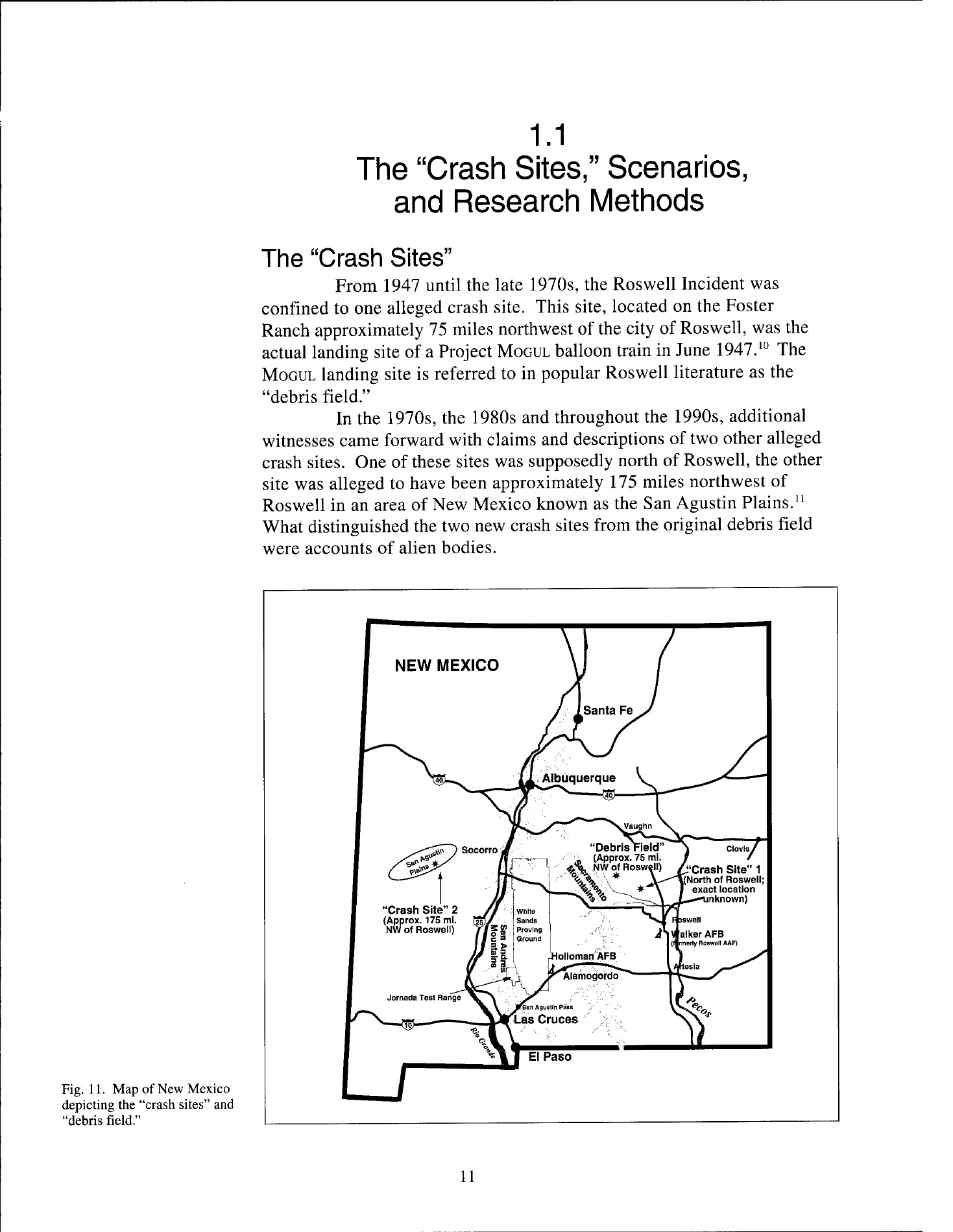
The phrase “the Roswell crash site” suggests a single marked place. In practice, the literature contains different locations, different kinds of location and competing attempts to join them. Even the Air Force’s 1997 report explicitly distinguishes the original Foster Ranch debris field from two other broad alleged crash areas. Acknowledging that geography is necessary whether one accepts or rejects the extraterrestrial interpretation.
Site one: the Foster Ranch debris field near Corona
This is the location with a direct connection to the 1947 public record. Brazel’s discovery, Marcel’s recovery role and the initial military announcement belong to it. Its approximate position northwest of Roswell is more securely rooted in the case than a precise point promoted decades later as the place where an intact craft rested.
The distinction does not make every modern boundary unquestionable. Ranch ownership, remembered landmarks and retrospective site visits introduce their own uncertainties. A tourist marker, an investigator’s preferred coordinate and a surviving witness’s recollection are different sources of location information. They should be labelled accordingly.
Most importantly, the original debris field is not automatically a body site. The 1947 press release and newspaper descriptions do not document bodies there. Later theories often propose that fragments fell at the ranch while the main vehicle continued elsewhere. That is a reconstruction intended to connect accounts; it is not a trajectory established by recovered flight data.
Site two: the impact and recovery accounts north of Roswell
A second family of stories places a more substantial wreck, and sometimes occupants, closer to Roswell. Different witnesses and authors have offered different locations and sequences. In some versions, the ranch debris and a separate main impact belong to one object. In others, more than one object is suggested. Those alternatives need to be kept distinct.
Walter Haut’s sealed statement dated 2002 describes learning of a second site roughly 40 miles north of town. Other accounts associated with the northern-site narrative came through witnesses whose reliability became disputed, including Frank Kaufmann and Jim Ragsdale. One cannot use Haut to authenticate every Kaufmann detail, or use Kaufmann’s collapse to pretend that every northern-site account originated with him.
Brigadier General Arthur Exon also became important to researchers discussing two locations. His later recollections of an aerial view and information received through his military career are frequently cited. These require a distinction between what he personally observed on the ground or from the air, and what he subsequently learned from others. They are not a 1947 excavated site plan.
Site three: the San Agustín Plains
The San Agustín story belongs to a much more distant area, about 175 miles northwest of Roswell in the Air Force report’s geographical summary. It is associated especially with the account attributed to Grady “Barney” Barnett and, later, Gerald Anderson. It should not be pictured as a nearby patch of the Foster Ranch or a short continuation of the same debris trail.
Barnett’s alleged encounter entered the modern story through people who said he had told them about it. By the time the major investigation developed, he was dead and could not be interviewed. The narrative included a crashed object, small bodies, civilians and military intervention. Its route into the record is therefore secondhand, whatever one thinks of the people transmitting it.
Some authors proposed a collision or separate crashes to connect San Agustín with Roswell. Those are attempts to reconcile stories separated by considerable distance. Neither the existence of several stories nor their dramatic compatibility demonstrates that two craft collided. A physical connection would require evidence of common material, matched dates, documented transport or another independent link.
Why there is no honest single-number answer
Asked how many crash sites Roswell has, the most useful answer begins by asking what counts as a site. There is one principal 1947 debris-recovery location, several later alleged main-impact locations, a distant San Agustín tradition, and additional places proposed in individual accounts. Counting all of them as confirmed crash sites would turn an inventory of claims into a finding.
It would be equally misleading to suppress the additional locations and pretend the entire story concerns one balloon-sized patch of ground. The multiple-site issue is central to why witness accounts appear to conflict. A person discussing the ranch debris and a person describing a body near Roswell may be making different claims, rather than describing different parts of an already demonstrated operation.
The historical task is to identify each location, establish when its account emerged, evaluate the witness’s access, and look for independent corroboration. Only then is it sensible to ask whether the locations belong together. A map should help the reader perform that separation. It should not manufacture a route between unverified points.
Jesse Marcel and the return of Roswell
The modern Roswell investigation owes much to Stanton T. Friedman’s contact with Jesse Marcel in 1978. Marcel was not an anonymous informant claiming an uncheckable job. He had participated in the recovery and appeared in the 1947 Fort Worth photographs. When he said, decades later, that the material had been extraordinary, researchers had a reason to listen.
Marcel described lightweight material that he could not identify, thin pieces with unusual resistance to damage, and small structural members bearing markings. His account suggested that the mundane explanation given to the press did not match what he had collected. Interviews with journalist Bob Pratt, television appearances and later publications carried those recollections to a much larger audience.
The important limitation is that Marcel’s standing as a recovery participant does not authenticate every feature of the later Roswell story. He did not provide a firsthand account of examining alien occupants. He did not publicly produce a retained specimen for independent testing. His evidence is principally an experienced officer’s retrospective description of debris and his interpretation of the official response.
Strange materials, remembered tests
Accounts of material that could not be cut, burned or permanently creased are among the case’s most memorable details. In ordinary conversation, those descriptions sound like measurements. They are not. A remembered attempt to burn or bend an unknown piece is different from a controlled experiment specifying temperature, duration, force, thickness and composition.
This does not mean the experience was unimportant. It means the inference must match the observation. A thin laminate can be difficult to tear in one direction and vulnerable in another. A coating may behave differently from the support beneath it. A material that looks metallic need not be a homogeneous metal. Without the original piece, those possibilities cannot be tested against Marcel’s memory.
The phrase “memory metal” is especially slippery. It can refer to a witness’s description of a sheet returning to its shape, a later researcher’s shorthand, or a claim about an advanced alloy. Those are different levels of assertion. Naming a familiar physical effect does not identify a recovered sample, and describing an unfamiliar effect does not establish an extraterrestrial origin.
A recovered interview adds detail—and complications
An extended interview by journalist Lee Speigel, made available online by Somewhere in the Skies in October 2025, lets readers hear Marcel’s account at length. He discusses the journey with Brazel, collecting debris, the material’s appearance, the Fort Worth display and his belief that the public explanation concealed what he had found. The recording is historical testimony, not a newly conducted interview.
One particularly useful passage concerns the ground. Marcel says he searched for evidence of an impact and did not find a scar, interpreting the scatter as an aerial breakup. That differs from later accounts of a conspicuous gouge. Another passage complicates the substitution story by distinguishing the material he posed with from a later display he believed was arranged after he left. Listening to the sequence is more informative than circulating one sentence.
Listen to the witness: archival Lee Speigel interview with Jesse Marcel Sr., published by Somewhere in the Skies in 2025. The upload’s promotional title is not a dating authority. The audio preserves Marcel’s later recollection, including uncertainties; it is not a recording from July 1947. Open the interview on YouTube.
Kevin Randle’s discussion of the recovered interview also identifies chronological problems, including Marcel’s placement of reporters at his home. Randle remains a supporter of an extraordinary explanation, yet acknowledges inconsistencies within the testimony. That is a useful reminder that criticism of a particular statement does not always come from someone opposed to the entire case.
The appropriate response to a conflict is to preserve it, establish its importance and seek other sources. An incorrect remembered time may leave a central observation intact. A contradiction over whether a witness recognised the photographed material can bear much more directly on the argument. Evaluating testimony requires that kind of discrimination.
Jesse Marcel Jr.: a child’s view inside the family home
Marcel’s son recalled being awakened and shown unusual material by his father. His accounts emphasised a small beam and unfamiliar markings. He later became a physician and military veteran, and spoke about the episode publicly for many years. Those later qualifications are part of his biography; they do not turn his childhood observation into a contemporary metallurgical examination.
His vantage point was narrow but potentially important. If his memory is accurate, his father considered the material unusual enough to share with his family before returning to duty. That supports the father’s interest in the recovery. It does not independently establish where every piece came from, its chemical composition, or what was happening at an alleged second location.
Family testimony also raises a question of independence. Father and son may both have seen the same material, while later discussing the event with each other and with researchers. Their reports are not simply duplicates, but neither should they be counted as wholly isolated information streams. The shared household is part of the history of the evidence.
The wider witness record: who saw what?
Roswell books often refer to large numbers of witnesses. A total can sound persuasive while concealing major differences. A person who handled debris, a person who watched a truck, a person told about a body and a person who later heard a relative’s story do not provide the same kind of evidence. The useful question is not merely how many names appear, but how each person connects to a specific claim.
| Person | Relevant access or claim | Important boundary |
|---|---|---|
| Mac Brazel | Discovered ranch debris and reported it | No preserved public account of examining an intact craft or bodies |
| Jesse Marcel Sr. | Participated in recovery; later described unusual material | Not a firsthand alien-body witness |
| Jesse Marcel Jr. | Recalled material brought to the family home | Childhood memory, not a visit to the field |
| Sheridan Cavitt | Recovery participant; described balloon-like material | His account conflicts with Marcel’s interpretation |
| Irving Newton | Examined material displayed in Fort Worth | Did not personally recover it from the ranch |
| Walter Haut | Issued the release; later statement expanded his claimed access | Accounts changed and require comparison by date |
| Glenn Dennis | Reported mortuary enquiries and a nurse’s story | Not himself the claimed examining doctor or nurse |
| Barney Barnett | Alleged San Agustín encounter transmitted by others | Secondhand testimony in the modern investigation |
| Gerald Anderson | Later claimed childhood presence at San Agustín | Serious credibility and documentation disputes |
Sheridan Cavitt: a participant who did not describe a spacecraft
Cavitt’s 1994 interview and signed statement are included in the Air Force’s documentary collection. He recalled lightweight, reflective material and supports, a limited debris area, and a balloon interpretation. His account did not support the picture of a large, exotic wreck. Because he was associated with the recovery itself, his testimony cannot be treated as merely an outsider’s guess from a newspaper photograph.
Critics question the reliability of his late recollection and note disputes about his earlier responses to researchers. Those are reasonable subjects for examination. They do not justify removing him from the case whenever the narrative reaches a conclusion he did not support. His account creates a direct disagreement among people with relevant access.
It is possible for two observers to perceive the same unfamiliar material differently. It is also possible for later memories to diverge or for one account to be inaccurate. The surviving record does not allow a reader to resolve that disagreement simply by choosing the more dramatic witness. Both accounts must be tested against the contemporary descriptions and the documented equipment.
Irving Newton: the weather officer in Ramey’s office
Newton’s role is unusually specific. He was called to identify material in the general’s office, where he recognised a balloon and radar target. In his later statement, he also described coloured markings on supports and rejected an extraterrestrial interpretation of them. The 1995 report reproduces his signed account.
For the photographed debris, that is relevant technical testimony. For the original recovery, it has a boundary: Newton was not standing beside Brazel on the Foster Ranch. If a substitution happened before he arrived, he could correctly identify the display without identifying the ranch material. But that conditional possibility does not establish the substitution. It shows exactly where corroboration is needed.
The disagreement over markings illustrates the larger problem. A pattern on lightweight material can be remembered as printing, decorative tape, symbols or unfamiliar writing. Demonstrating language would require legible specimens, repeated structure and a reliable record of their origin. An artist’s later drawing of remembered symbols cannot supply all of that missing information.
Thomas DuBose and the alleged diversion at Fort Worth
Colonel Thomas J. DuBose, Ramey’s chief of staff in 1947 and later a brigadier general, occupied a different position from a ranch witness. He was part of the command through which material passed. His 1991 affidavit described a request from General Clements McMullen, sealed material sent from Roswell and onward transport arranged through Washington. It called the weather-balloon explanation a diversion for the press. Randle publishes the statement and an image of the affidavit.
This is important testimony for the concealment argument. It is also more limited than some retellings imply. The statement does not contain a scientific identification of the contents as extraterrestrial, an examination of bodies or a complete contemporary cargo inventory. A claim that the press explanation was a cover story still leaves the identity of the concealed subject to establish.
DuBose’s presence in the Fort Worth photographs can be independently checked. His later account of orders and transport requires comparison with other evidence. Treating those two propositions separately gives his testimony a clearer place in the investigation: a documented command participant making retrospective claims about how the response was managed.
The Brazel family and neighbouring ranchers
Bessie Brazel Schreiber’s 1993 affidavit described foil-like and rubber-like material, kite-like sticks and tape with faint decorative designs. Her account, as reproduced by the Air Force, also denied remembering a ground gouge. Some Roswell researchers dispute aspects of her presence and later recollection. The disagreement is part of the record, not a reason to conceal the affidavit.
Bill Brazel, Mac’s son, became associated with stories of later-collected fragments and descriptions of the field. These are not automatically accounts of the same day or the same collection of material. When a narrative says simply “Brazel saw,” readers need to know whether it means Mac, Bill, Bessie or Vernon, and whether the information comes from 1947 reporting or a much later interview.
Loretta Proctor, a neighbour, recalled Brazel showing a piece to her and her husband. Her statement included an account of unusual properties and what Brazel said about the larger scatter. The distinction between what she personally handled and what he described to her should remain explicit. A second person repeating a rancher’s description can corroborate that he told the story, while still depending on him for the original discovery.
Sally Strickland Tadolini recalled material shown to her as a child. Like the Marcel household episode, such an account is potentially relevant to the appearance of a piece, yet difficult to tie to a surviving specimen. Childhood observers may preserve striking memories, but the elapsed decades and the absence of a documented sample limit the conclusions available.
Flights, packages and secondhand knowledge
Flight engineer Robert Porter recalled helping transport wrapped material from Roswell to Fort Worth. His statement describes packages, handling and what people said the contents were. It does not amount to a personal examination of an intact flying vehicle. A person can be an excellent witness to loading an aircraft without being able to identify a package’s contents.
The story associated with pilot Oliver “Pappy” Henderson is often conveyed through his wife, Sappho, who said he later told her about transporting wreckage and bodies. Her statement is evidence of what she remembered her husband saying. It is not her own eyewitness account of the cargo. Presenting it as though a pilot’s signed operational log survives would misstate the source.
Other accounts mention armed guards, unusual flights, restricted buildings or heightened activity. In a military setting, these observations can be real without identifying an extraterrestrial recovery. Their value increases when they contain a checkable date, aircraft identifier, destination, named crew or document that can be independently matched. General recollections of secrecy are much harder to distinguish from routine operations.
Radio workers and the claim of pressure
Frank Joyce, a local radio newsman, later described conversations with Brazel and pressure surrounding the story. Lydia Sleppy’s account concerned a teletype transmission and an alleged instruction to stop. These narratives matter because the public-information sequence is central to Roswell. They are also retrospective, rather than surviving recordings of the alleged exchanges.
A recollection of an official warning is not the same as the original message carrying that warning. If an order can be found, its sender, routing, date and authority can be checked. Without it, the historical evidence remains the witness’s memory. A careful account can report the allegation while avoiding an invented transcript of officials threatening a newsroom.
When a witness’s story collapses
Frank Kaufmann provided some of the most elaborate insider accounts used in 1990s Roswell narratives. After his death, researchers examining his papers found evidence of altered and manufactured documentation. Randle’s own account of the failure acknowledges that endorsements, apparently old papers and the desire to believe had allowed the story to acquire authority it did not deserve.
That discovery has a concrete consequence: details resting on Kaufmann’s purported documents cannot be retained as established history merely because they appeared in an earlier book. It does not invalidate the 1947 press release, which exists independently. The correction has to be applied to the claims affected, not used as a universal shortcut in either direction.
Jim Ragsdale’s crash account and Gerald Anderson’s San Agustín narrative also became subjects of serious credibility disputes. Rather than stage their most dramatic scenes as fact, an evidence-led history records their place in the expansion of the story and the subsequent challenges. A case grows weaker, not stronger, when discarded testimony keeps circulating without its correction.
Walter Haut: the press officer, the affidavit and the contradiction
Haut’s importance begins with a documented act: he released the Army’s announcement. His later statements are a different evidentiary layer. In a 1993 affidavit, he described being instructed to distribute the release and explained his confidence in Blanchard and Marcel. That statement is useful for the communications history, but it is not an account of personally conducting an examination of bodies.
A statement dated 26 December 2002, published after his death, goes much further. It describes a staff briefing about two locations, unusual debris passed around, and a visit to a guarded hangar. There, the account says, Haut saw an egg-shaped object and partially covered, child-sized bodies with large heads. It also attributes a debris-substitution story to Marcel. A typed reproduction of the statement identifies its source as Carey and Schmitt’s Witness to Roswell.
The date matters twice. The document was created 55 years after the alleged event and became public in 2007, after Haut’s death in 2005. Calling it a “1947 affidavit” would confuse the time described with the time of testimony. Calling it a statement first disclosed in 2026 would erase its earlier publication.
What Haut told Larry King in 2003
There is a direct public comparison. On CNN’s Larry King Live on 1 July 2003, after the sealed statement’s date, King asked Haut whether he had seen any wreckage. Haut answered, “No, sir.” He continued to express his belief that the base had possessed a flying saucer. The broadcaster’s transcript preserves the exchange.
That answer conflicts with the later-published document’s account of handling or viewing material. Supporters may interpret the public denial as continued concealment. Critics may regard it as a reason to distrust the expanded statement. The historical account should show the contradiction before offering either interpretation. A reader cannot assess a revelation fairly if the incompatible public answer has been removed.
Researchers helped prepare the later statement, and participants have described its production differently. A notarised signature supports the fact that a document was executed; it does not independently verify the scene described inside it. Neither the document’s formal appearance nor its dramatic content supplies the missing contemporaneous corroboration.
There is also a necessary distinction within the statement. Seeing a covered form, being told about a temporary morgue and concluding that a craft came from space are three different kinds of assertion. The first is a claimed observation, the second reported information, and the third an interpretation. Repeating them all as “Haut confirmed aliens” removes the very details needed to evaluate his account.
The alleged Roswell occupants and the hospital story
The familiar Roswell alien is small, slender and large-headed. That image is now so recognisable that it can feel like a description copied from a single official photograph. No publicly authenticated photograph of a Roswell alien body has been established. The familiar appearance comes from later descriptions, illustrations, displays, films and the broader culture of UFO imagery.
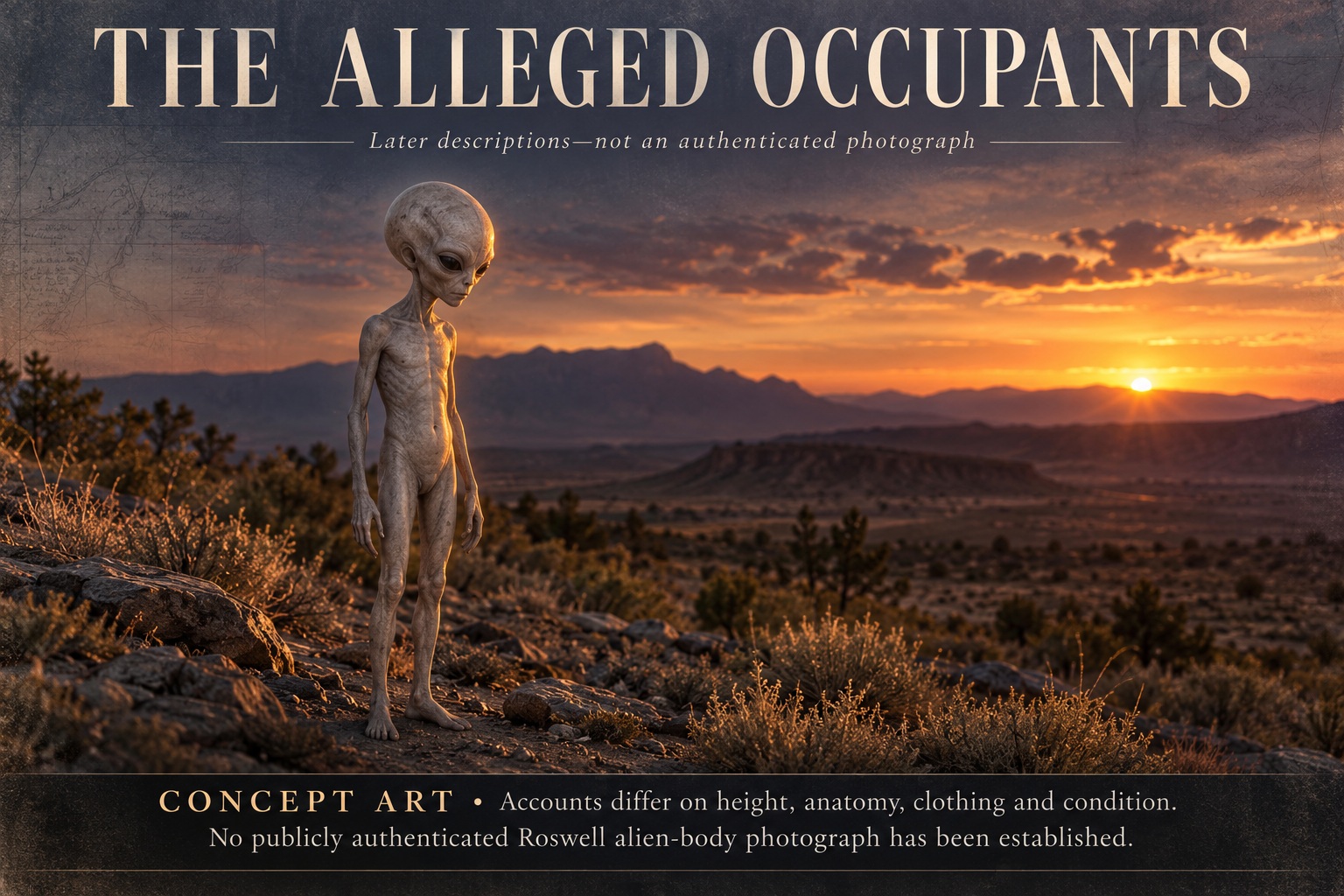
Different accounts do not describe a single consistent anatomical specimen. Some concern forms seen at a distance, others covered bodies, drawings attributed to another witness, or stories passed through relatives. Descriptions of a body’s size cannot be converted into a detailed face, skin texture or internal anatomy without invention. The illustration here is therefore deliberately labelled as concept art.
Glenn Dennis and the small-casket enquiries
Glenn Dennis worked for a Roswell funeral business and later became a major figure in the case. His account included enquiries about small, hermetically sealed caskets and questions about the preservation of exposed remains. It also involved a nurse who supposedly described unusual bodies and procedures at the base hospital. These claims linked the recovery narrative to a medical setting.
Dennis was not claiming to be the physician who dissected an extraterrestrial specimen. The most extraordinary medical details in his narrative came through the nurse he described. That distinction is routinely lost when a documentary cuts from his interview to a staged autopsy scene. The staged scene is an illustration of a story, not a camera recording of the event.
The nurse’s identity became a major problem. Names, personnel records and later explanations did not produce a securely corroborated examining witness. The Air Force’s 1997 report devoted a section to the “missing” nurse and the medical account, comparing it with hospital personnel and later incidents. Researchers sympathetic to Roswell also challenged the story’s development.
One small detail is particularly useful because it can be checked in a public interview. Dennis told Larry King that the military did not actually order caskets from the funeral home. A retelling that says the funeral business supplied alien-sized coffins has therefore advanced beyond the claim he made on that programme. Enquiries, orders and deliveries are different events.
Where are the examining doctors?
The medical branch of Roswell is much weaker than a reader might expect from the imagery surrounding it. There is no publicly authenticated 1947 clinical file identifying a nonhuman patient, no verified chain of biological samples, and no demonstrated laboratory examination of a Roswell occupant available for independent replication. A name repeated in a later account is not a surviving pathology record.
That absence does not prove that no restricted medical event could have occurred. It does place a limit on what can responsibly be written. The article cannot supply a detailed alien anatomy, a cause of death or an autopsy result merely because a film depicts one. Those would be medical findings without medical evidence.
The distinction also helps when comparing Roswell with the Varginha case and James Fox’s investigation. Both narratives include military recovery and medical claims, but the witnesses, hospitals, dates and documentation differ. Similar story elements do not establish that one case corroborates the other.
The San Agustín body accounts require their own investigation
The Barnett narrative is one important route by which bodies entered the modern Roswell story. Its supposed civilian witnesses and military intervention made it a natural complement to Marcel’s debris account. But complementarity is not independence. Before joining the stories, researchers must establish that Barnett’s alleged event occurred at the relevant time and that the two locations had a real connection.
Gerald Anderson’s later account appeared to offer a more direct childhood witness to San Agustín. Instead, disputes over his supporting material and statements created further difficulties. Researchers did not reach a common assessment. A new witness who appears decades later can be valuable, but the late arrival makes provenance and independent records especially important.
Randle’s discussion of Ruth Barnett’s diary illustrates a more useful direction: compare a dramatic recollection with ordinary contemporary records. A diary may establish where someone was or narrow a date without mentioning the alleged encounter. Its silence must be interpreted cautiously, but its mundane entries can still test a proposed chronology.
Ultimately, the body stories cannot borrow certainty from the debris story. A confirmed recovery of unusual-looking material does not confirm occupants. Nor does a documented hospital accident automatically explain a witness who claims a different time and place. Each branch needs its own evidence before a comprehensive theory can tie the branches together.
Project Mogul: the strongest documented terrestrial explanation
The Air Force’s 1994 investigation, published with a much larger documentary collection in 1995, concluded that the ranch debris most probably came from Project Mogul. This was not simply a new name for an ordinary daily weather observation. The programme investigated whether balloon-borne acoustic equipment could help detect distant Soviet nuclear tests.
The scientific idea involved sound travelling through favourable layers of the atmosphere. A balloon system could carry instruments at altitude while researchers studied detection and transmission. The project used an assortment of balloons, tracking devices, radar reflectors and acoustic equipment. Its strategic purpose could be sensitive even when individual components were ordinary and recognisable.
That distinction is central to the explanation. A rancher might encounter rubber, lightweight supports, foil-backed material and tape without possessing anything technologically extraordinary. An officer might investigate an unfamiliar assembly without knowing its broader purpose. Secrecy could concern what the experiment was intended to detect rather than the composition of every fragment.
What the programme records actually add
The documentary collection includes technical reports, diagrams, professional journal entries and interviews with people involved in the balloon work. Those sources establish that relevant experiments were taking place in New Mexico in 1947. They provide a real candidate class of equipment rather than an imaginary balloon invented solely to explain the photographs.
Engineer Charles B. Moore described the early assemblies and the way damaged balloon and reflector material could look after exposure in the desert. He connected descriptions of the Roswell debris with lightweight radar targets and degraded balloons. The collection also discusses the use of coloured reinforcing tape, an ordinary possible source for markings remembered as unusual symbols.
None of that makes every historical inference automatic. Demonstrating that similar equipment existed is different from proving that a particular flight landed on the Foster Ranch. To establish the latter securely, one would want a launch record, a well-constrained track, a recovery record or a matching physical component with an adequate chain of custody.
The Air Force argued from a combination of programme history, material descriptions, photographs and participant testimony. Its conclusion was an identification based on converging evidence, not the production of a surviving piece labelled “Foster Ranch, July 1947” that had remained under continuous custody. A fair presentation should state both the explanatory strength and that limitation.
The Flight 4 dispute
The proposed connection to a flight on 4 June 1947 remains one of the most technical arguments in the case. The Air Force’s report associated the likely debris with a balloon assembly referred to as Flight 4. Critics challenge whether the relevant full flight occurred, what equipment a smaller launch carried, and whether the proposed drift could take it to the ranch.
Albert P. Crary’s contemporary journal is especially important because it is not merely a 1990s recollection. The 4 June entry records that balloon flights were prevented by clouds, while also describing a sonobuoy carried up in a cluster of balloons and reception tests. The original is reproduced in the 1995 collection, in the section containing Crary’s professional journal.
That entry supports the occurrence of some balloon-related activity. It does not, by itself, provide a complete manifest for a full constant-altitude assembly, list every reflector, or plot a landing point. The dispute concerns how the cancelled flight and the smaller cluster should be interpreted within the programme’s numbering and documentation.
In a September 2026 statement of his objections, Randle argues that the cancellation, payload diagrams and wind reconstruction rule out the proposed Flight 4 explanation. His criticism also distinguishes the classified strategic aim from the publicly discussed balloon experiments. Those are substantive objections to examine against the technical record, rather than dismiss with the word “balloon.”
At the same time, demonstrating a weakness in a reconstructed flight does not establish a spacecraft. It could weaken the identification of one candidate without eliminating other balloon activity or other terrestrial possibilities. A historical explanation can be plausible at the programme level and uncertain at the individual-flight level. Those levels should not be collapsed into an all-or-nothing claim.
Would experienced personnel have recognised the equipment?
This objection has intuitive force. Roswell officers worked at an important installation. Brazel knew that balloons sometimes came down on ranch land. If the pieces were so ordinary, why did anyone announce a flying disc? The Air Force’s own research did not locate a document that definitively explains why that original wording was chosen.
Several possibilities have been proposed: incomplete identification at the local base, a misunderstanding, exaggerated publicity, an unfamiliar assembly or an effort to divert attention from sensitive work. The available evidence does not require choosing a psychological motive with confidence. The important technical question remains whether the recovered material is better explained by known equipment than by an extraterrestrial vehicle.
Recognising familiar components and understanding an assembly are also different tasks. A torn reflector may look like disconnected sticks and foil. A damaged research train may not resemble a small weather balloon previously encountered. Those possibilities make misidentification conceivable. They do not prove the exact sequence at the base.
Likewise, the substitution theory would explain why recognisable equipment appeared in the photographs while witnesses remembered something else. But an explanation that can accommodate a contradiction is not necessarily the correct explanation. It needs positive support: a documented switch, independent observation of both sets of material, or another checkable link.
The 1997 explanation of body reports
The later report, The Roswell Report: Case Closed, addressed claims that the earlier debris investigation had not resolved. It proposed that accounts of small bodies and military recovery operations reflected later high-altitude research involving anthropomorphic test dummies. It also compared hospital stories with documented accidents.
The timing is crucial. The Air Force was not claiming that the 1950s dummy programme had taken place in July 1947. It argued that memories of activities spread across later years had been compressed and attached to Roswell. That is a hypothesis about the formation of retrospective accounts.
Two later events identified in the report’s summary were a 1956 KC-97 aircraft accident in which eleven Air Force personnel died, and a 1959 manned-balloon mishap that injured two pilots. Those dates should be printed clearly. Hiding them would make the explanation appear chronologically stronger than it is; pretending the Air Force forgot the dates would misrepresent the argument it actually made.
The report documents real research and recovery operations that can explain some otherwise unusual-looking scenes. Its more difficult task is demonstrating that a particular witness remembered one of those scenes and assigned it to 1947. A resemblance in description is suggestive. A match in personnel, place, date and distinctive detail would be stronger.
Critics reasonably challenge the scale of the proposed time displacement and whether it explains all relevant testimony. The existence of that criticism does not erase the documented programmes. The existence of the programmes does not prove that every body account has been individually solved. The useful discussion concerns specific matches and specific mismatches.
The GAO search and the missing military records
Congressman Steven Schiff’s efforts to obtain information helped bring federal records management into the Roswell debate. The General Accounting Office, now the Government Accountability Office, examined what records could be located and how an incident of this kind would have been documented. Its report NSIAD-95-187 was released on 28 July 1995.
The GAO inquiry and the Air Force’s technical explanation were related but different projects. One searched records and reporting requirements; the other argued for an identification of the debris. Quoting the GAO as though it had independently established an alien recovery, or as though every line were an independent laboratory confirmation of Mogul, misstates its role.
What the search found
The GAO identified two 1947 records directly relevant to the public incident: the unit’s combined history and the FBI teletype. The unit history described the publicity surrounding a supposed flying disc and its identification as balloon equipment. The teletype preserved the contemporary military communication already discussed. Both are valuable precisely because they predate the modern wave of books and interviews.
The search also contacted agencies and examined archival holdings. An agency response that it found no additional record is meaningful within the search conducted. It is not a magical statement about every document ever created, every unindexed box or every record that might have been destroyed. Archival research has a scope, and its conclusion should be read within that scope.
What was destroyed—and what that does not establish
The report found that some Roswell administrative records covering March 1945 through December 1949, and outgoing messages covering October 1946 through December 1949, had been destroyed. The associated disposition information did not identify who destroyed them, when, or under what authority. That is a genuine gap in the surviving record.
It is often retold as a targeted destruction of the Roswell alien files. The GAO did not demonstrate that. The date ranges cover years of ordinary base activity, not an identified folder labelled with a spacecraft recovery. Poorly documented destruction can obstruct investigation without proving what the missing records contained or why they were destroyed.
The gap should not be minimised either. Outgoing messages could have helped establish communications, orders and transport. Their absence makes some questions harder to resolve. A credible account can acknowledge that loss without supplying an imagined inventory of secret messages or accusing an unnamed official of a specific concealment operation.
Why an absent file cannot carry the whole argument
A missing record creates uncertainty. It does not have a predetermined content. The same gap can be made to support incompatible stories if the investigator is free to fill it with anything. To move beyond that impasse, a proposed explanation must predict evidence elsewhere: recipient copies, related correspondence, aircraft records, personnel activity or physical traces.
This is particularly important for an alleged operation spanning several sites, hospitals and destinations. More participants can mean more opportunities for silence, but also more opportunities for independent records. A broad conspiracy theory becomes weaker as a historical explanation if every possible absence and every contradictory document is treated as confirmation of its effectiveness.
The strongest reason to continue searching is not that the gap proves aliens. It is that better records could distinguish among competing accounts. A dated inventory, an authenticated message or an original witness recording can answer a narrow question even if it does not solve the entire case. That is how historical investigations make durable progress.
Photographs, the Ramey memo and the evidence that failed
Roswell has generated an enormous visual culture. Only a small part of it is contemporary documentary imagery. The Fort Worth photographs occupy that category. Illustrations of a craft lying in the desert, a hangar full of bodies or surgeons examining an alien usually do not. Their cinematic familiarity should not be confused with their historical status.
The paper in General Ramey’s hand
One photograph shows Ramey holding a sheet of paper. Researchers have spent years trying to read the small, oblique text. Some proposed readings contain highly significant phrases; other readers see different words or cannot resolve the relevant letters. The original photographic collection is held by the University of Texas at Arlington, whose account of the Ramey memo explains the continuing effort to decipher it.
A possible reading is not a transcription. If a word becomes visible only after the viewer is told which dramatic phrase to expect, the interpretation is vulnerable to suggestion. A robust result should survive independent readers, alternative processing methods and examination of the original photographic information.
Modern image tools make this problem more urgent. Sharpening can clarify existing structure, but generative enhancement can invent plausible letter shapes. A beautifully legible AI reconstruction would not recover an authenticated message unless the original data actually supported those characters. For that reason, the illustrations in this article do not “restore” the memo or put invented wording into a historical document.
The 1950 Hottel memo is a different case
The FBI’s Guy Hottel memorandum is repeatedly attached to Roswell stories. It dates from 22 March 1950, nearly three years later, and relays a claim about recovered saucers and small bodies in New Mexico. The bureau has explicitly explained that it is a second- or thirdhand report, was not followed up as a verified discovery, and is not a demonstrated record of the July 1947 incident.
The FBI’s explanation is a useful antidote to a recurring error: a genuine government document can contain an unverified story. Authenticity answers who created or retained the paper. Accuracy answers whether the events described happened. Those questions require different evidence.
Alien autopsy and the danger of borrowed imagery
The film marketed in 1995 as an alien autopsy became attached to Roswell in public memory. Its provenance was never comparable to that of the 1947 Fort Worth photographs. In 2006, Ray Santilli and Gary Shoefield described the circulated footage as a reconstruction or “restoration,” while continuing to claim an underlying original. Their admission removed any basis for treating the familiar film as an authenticated recording of a 1947 medical procedure.
The relevant lesson does not depend on proving every detail of how the film was produced. A reconstruction cannot authenticate the event it depicts. The producer of the original television special also discussed the footage’s problems in a 2006 interview. Stills from that film should never be captioned simply as Roswell autopsy photographs.
The 2015 slides
Another highly publicised episode involved old colour slides promoted as possible photographs of a Roswell body. Examination of the museum label and related records identified the displayed remains as those of a human child. The Anomaly Archives collection preserves the investigation’s documentary trail and links to the released Park Service material.
Those slides did not establish a Roswell occupant. Nor did their failure retroactively erase the 1947 announcement. The correction belongs to the claim that was made about the images. Keeping that distinction protects the investigation from two opposite mistakes: accepting every exciting image as cumulative confirmation, or treating one exposed misidentification as an answer to every historical question.
Visual evidence should arrive with an origin, an unbroken account of custody, a date and a description of any processing. A caption should tell readers whether they are seeing a genuine historical photograph, a later witness drawing, a museum display, a reconstruction or concept art. Without that information, even an attractive and technically sharp picture can mislead.
How investigators, books and television changed the case
Roswell’s second life was an investigation as well as a media phenomenon. Friedman’s work brought attention back to Marcel and encouraged a search for additional witnesses. Charles Berlitz and William Moore’s The Roswell Incident, published in 1980, assembled a narrative far broader than the original newspaper episode. Friedman contributed research but was not one of that book’s two named authors.
The difference matters because later summaries often describe “the Roswell account” as though it had existed in its finished form since 1947. The books did not simply reproduce a single lost file. They brought together contemporary reporting, interviews, secondhand stories and proposed connections. Each connection remained something to investigate.
Randle and Donald Schmitt’s books in the early 1990s, and Friedman and Don Berliner’s Crash at Corona, developed different reconstructions. Differences among researchers were not limited to belief versus disbelief. Supporters of a non-terrestrial explanation disagreed about witnesses, dates and the relationship between the Foster Ranch and San Agustín.
The Air Force’s documentary report lists the major works it considered, along with criticism from researchers such as Robert Todd and Philip Klass. That history is valuable because it shows the official inquiry responding to an existing body of claims. It was not investigating only the few sentences in the original press release.
The search for something still in the ground
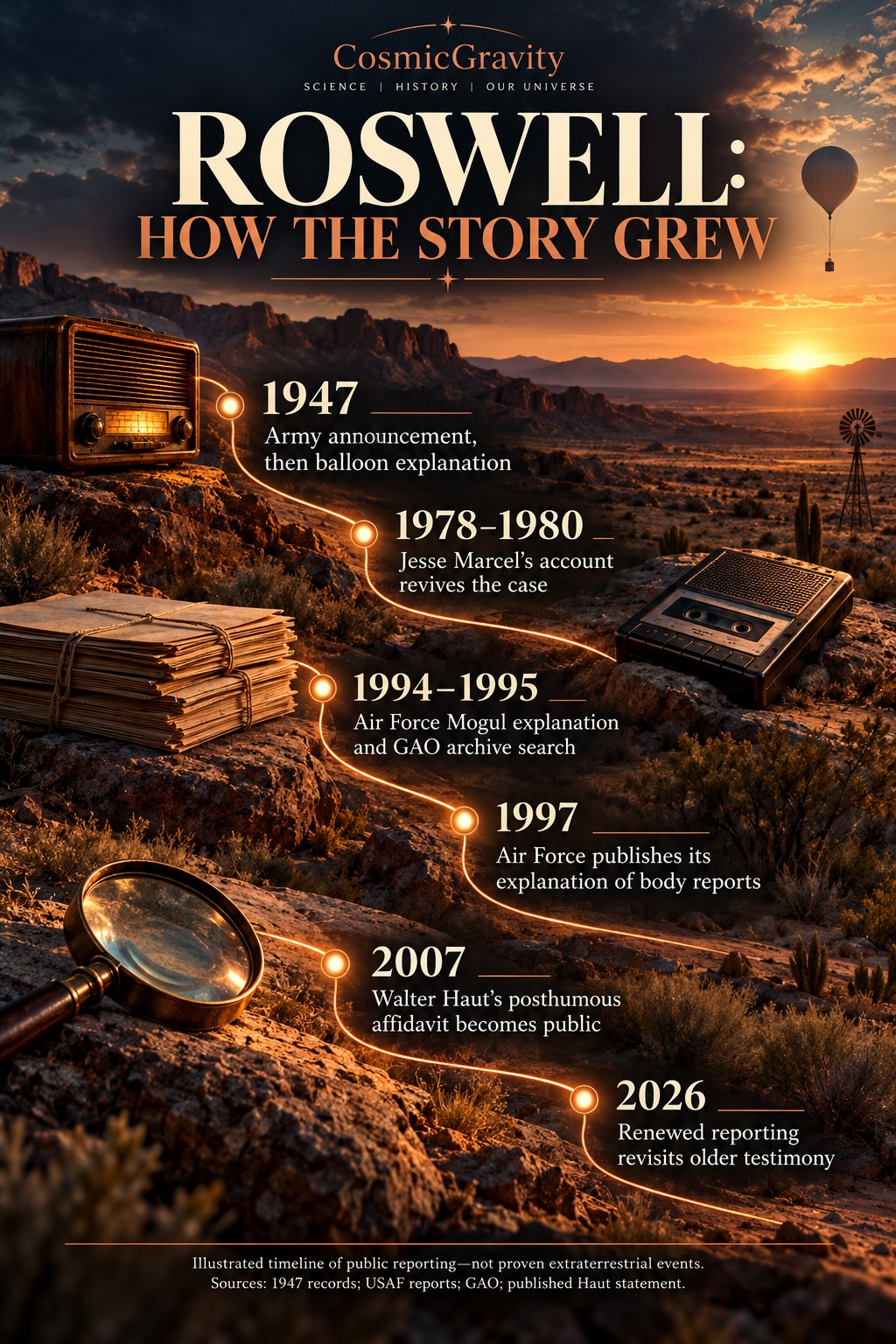
In 2002, archaeologist William Doleman led a SCI FI Channel-funded investigation using archaeological and geophysical methods at the reported debris-field area. This was an attempt to move beyond interviews and search for material or ground features. His published material synopsis describes both the work and the limits of the follow-up analyses.
The recovered items included ordinary-looking material and objects initially treated as uncertain. Preliminary laboratory identifications for submitted samples indicated synthetic or cellulose material, not demonstrated extraterrestrial technology. Doleman nevertheless argued for more complete identification and dating. His account also recognised that ranching, later visitors and previous investigations could introduce objects into the site.
That is a more informative result than either “scientists found alien wreckage” or “nothing was found.” Objects were recovered, but connecting an object in the ground to a particular event in 1947 requires context and dating. An unidentified fragment is a research task, not an origin determination.
What a documentary can preserve
A recorded interview can preserve a witness’s exact answer, hesitation and response to a follow-up question. Those are advantages over a remembered conversation reported years later. A documentary can also make an archive accessible, locate a surviving participant or expose a contradiction between two accounts.
Its weaknesses arise in the edit. Several people speaking in succession can appear to corroborate one scene even when they describe different places or repeat information from the same source. A reconstruction may supply precise timing, lighting, uniforms and dialogue that no witness actually specified. Music and visual continuity can make an uncertain sequence feel inevitable.
Readers arriving from our James Fox coverage should keep the cases separate. Moment of Contact investigates the 1996 Varginha allegations in Brazil. It is not a documentary record of the 1947 New Mexico recovery. The shared themes make comparison interesting, but the evidence must be traced within each case.
Historical context: Smithsonian Channel’s short segment from Aerial America: New Mexico. This is a modern overview of Roswell’s public legacy, not original footage of a crash or recovery. Watch the publisher’s clip on YouTube.
Philip Corso and the much larger technology claim
Philip J. Corso’s The Day After Roswell, written with William J. Birnes and first published in 1997, expanded the narrative from a recovery to an alleged technological legacy. The book claimed that recovered material fed military and industrial development. The publisher’s description identifies circuit chips and fibre optics among the technologies associated with the claim.
Corso also claimed to have seen a body at Fort Riley, Kansas, as reflected in the statement reproduced by his Italian publisher. That is a separate claimed encounter, not his personal presence beside Brazel on the ranch. His military career and his extraordinary account must likewise be evaluated separately.
The technological argument demands evidence beyond a recovery story: authenticated transfers, identifiable components and a demonstrated connection to the research that produced a technology. A device appearing after 1947 is not enough. Without that link, a broad claim about reverse engineering cannot retroactively authenticate the debris or a biological specimen.
The museum and the city
The International UFO Museum and Research Center provides a visible home for the case’s public history. Roswell’s identity now includes exhibits, conferences, tourism and an immediately recognisable alien imagery. That cultural afterlife is real, irrespective of the original debris’s identity.
It is unfair to treat the existence of a museum or a book market as proof that every participant invented a story for money. It is equally unwise to ignore the incentives of publicity. The appropriate response is transparency about affiliations, production, funding and access, followed by assessment of the underlying evidence.
A museum reconstruction can help a visitor understand a witness’s claim. Its label needs to make clear that it is a reconstruction. The same principle applies to this article’s graphics. Visual beauty can invite a reader into a difficult history without implying that an artist had access to a secret photograph.
Why Roswell is back in the news in October 2026
New publication can give old testimony new visibility. In its 23 October 2026 coverage, NewsNation reported that the seventh UAP-file release included Haut’s account inside a 2008 contractor report. The outlet also noted that the statement’s contents had appeared in Carey and Schmitt’s 2007 book. That publication history is essential context for current headlines.
A report containing an affidavit is not a new eyewitness, and government release is not independent verification of the affidavit’s claims. The original statement still has to be compared with Haut’s earlier account and his 2003 public answer. Reclassification, redaction or a new download link does not remove those historical questions.
For this guide, the statement’s substance was checked against the publicly available reproduction and the dated CNN transcript. The current-release description above is attributed to NewsNation; it should not be read as a claim that this review independently authenticated every file or redaction in the 2026 collection.
The wider official position also remains relevant. AARO’s 2024 historical report repeated the Mogul explanation and stated that the reviewed record did not establish recovered extraterrestrial material or aliens. That is an official assessment, not a newly released piece of Roswell wreckage. Its conclusions can be examined alongside the underlying reports and the specific objections to them.
Our separate guide to the seventh UFO-file release covers the broader collection. Keeping the two subjects connected but distinct prevents a modern disclosure headline from being mistaken for a new event at a 1947 crash site.
What can the Roswell evidence actually support?
The surviving public record supports a military recovery of debris, an initial flying-disc announcement, a rapid balloon explanation, contemporary photographs of balloon-like material, and later witnesses who disputed that explanation. It also supports the existence of relevant balloon research and later programmes that the Air Force used to explain body stories. Those are substantial, examinable facts.
The public record does not establish an authenticated extraterrestrial craft, a verified alien body, a reproducibly non-terrestrial sample or a single agreed reconstruction of several crash locations. That conclusion is narrower than saying every aspect of the incident has been explained. It identifies what the extraordinary interpretation has not yet demonstrated.
The best argument for taking the case seriously
Roswell has named participants, genuine contemporary documentation and a reversal that understandably invites scrutiny. Marcel’s involvement was real. Haut’s communications role was real. The original release did not have to be invented by a later researcher. Those features make the case more historically substantial than a story resting entirely on an anonymous internet post.
Supporters also point to recurring descriptions of unusual material and the testimony of people who believed a consequential recovery had been concealed. Some accounts come from people whose presence at the relevant institutions can be checked. Their memories deserve to be preserved and compared, particularly where unedited recordings survive.
The strongest version of that argument identifies particular witnesses, particular observations and independent connections between them. It becomes weaker when it relies on a large undifferentiated witness count or retains a dramatic detail after its sole source has been discredited. Good evidence does not need a failing witness kept artificially alive.
The best argument for the balloon explanation
The balloon interpretation has direct material support in the photographs, contemporary descriptions compatible with lightweight equipment, technical testimony and a documented research programme operating in the region. It explains why a collection of fragments could look unusual without requiring an unknown propulsion system, extraterrestrial metallurgy or biological recovery.
Its vulnerable points concern the precise historical reconstruction: which flight, its payload, its route, the recovery chronology and the reason for the initial announcement. These are legitimate questions. A strong explanation should state where it relies on inference instead of presenting a reconstructed chain as a complete surviving operational record.
There is no requirement that a terrestrial explanation resolve every remembered detail of every account. Some memories may be mistaken or some stories fabricated. But the same allowance should not become an excuse to ignore reliable contrary documentation. The standard is the best-supported explanation of the strongest evidence, with remaining uncertainties named.
What would change the assessment?
A newly located document could matter greatly if its provenance were secure and its contents specific. An original message naming a recovery, a dated inventory, a hospital record or a recipient’s copy of a disputed order would offer concrete points to test. A sensational typed sheet with no demonstrated origin would not carry the same weight.
A physical specimen would require an equally careful history. Where was it found? Who possessed it? Can its connection to the 1947 event be established independently? What tests were performed, with what controls, and can another laboratory reproduce the result? An unusual composition or isotope ratio would still need comparison with known terrestrial materials and contamination pathways.
For the multiple-site claim, the most useful evidence would connect the sites rather than merely repeat them. Matched material, documented transfers, independent contemporary witnesses or securely dated ground evidence could do that. Without a connection, several locations remain several claims, however well they fit a compelling story.
Roswell’s enduring importance lies partly in that tension. The event is real as a historical controversy, and the original announcement remains remarkable. The most consequential interpretation is still unproved. Keeping both facts in view allows curiosity to survive without asking the reader to surrender judgment.
Questions readers ask about the Roswell incident
Did something really happen near Roswell in 1947?
Yes. Debris was recovered, the Army announced a flying disc, and a balloon explanation followed. Those events are documented. The disputed question is what the debris was and whether later claims about a craft, occupants and a wider recovery operation describe the same event accurately.
Were there two or more Roswell crash sites?
There are multiple alleged sites in the literature. The Foster Ranch debris field is tied to contemporary reporting. Northern impact and body-recovery locations, and the distant San Agustín Plains account, have different histories and supporting testimony. Their existence as claims does not establish that several extraterrestrial craft crashed.
Is there a genuine photograph of a Roswell alien?
No publicly authenticated Roswell alien-body photograph has been established. Familiar images include illustrations, museum displays, film reconstructions and discredited material. The concept image in this guide is labelled accordingly. The Fort Worth photographs are authentic historical images of displayed debris, not photographs of occupants.
Did the Air Force change its explanation?
Its later investigation identified the likely debris as part of Project Mogul, adding a classified strategic purpose to a balloon-based explanation. In 1997 it separately proposed explanations for body and hospital accounts. Whether those reconstructions adequately resolve the testimony remains disputed; they should be assessed from their actual wording and dates.
Did the government admit destroying alien evidence?
The GAO found inadequately documented destruction of categories of base records spanning several years. It did not establish that those records contained alien evidence or were destroyed specifically to conceal Roswell. The loss is a genuine archival limitation, and its contents cannot responsibly be invented.
Does the 2026 release confirm Walter Haut’s account?
Publication of a statement establishes that the account was included in a released record, not that its scenes were independently verified. Haut’s expanded statement was already public in 2007. Its claims still need to be compared with his other statements and with contemporary evidence.
Sources, documents and a practical reading route
Start with the contemporaneous material reproduced in the official collections, then read the later witness statements and the government explanations. The links below distinguish records, assessments, testimony and research commentary. Inclusion identifies a source’s role; it does not endorse every conclusion it contains.
- U.S. Air Force, The Roswell Report: Fact Versus Fiction in the New Mexico Desert (1995). The large documentary collection includes the 1994 investigation, newspaper reproductions, witness statements, technical records and Crary’s journal. Particularly useful: the main report’s discussion of the recovery witnesses and the balloon programme; attachments containing Cavitt, Newton, Moore and programme records.
- U.S. Air Force, The Roswell Report: Case Closed (1997). See printed page 11 for the site comparison, sections 1.2–1.4 for dummy and balloon explanations, and section 2 for hospital claims. This article reproduces page 11 as an unaltered documentary image.
- GAO, NSIAD-95-187 (28 July 1995), and the NSA-hosted report copy. Records search, destruction findings and appendices containing the 1947 unit history and FBI teletype.
- National Archives: Air Force UFO records. Archival context and routes into official collections; later Project Blue Book records should not be confused with a complete archive of the 1947 event.
- Typed reproduction of Walter Haut’s statement dated 26 December 2002, credited to Carey and Schmitt’s 2007 book. A reproduction of testimony, not a contemporaneous 1947 report or independent authentication of its contents.
- CNN, Larry King Live, 1 July 2003. Public answers from Haut, Dennis, Marcel Jr. and other guests. The broadcaster labels it a rush transcript; apparent speaker-label errors should not be treated as new evidence.
- Lee Speigel’s archival Jesse Marcel interview, uploaded by Somewhere in the Skies in 2025. Listen to full answers rather than isolated promotional excerpts.
- Randle on the recovered Marcel interview; his September 2026 Mogul objections; his account of the Kaufmann failure; and his Barnett diary investigation. These are an investigator’s arguments and recollections, to be compared with the records he cites.
- UTA Libraries’ Ramey memo context. The institutional collection is the appropriate starting point for the original photograph, rather than an AI-generated “enhancement.”
- FBI on the 1950 Hottel memo. Explains why the genuine document is neither verified alien evidence nor a demonstrated Roswell record.
- Doleman’s material synopsis of the 2002 investigation, reproduced on Michael Heiser’s site. Useful for the recovered objects, preliminary analysis and contamination questions.
- NewsNation, 23 October 2026. Contemporary reporting about Haut’s account resurfacing in the seventh release; used with explicit attribution rather than as a substitute for the older statement.
- AARO historical report, Volume I (2024). The later official assessment, whose Roswell discussion draws on the Air Force investigations.
Continue reading: compare this case with our Varginha cornerstone investigation, follow the documentary questions in our Majestic 12 files guide, or examine how modern recordings can mislead in our UAP video-analysis guide.
Editorial and image note: Original illustrations were created with AI assistance and reviewed for labels and factual scope. They are not recovered photographs. The government-report page is identified separately. This expanded cornerstone replaces the site’s shorter Roswell anniversary article while retaining its historical publication record.
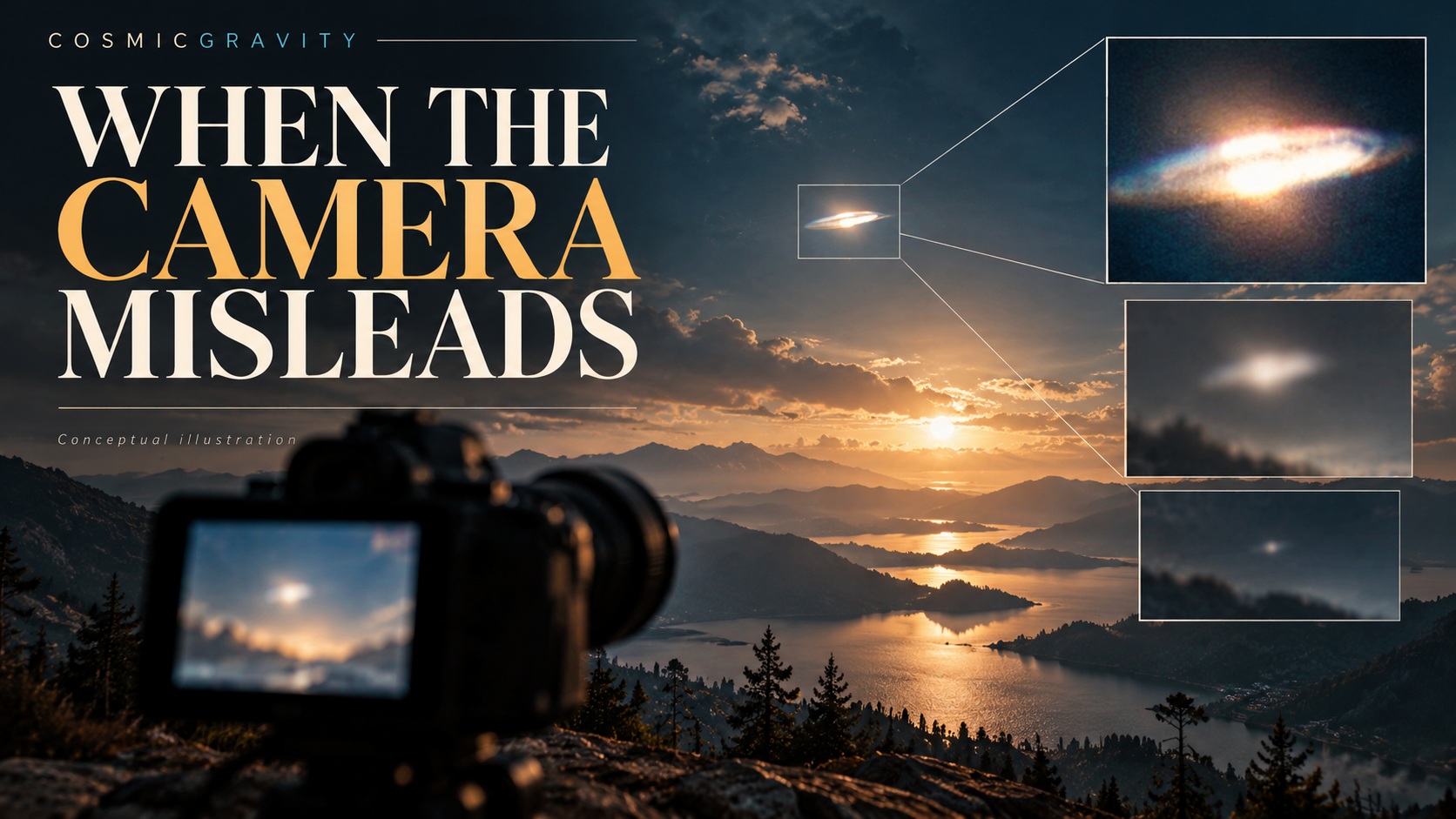
latest video



news via inbox
Subscribe to our Cosmic newsletter to get notified when we have new articles.