Why the Pentagon Wants Access to a Private UFO Archive
CosmicGravity · News & analysis · September 5, 2026
Some of the most useful UAP evidence may be sitting in correspondence folders, old case notes and collections assembled outside government. That is why a new report about the Pentagon seeking access to a private UFO archive is worth a closer look.
On September 2, DefenseScoop reported that the All-domain Anomaly Resolution Office is pursuing a commercial data subscription to the National UFO Historical Records Center, a New Mexico nonprofit. The proposed sole-source arrangement concerns historical material, including pre-1990 records, relevant to AARO’s review of the subject. Read the reporting and its linked procurement notice.
The AARO private UFO archive story describes a planned means of access. It is not, by itself, confirmation of a completed purchase, a seizure of the collection or the discovery of extraterrestrial technology.
Why old civilian files could still matter
A government report and a witness’s original correspondence are not interchangeable. A later summary may omit a timing detail, compress several interviews into a paragraph or repeat information whose origin has become unclear. Comparing versions can expose both overlooked clues and errors that have acquired authority through repetition.
That is an argument for preserving and examining the material carefully. It is not an assumption that every unresolved account will support the same explanation.
More records are already available to readers
The National Archives maintains UAP material across multiple collections, alongside Record Group 615, the dedicated collection established under the 2024 National Defense Authorization Act. NARA says additions are made on a rolling basis as federal agencies transfer records. Its UAP research hub separates photographs, moving images, textual records and presidential-library material.
Those public collections and the proposed private subscription are different things. A news story about access for an agency does not necessarily mean the same files are now freely downloadable by everyone.
A better question than “does this prove disclosure?”
Ask what becomes easier to verify. Can researchers identify an original witness statement? Is there a documented sequence from the first report to the final assessment? Do apparently independent accounts turn out to share a single source? Can another researcher retrieve the same record?
Those questions are useful whether a case ends with an ordinary explanation or remains genuinely puzzling. They also leave room for disagreement without turning missing information into a conclusion.
The next development to watch is concrete: the status and scope of the proposed access, followed by any research that identifies which records changed an assessment and why. An archive can improve the investigation. What it establishes depends on what its records actually contain.
Use our Record Group 615 guide and Global UAP/UFO Case Atlas to put individual reports in context.
COSMICGRAVITY · EXPLORE THE EVIDENCE
A quick archive-reading checklist
Tap a heading to open the explanation.
Provenance
Who created the record, when, and for what purpose? A scan without that context is only part of the evidence.
Independence
Do several reports come from different witnesses, or do they repeat the same account? Count sources, not copies.
Accessibility
Is the underlying record public, restricted or only described by a reporter? Access for an agency is not automatically public disclosure.
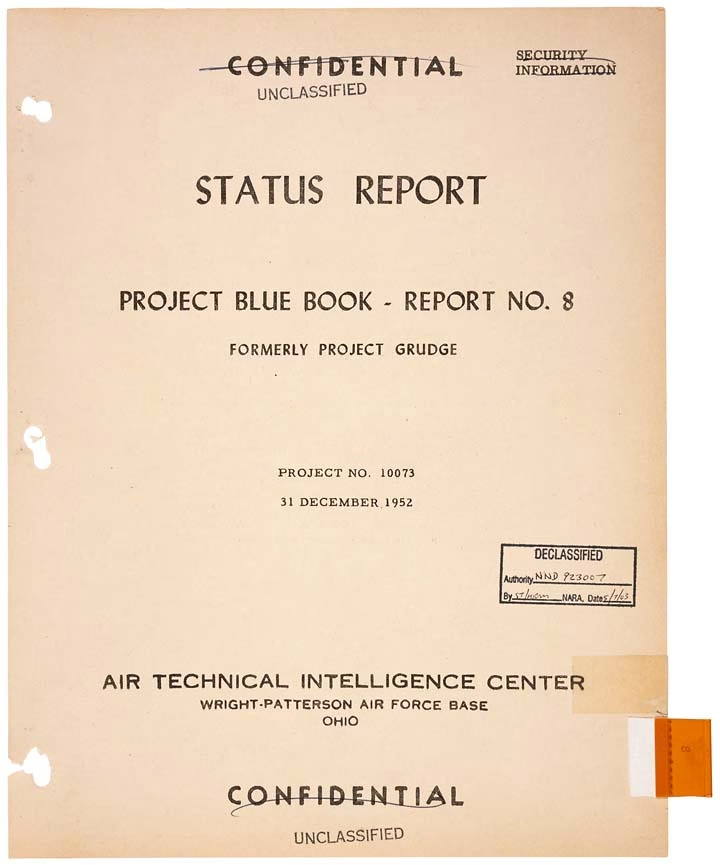
Lead image: Historical context: the cover of a Project Blue Book status report dated December 31, 1952. U.S. Air Force/National Archives. This is not a document newly released through the proposed private-archive subscription. Image source and usage information.
Editorial note: Reporting checked September 5, 2026. Linked sources distinguish the underlying observations from interpretation. Future plans and preliminary results may change.
latest video

news via inbox
Subscribe to our Cosmic newsletter to get notified when we have new articles.