Black Triangle UFO: Why Two Federal Records Give Different Timings
A black triangle UFO reported in the western United States appears in two federal records released on 23 October 2026. Both describe a dark, angular object near a ridge. Both describe vertical movement followed by a rapid departure. Then the records diverge. An All-domain Anomaly Resolution Office memo sets out a sequence that would last more than half a minute if its phases are added. A statement preserved by the FBI gives a total duration of about three seconds. AARO memo, DOW-UAP-D176 and FBI file, FBI-UAP-D043.
The difference matters because the timing is part of the evidence for the reported motion. A prolonged hover followed by a short departure tells a different story from an encounter that lasted only a few seconds. Reading the documents side by side also shows why the number of documents and the number of independent observations are separate things.
What the black triangle UFO records agree on
In the AARO account, a third observer at a second post first drew attention to something over the western ridge. Two primary witnesses moved to a spot where they could look in that direction. The memo describes observations by eye and with binoculars and handheld thermal equipment. The FBI file also recounts a call from another observation post and describes a handheld thermal view alongside an unaided one. The setting, order of events and object descriptions strongly suggest that the files cover the same incident.
The witnesses reported a dark object with a low profile. The FBI statement compared its appearance to a delta-wing drone. The AARO memo describes the outline looking more clearly triangular as the object banked. Neither published record supplies an identification of a model or operator. The comparison to a drone belongs to the witness description, just as the impression of high speed belongs to their estimate. Release 07 file index and original government links.
Why the black triangle UFO timings differ
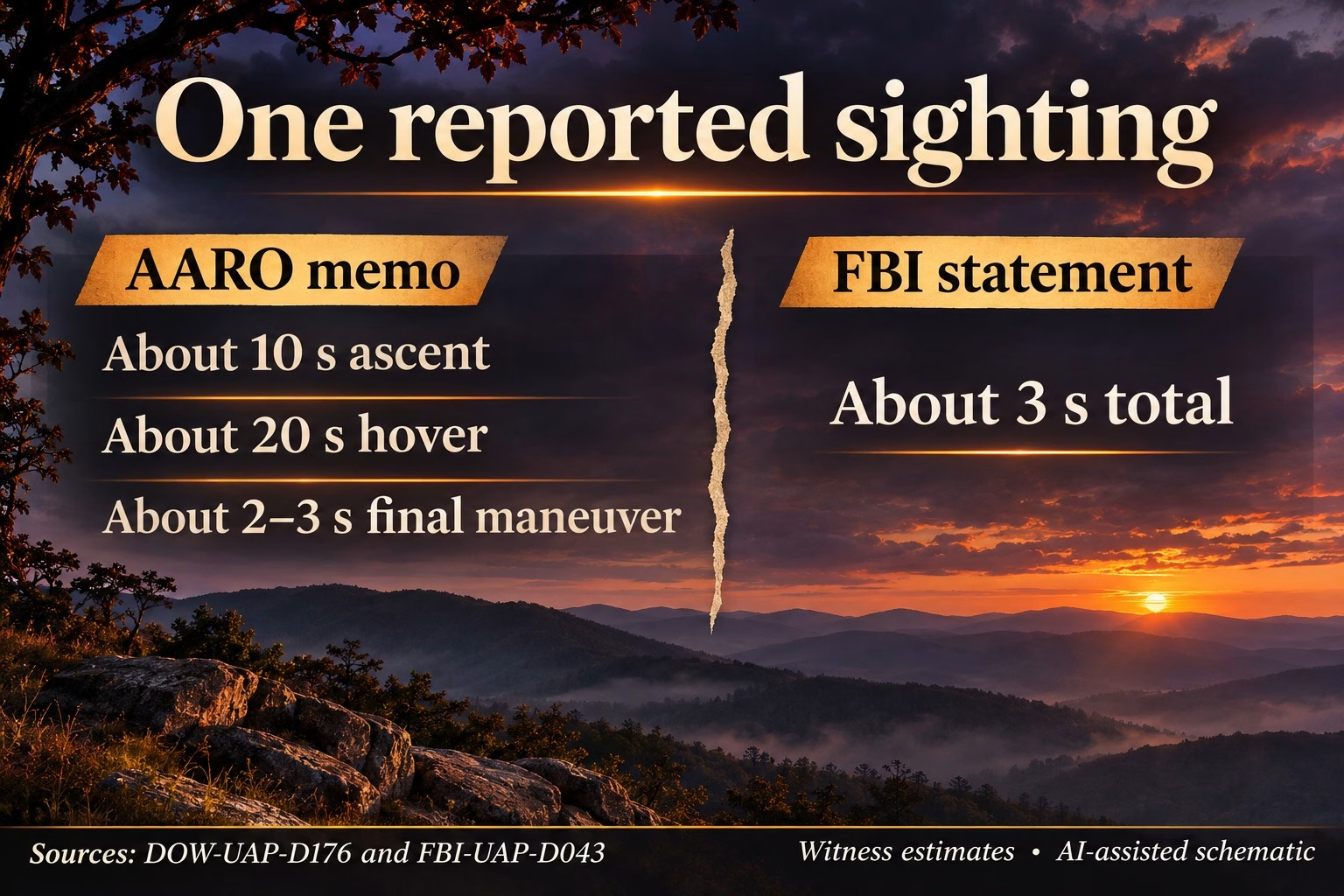
AARO divides the reported motion into three phases. It assigns about 10 seconds to the climb, around 20 seconds to the hover and another two or three seconds to the final movement and loss of contact. Those figures appear under separate headings in the memo.
Page two of the FBI file uses the three-second estimate differently. In the visible text, it applies to the total sighting. The FBI file preserves a statement co-signed by witnesses. It also says the form contains no FBI findings or recommendations. There is no clear basis in the public text to swap the word total for final maneuver and make the two timings agree.
Perhaps the observers were counting from different moments, or perhaps the records reflect different recollections. However, parts of the documents are redacted, and the public versions do not settle that question. Two agencies recording apparently overlapping accounts can add detail about how a report circulated. They cannot, by themselves, supply two independent clocks.
What could make the movement measurable?
The AARO memo says the witnesses used nearby terrain features to estimate distance, height and speed. It explicitly says they obtained no instrumented speed measurement. A silhouette can appear to move quickly against a ridge, but converting that apparent movement into a speed requires knowing how far away it was and how long it took to cross a measured angle. Uncertainty in both the timing and the range carries through to the speed estimate.
The thermal description deserves the same care. The witness statement describes what the object looked like through a handheld device, including the apparent lack of a distinct exhaust feature. A time-stamped recording, instrument settings and a documented line of sight would help an independent analyst assess how much that observation can establish. A report that the witnesses heard no sound is valuable as an account of their experience. Assessing the source would also require information about range, background noise and terrain.
The two releases give investigators questions they can test if more material becomes available. Did anyone log the radio call or record the thermal image? Were the clocks at the two posts synchronized? Does a full statement make clear when each observer began and ended their count? For readers following the release, those are more useful questions than treating either estimate as a measured flight time. Our analysis of the Utah ranch report covers another primary document from the same release.


latest video



news via inbox
Subscribe to our Cosmic newsletter to get notified when we have new articles.