Germany’s UAP Policy: What the Bundestag Answer Actually Says
Germany UAP policy has come into clearer view through a parliamentary exchange that asks a practical question: what happens when an observer cannot immediately identify something?
In October 2026, the government described an existing airspace-surveillance system without a separate federal UAP reporting structure. That distinction matters. Monitoring aircraft, collecting unusual observations and building a scientific case archive are related activities, but they do not automatically produce the same information.
Here is how to read the documents, what their wording establishes and which conclusions remain beyond the evidence.
Where the Germany UAP policy answer comes from
The starting point is Bundestag paper 21/8323, dated 2 October 2026. It records a written inquiry from AfD parliamentarians about unidentified aerial phenomena and the organisation of air and space security.
Its questions concern responsibilities, terminology, reporting routes, data sources, coordination and international contacts. The introduction points to developments abroad, including NASA’s scientific work and France’s GEIPAN. However, an introduction written by the questioners is their framing of the issue; it is not a finding endorsed by the government.
The response, paper 21/8662, is dated 16 October. The Defence Ministry transmitted it on behalf of the federal government. Its opening expressly separates the government’s position from the judgments and assertions in the inquiry’s introduction.
For readers, that is an essential reading habit. Parliamentary documents can contain questions, quoted claims and official answers on the same page. Treating every sentence as a government admission can reverse the meaning of an exchange.
Airspace monitoring is already in place
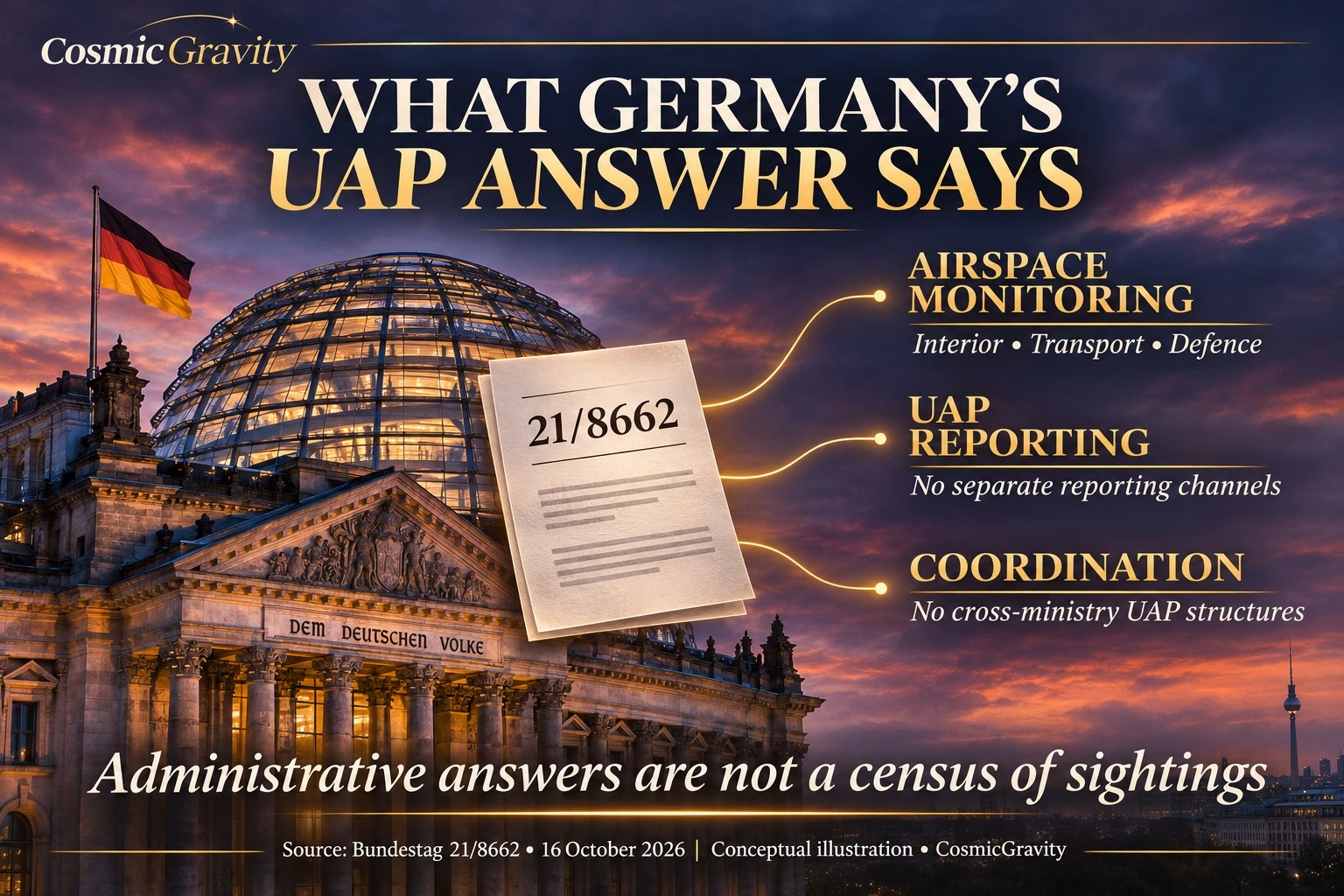
The Bundestag’s official summary, published on 22 October, identifies the Interior, Transport and Defence ministries as responsible for monitoring German airspace. Space-object detection, assessment and cataloguing involve the Research, Technology and Space ministry and the Defence Ministry.
The answer describes how the surveillance system combines and evaluates sensor information. It also refers to checking tracked space objects against the publicly available TLE catalogue at Space-Track, alongside measurements from European and international partners.
Therefore, the absence of a dedicated UAP channel does not mean an absence of airspace observation. Nor does routine surveillance alone tell us how researchers could preserve an unusual event for later, publicly accessible scientific investigation.
Imagine an observer who supplies a direction and an approximate time. For example, a useful follow-up might require the original time reference, the viewing position, the recording’s metadata and an explanation of which other records were checked. This is an illustrative example of the information problem, not a case described in the German answer.
What Germany UAP policy does not separately provide
The response says there are no separate reporting routes for UAP, no corresponding government terminology or nationwide definitions, and no cross-ministry structures or working groups for evaluating such events. It also states that information answering the request for a ten-year breakdown of reports is unavailable.
In addition, the government says a revision of existing procedures is not currently planned. On international cooperation, it refers to regular exchanges with allies and partners about relevant security matters, while declining to discuss details.
These statements describe the government’s position in this particular exchange. They do not supply a list of every unidentified radar return, every civilian observation or every privately investigated sighting in Germany.
Likewise, an unavailable report count does not establish a count of zero. Without an agreed definition and a known collection process, a reader cannot turn the answer into a reliable estimate of how often people see something they cannot identify.
Why the comparison with scientific research matters
NASA’s UAP study page describes a different kind of exercise: identifying available data, considering how future information should be collected and examining suitable analysis methods. The independent team’s final report appeared on 14 September 2023.
That remit helps explain why an administrative answer and a scientific research plan cannot substitute for each other. One identifies responsibilities and procedures. The other asks what observations and methods could support stronger conclusions.
France’s GEIPAN offers another public-facing model, with testimony and statistical resources accessible through its official site. Our guide to GEIPAN’s investigation and classification system explains why the evidence behind a category matters as much as its label.
For a wider historical perspective, the CosmicGravity UFO case atlas lets readers explore named reports in their own settings. Individual cases and national policies answer different questions, so it is useful to keep both in view.
How to read the next Germany UAP policy development
Several concrete changes would make a future update easier to assess: a named receiving office, a published definition, a standard report form, a retention policy and a clear route for scientific review. These are our proposed evaluation criteria, not measures announced in the October answer.
For example, a new reporting portal would be a procedural change. A released dataset would be a new research resource. A documented explanation of a sighting would be a case finding. None automatically determines an extraterrestrial origin.
The reverse inference is equally weak. A government’s statement that it has no findings on UAP does not, by itself, explain every observation made within its borders. A persuasive explanation still needs evidence that investigators can connect to the event.
For now, the October exchange gives readers a dated, citable description of federal arrangements. Its value lies in that precision. Readers can compare future claims about a change in Germany’s approach against the original questions and answers. That is a firmer starting point than a dramatic retelling.



latest video



news via inbox
Subscribe to our Cosmic newsletter to get notified when we have new articles.