How Chariklo’s rings changed between two glimpses of starlight
Chariklo’s rings gave themselves away by briefly dimming a star. On October 18, 2022, the James Webb Space Telescope watched a second such encounter. From Webb’s vantage point the star missed Chariklo itself. The rings still crossed the line of sight, leaving two small interruptions in the starlight. For anyone trying to study a few kilometres of material well beyond Saturn, it was an especially convenient near miss. See the recorded brightness as the star passed behind the rings.
In September 2026, Pablo Santos-Sanz and colleagues published their comparison with earlier observations from Earth. The rings remained in much the same places. The inner ring blocked more light than before, while the outer one let more through. That finding raises a question a photograph alone would struggle to answer. What can change inside a ring that appears to stay put? Read the study in Science Advances.
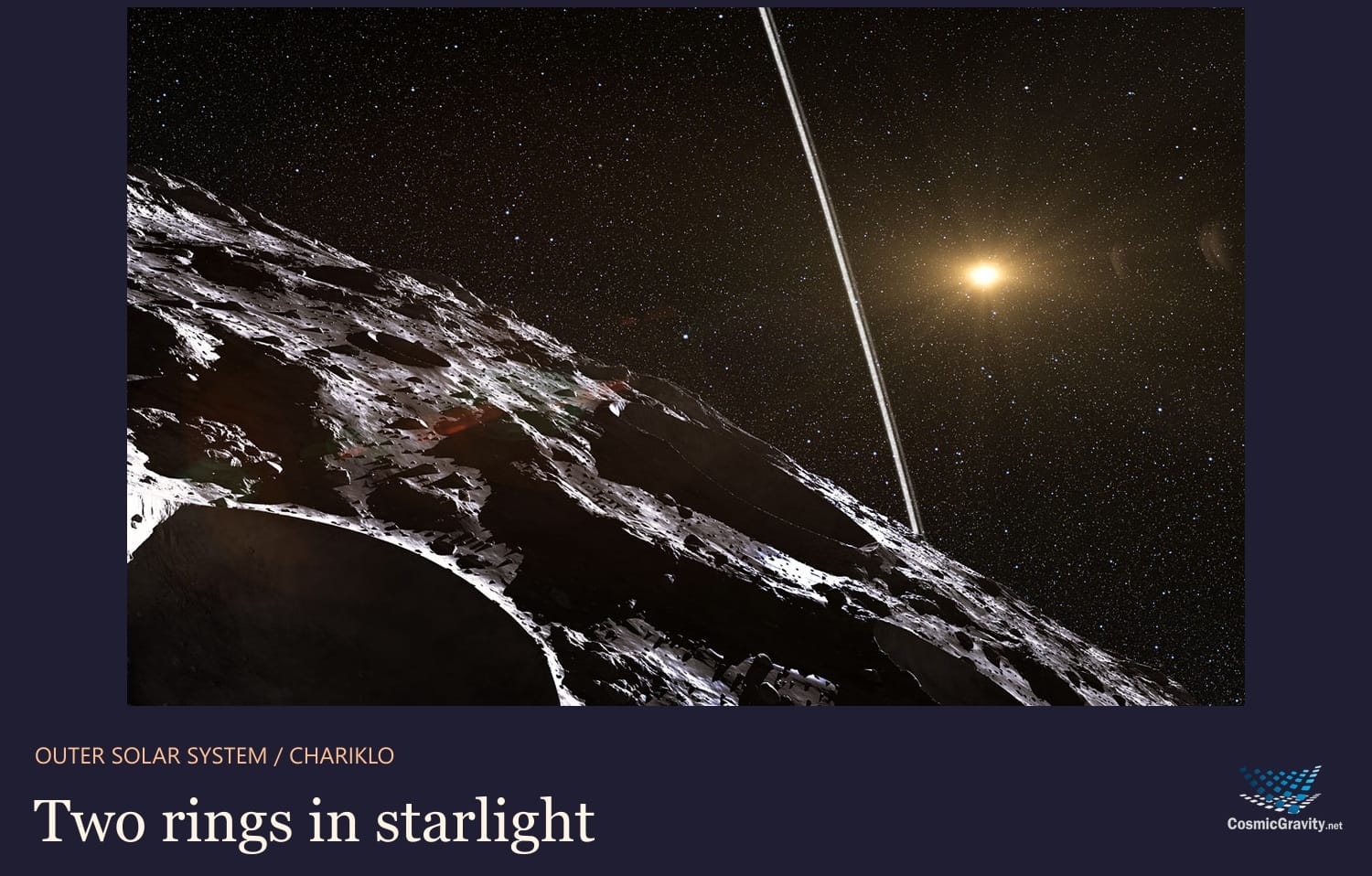
Feature image. Artist’s impression by ESO/L. Calçada/Nick Risinger (skysurvey.org), CC BY 4.0. Editorial layout by CosmicGravity. Image source. Image licence.
How a star revealed Chariklo’s rings
Chariklo belongs to the outer solar system’s population of minor bodies called Centaurs. It measures roughly 250 kilometres across. In June 2013, observers gathered at sites in South America to time its passage in front of a star. They expected the starlight to disappear behind the body and return as it moved on. The surprises came just before and just after the main event.
Instruments recorded additional brief drops in brightness. Telescopes at different sites saw the star take slightly different tracks across the system. By fitting the interruptions from those tracks together, the team could trace two narrow rings. Their discovery estimates put the widths at roughly seven and three kilometres, with about nine kilometres of clear space between them. Think of how difficult it would be to pick out those edges directly against a dark sky. Timing the shadow made the dimensions measurable. ESO’s account of the discovery explains the observing geometry.
The opacity changed in opposite directions
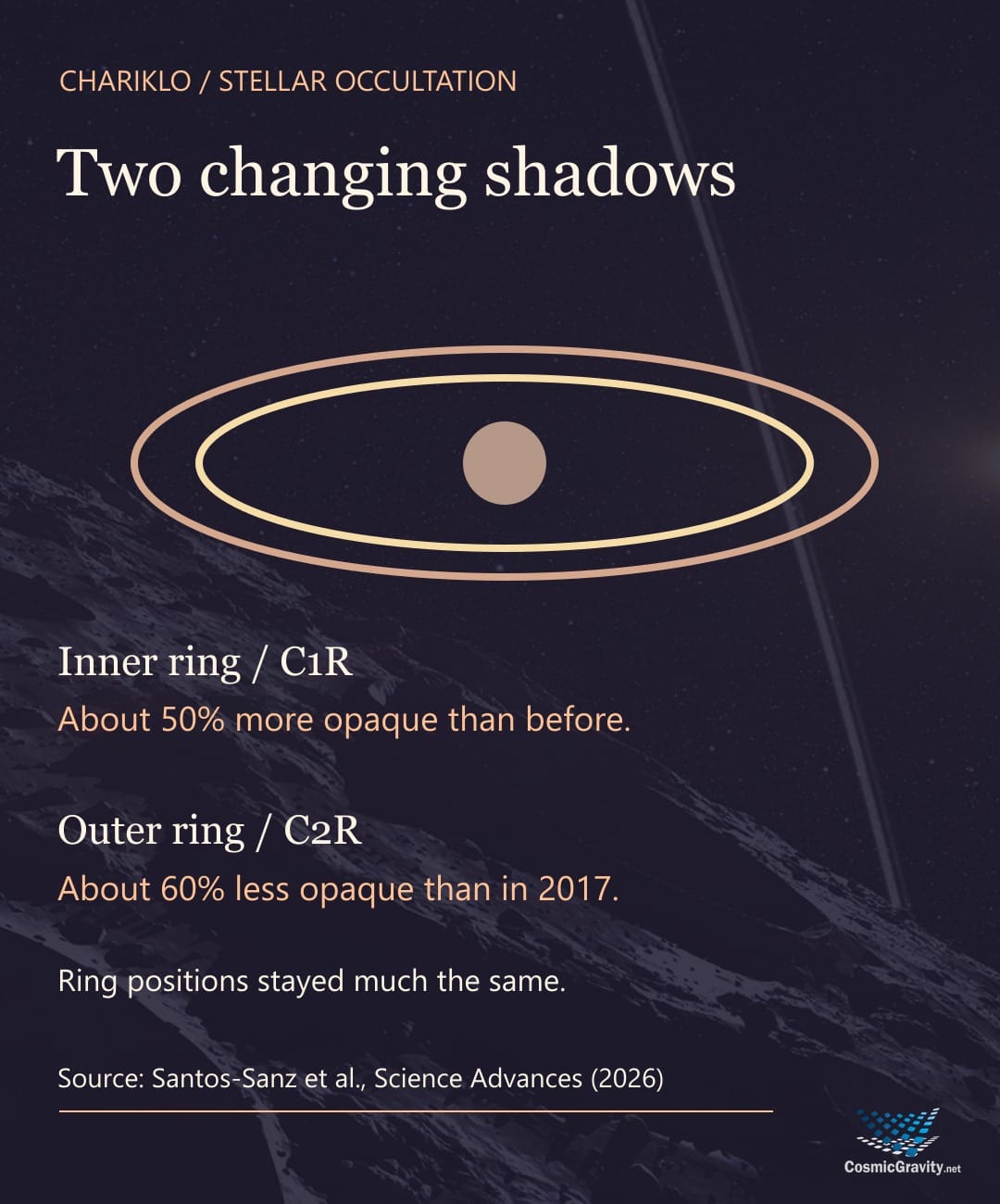
The 2022 Webb measurements gave the team a chance to revisit that picture in infrared light. Their analysis puts the inner ring’s opacity about 50 percent higher than in earlier observations. The outer ring’s opacity appears about 60 percent lower than in 2017. Those are relative changes in how effectively the material obscures a background star. A ring that becomes half again as opaque has not necessarily gained half again as much mass. Read the Paris Observatory team’s explanation of the comparison.
Consider a handful of grains crossing a beam of light. Whether much light gets through will depend on the total area the grains present to the beam and on how they scatter or absorb light at that wavelength. Break some large particles into smaller ones and the amount of exposed surface can change while the amount of material stays much the same. A delivery of fresh debris is another way to deepen a shadow. These are possible explanations for the inner ring. The light curve alone cannot choose between them.
What another crossing could settle
The outer ring poses the reverse puzzle. Its weaker shadow could mean a loss of material. But the observations are snapshots years apart. A slow thinning and a short disturbance between observations could leave similar endpoints. There is also a practical complication in comparing measurements made with different instruments. Visible light and infrared light can respond differently to the same grains.
That makes another well-timed occultation particularly valuable, especially in visible light. It would give astronomers another date and a closer match to earlier observing conditions. The published numbers tell us something changed in the shadows. A sequence of future crossings could reveal whether the pattern persists. In the meantime, anyone can inspect the two dips in Webb’s plot and retrace the inference from star to ring. CosmicGravity covered a related challenge from a survey telescope in how Euclid detected a moving comet.



latest video


news via inbox
Subscribe to our Cosmic newsletter to get notified when we have new articles.