3I/ATLAS Composition: An Ancient Chemical Fingerprint From Another Star System
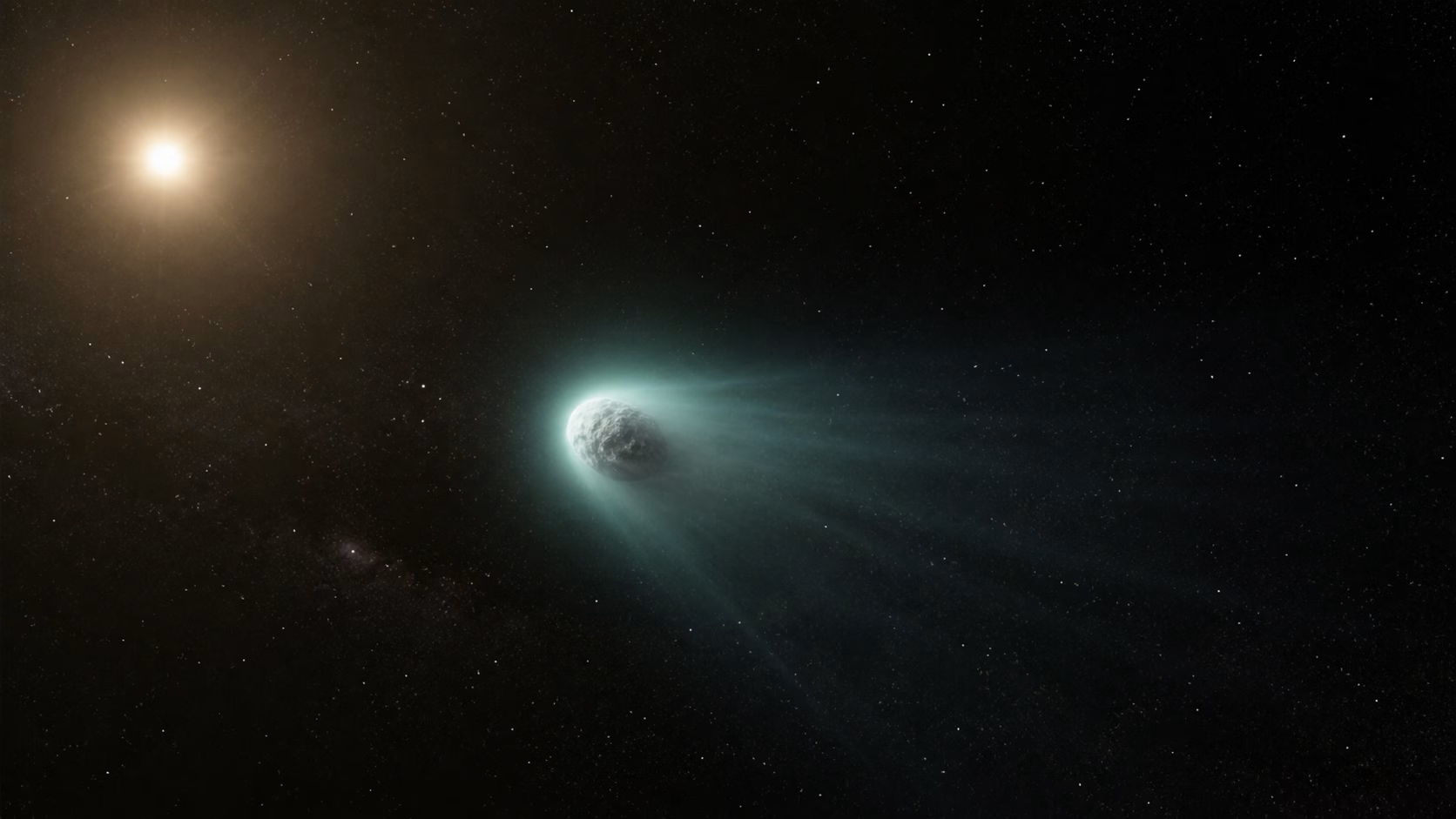
When the interstellar comet 3I/ATLAS crossed our Solar System, astronomers expected a rare look at material formed around another star. The first observations already showed an unusual, carbon-dioxide-rich object. Then the James Webb Space Telescope detected methane. Now isotopic measurements have made the story much stranger.
3I/ATLAS does not contain mysterious elements unknown to science. Its carbon, hydrogen, oxygen, nitrogen, nickel and iron are familiar. The surprise lies in the recipe: the proportions of their isotopes differ sharply from those measured in Solar System comets.
That distinction matters. “Alien chemistry” is a fair description in the literal sense that the object formed beyond our Sun. “Entirely alien heavy elements” is not. What researchers have found is a chemical fingerprint that may preserve conditions in a cold, old and relatively metal-poor planetary system—possibly one that formed billions of years before our own.
A visitor with no return ticket
Most comets seen from Earth belong to the Solar System. Their paths may stretch far beyond the planets, but the Sun still holds them gravitationally. Interstellar objects arrive on open, hyperbolic trajectories and move too fast to remain bound.
3I/ATLAS is only the third confirmed interstellar object after 1I/’Oumuamua and 2I/Borisov. More than 4,000 observations established its natural cometary activity and its unbound orbit. It posed no threat to Earth. Its importance came from something more valuable than danger: it delivered material from another planetary nursery within range of our telescopes.
We cannot hold that material in a laboratory. Instead, instruments split the comet’s light into a spectrum. Molecules and isotopes leave patterns at precise wavelengths, allowing researchers to reconstruct part of the object’s composition while it is already racing away.
Webb’s methane detection
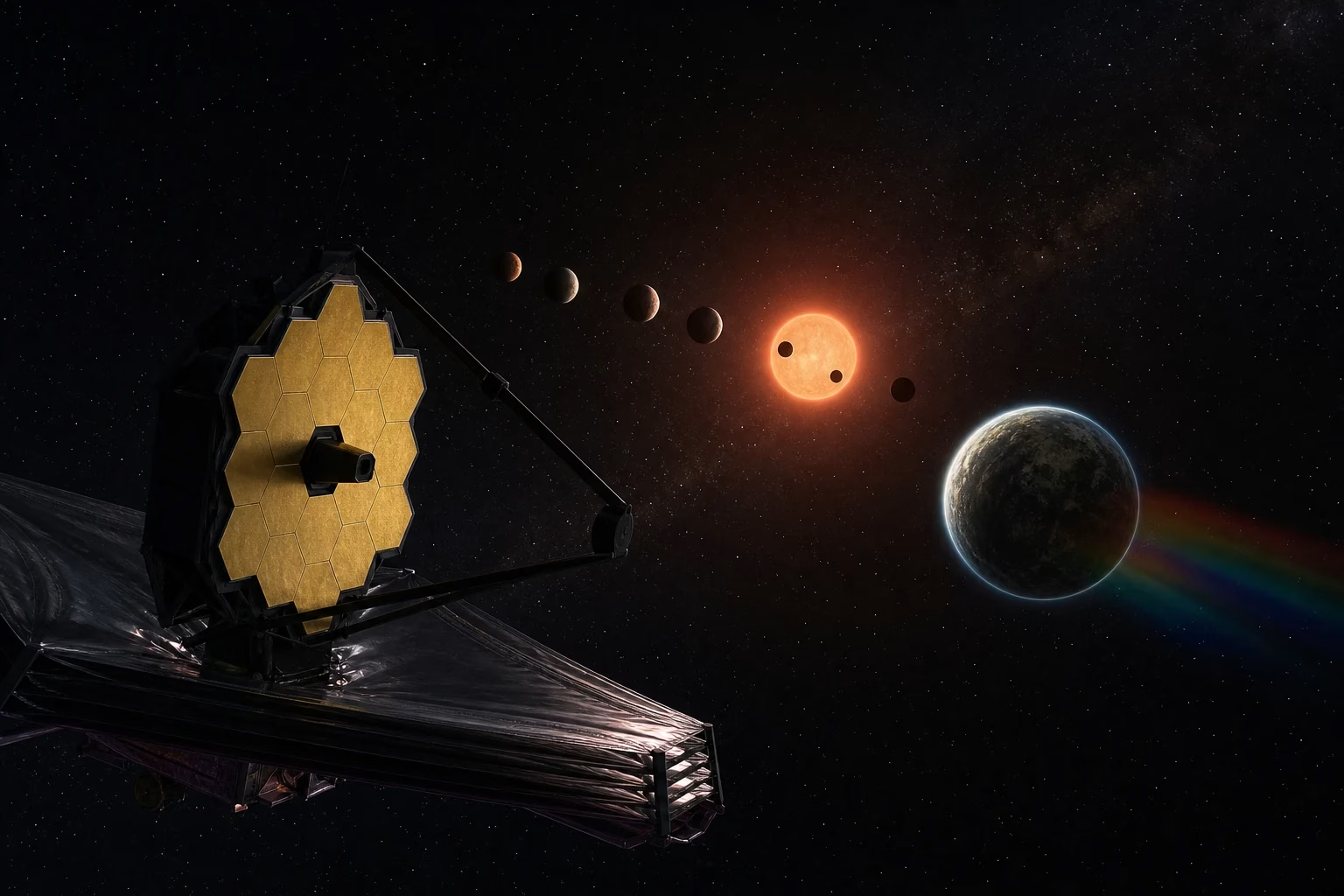
Webb observed 3I/ATLAS with its Mid-Infrared Instrument after perihelion. The telescope detected methane in an interstellar object for the first time. The methane-to-water ratio was unexpectedly high, adding to earlier evidence that the comet was rich in carbon dioxide.
Water vapour extended through the coma, probably because icy grains continued releasing it after leaving the nucleus. Methane and carbon dioxide were more concentrated near the nucleus. One possibility is that methane had remained buried below a processed surface until solar heat reached deeper layers.
Methane does not imply life. It forms through non-biological chemistry in cold molecular clouds, planetary disks and icy bodies. In this context it is a clue to formation temperature and internal layering, not a biosignature.
The isotope result that changed the picture
Atoms of the same element can contain different numbers of neutrons. Those variants are isotopes. Chemical reactions treat them almost—but not perfectly—the same, so isotope ratios can preserve information about temperature, stellar history and the environment where material formed.
A 2026 study reported a water deuterium-to-hydrogen ratio of about 0.98 percent in 3I/ATLAS, more than an order of magnitude above values measured in known comets. Deuterium is the heavy isotope of hydrogen. Such strong enrichment is a signature of extremely cold chemistry.
The same work found unusually high ratios of carbon-12 to carbon-13 in carbon monoxide and carbon dioxide. Separate measurements also indicated a high nitrogen-14 to nitrogen-15 ratio. These are not exotic new forms of matter. They are ordinary isotopes mixed in proportions unlike those seen in Solar System comet samples.
What “metal-poor” really means
Astronomers use the word metals differently from chemists. In astronomy, every element heavier than helium counts as a metal—including carbon, nitrogen and oxygen. A metal-poor star or disk is not literally made without carbon or iron; it contains a smaller proportion of heavy elements compared with hydrogen and helium.
The carbon and nitrogen isotope ratios in 3I/ATLAS are compatible with material from an older, less chemically enriched region of the Galaxy. Earlier generations of stars had not yet produced and distributed the same mixture of heavy isotopes that surrounded the young Sun.
This is why the comet has been described as a possible piece of galactic archaeology. Its ice may record not only another planetary system, but another era of Milky Way chemistry.
A birthplace colder than our familiar comets
The combined isotope evidence points to formation at temperatures below roughly 30 kelvin—less than 30 degrees above absolute zero. That suggests 3I/ATLAS assembled in the distant outer region of a protoplanetary disk or in exceptionally cold inherited material.
Models discussed in the 2026 research allow an age of up to about 12 billion years. That is not a direct birthday measurement, and the upper estimate should not be mistaken for certainty. It means the composition is consistent with formation during an early period of intense star formation, long before the Sun formed 4.6 billion years ago.
If that interpretation holds, the object spent most of cosmic history travelling between stars before its brief passage through our neighbourhood.
Nickel without iron? The story evolved
Early spectra attracted attention because neutral nickel appeared unusually abundant compared with iron. Sensational summaries turned that into “nickel but no iron,” sometimes implying artificial alloys or technology.
Continued observations changed the picture. As the comet approached the Sun and became more active, iron lines appeared and the nickel-to-iron ratio moved toward the range seen in ordinary comets. The early extreme ratio was real, but it was not fixed. Different compounds can release nickel and iron at different temperatures and distances from the Sun.
This is a useful lesson in live science. A first measurement is not necessarily wrong, but it may describe one phase of an evolving object rather than its complete bulk composition.
Can we identify its home star?
Probably not with confidence. The comet’s current path can be measured very precisely, but tracing it backward through the Galaxy is difficult. Stars, molecular clouds and the Milky Way’s gravitational field continually perturb small bodies. Tiny uncertainties grow enormous over millions of years.
The chemistry can describe a type of birthplace: very cold, old and relatively metal-poor. It cannot point to an exact “unmapped sector” of the Galaxy. The object may also have wandered for billions of years after being ejected from its home system.
That makes 3I/ATLAS more like a message in a bottle than a return address. We can analyse the glass and contents even if the ocean has erased the route.
What it tells us about other solar systems
Astronomers usually study planet-forming disks from far away, measuring averaged light across vast regions. An interstellar comet offers a compact physical sample. Its ices preserve local conditions from the outskirts of one disk, where volatile molecules could survive.
One comet cannot tell us what all distant systems are made of. It can, however, break the assumption that Solar System comets cover the full range of possible chemistry. The high deuterium abundance, unusual carbon and nitrogen isotopes, carbon-dioxide-rich activity and buried methane show that planetary building material can develop along very different chemical paths.
Future interstellar visitors may prove equally individual. Some may resemble local comets; others could occupy entirely new regions of the chemical map. With a large enough sample, astronomers could compare comet populations by stellar age, galactic environment and formation temperature.
Mysterious without becoming artificial
Nothing in the available composition data requires an artificial origin. Methane, unusual isotope ratios and changing nickel-to-iron emissions all have natural pathways. The International Astronomical Union has specifically warned about misinformation surrounding the object.
That does not make 3I/ATLAS ordinary. It may be among the oldest solid bodies ever observed close to Earth, carrying an isotopic record that no Solar System object shares. The evidence is extraordinary precisely because spectroscopy can reveal such a history without inventing unknown elements or technology.
Like the search for biosignatures in alien atmospheres, interpreting an interstellar comet requires both imagination and restraint. The aim is not to remove the mystery, but to locate it accurately.
Sources and further reading
- Nature: Isotopic evidence for a cold and distant origin of 3I/ATLAS
- Nature Astronomy: High nitrogen and carbon isotopic ratios in 3I/ATLAS
- NASA: Webb detects methane on interstellar comet 3I/ATLAS
- Astronomy & Astrophysics: the evolving nickel-to-iron ratio
- International Astronomical Union: 3I/ATLAS information and misinformation response


latest video


news via inbox
Subscribe to our Cosmic newsletter to get notified when we have new articles.