BepiColombo Is Closing In on Mercury. Arrival Will Take Months.
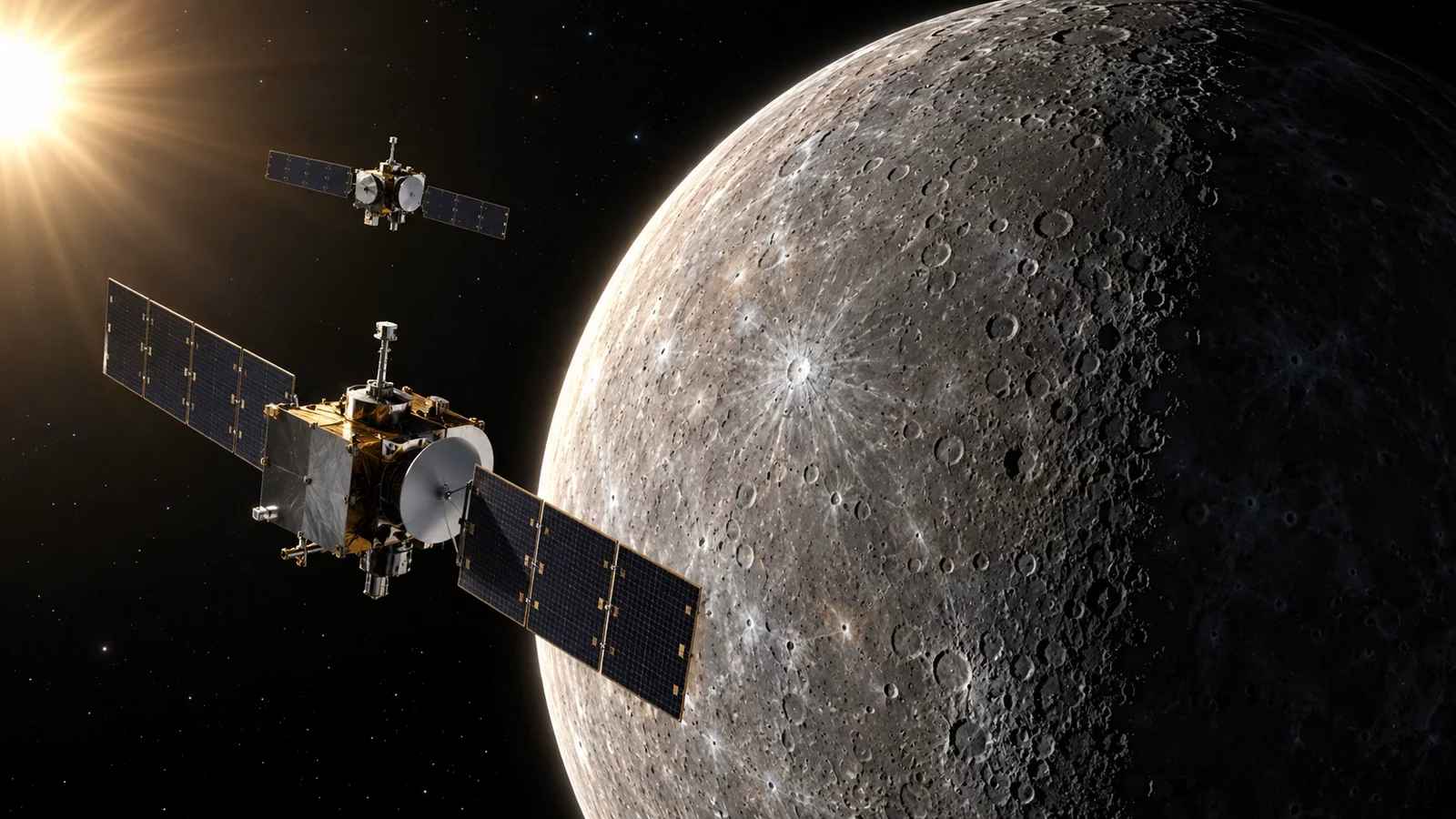
Feature image: AI-generated editorial illustration; not an observation or verified reconstruction.
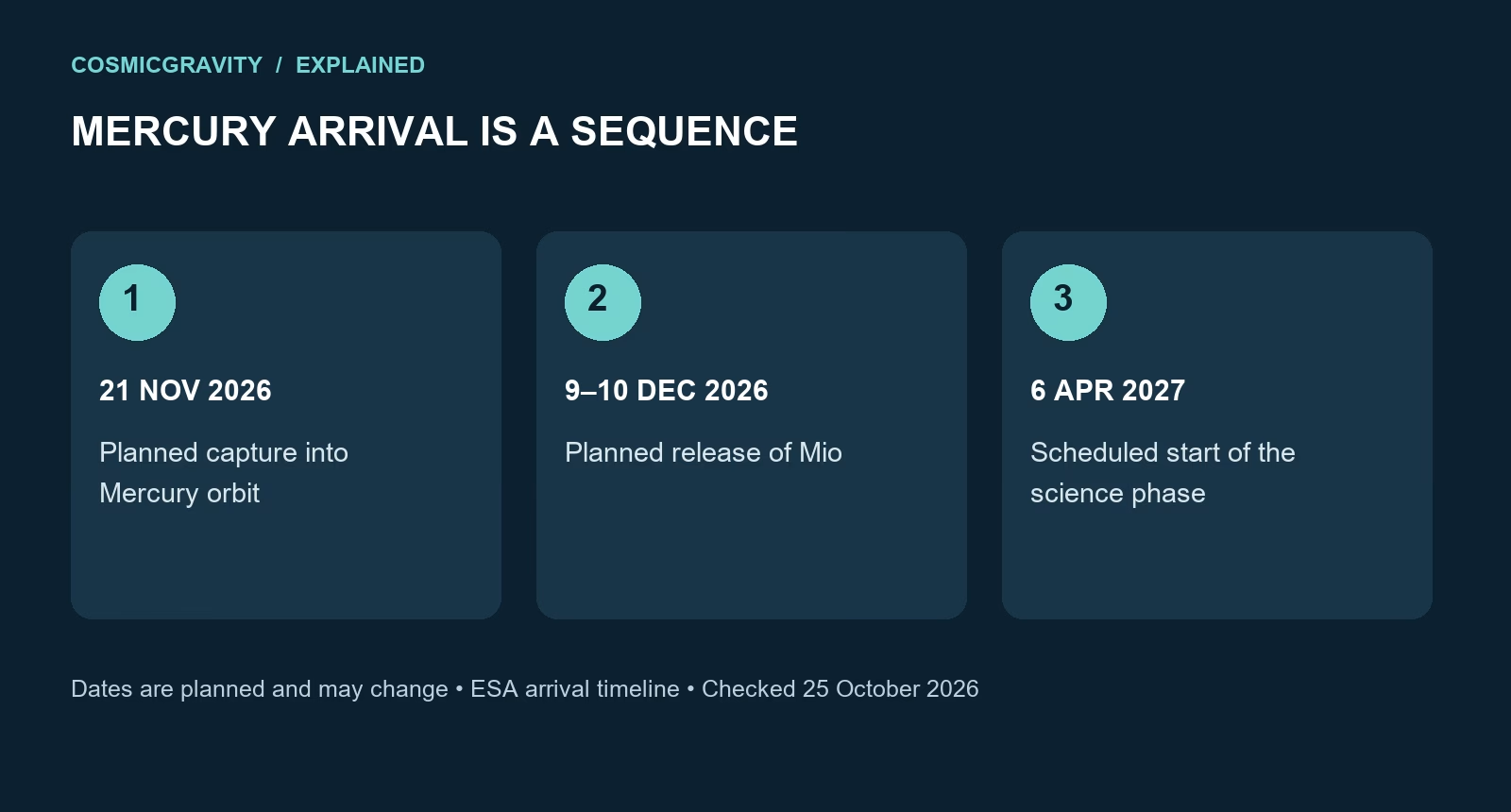
The BepiColombo Mercury arrival is approaching its next major test. ESA and JAXA’s mission is targeting orbit insertion on 21 November 2026, but reaching Mercury is only part of the job. The two science orbiters must then separate and prepare for their own investigations.
ESA’s October arrival update reports encouraging instrument tests following the transfer module’s separation on 3 September. These are checks on the way to the destination, rather than an announcement that the main science mission has begun.
Why the BepiColombo Mercury arrival is complicated
Mercury looks close on a diagram of the Solar System. Getting into orbit around it is another matter. A spacecraft travelling inward gains speed under the Sun’s gravity. Unless it sheds enough orbital energy, it can reach Mercury too quickly to remain there.
ESA’s explanation of the journey makes the crucial distinction: flying past a planet is much easier than arriving at the right relative speed to orbit it. Gravity assists and propulsion help solve that problem, at the cost of a long and carefully timed route.
It is useful to think of arrival as matching motion. Crossing the right patch of space is not enough; the spacecraft also needs the right trajectory and speed.
Two orbiters, different questions
ESA’s Mercury Planetary Orbiter, or MPO, will investigate the planet, while JAXA’s Mio will study its magnetic environment. The mission overview describes how the two spacecraft divide those responsibilities.
That partnership offers more than two sets of pictures. Surface, interior and environmental measurements can be considered together, helping researchers study Mercury as a connected system.
What happens after November?
The published arrival timeline schedules Mio’s release for 9–10 December. MPO then continues towards its final science orbit in March 2027. The science phase is scheduled to begin on 6 April 2027.
Those dates are operational plans and may change. Orbit adjustments and instrument commissioning take time because teams need to establish that the spacecraft and measurements are behaving as expected before routine observations begin.
The next milestone to watch
For readers following the mission now, the immediate event is November’s planned orbit insertion. A successful outcome would move the mission into a new phase, with separations and checks still ahead.
After eight years, that may sound like another wait. It is also the point where a travelling spacecraft starts becoming a working planetary observatory.
Continue exploring
Another mission taking shape: Dragonfly at Titan
Sources and further reading



latest video



news via inbox
Subscribe to our Cosmic newsletter to get notified when we have new articles.