The Moon Meets the Pleiades This Week. Here’s What to Look For.
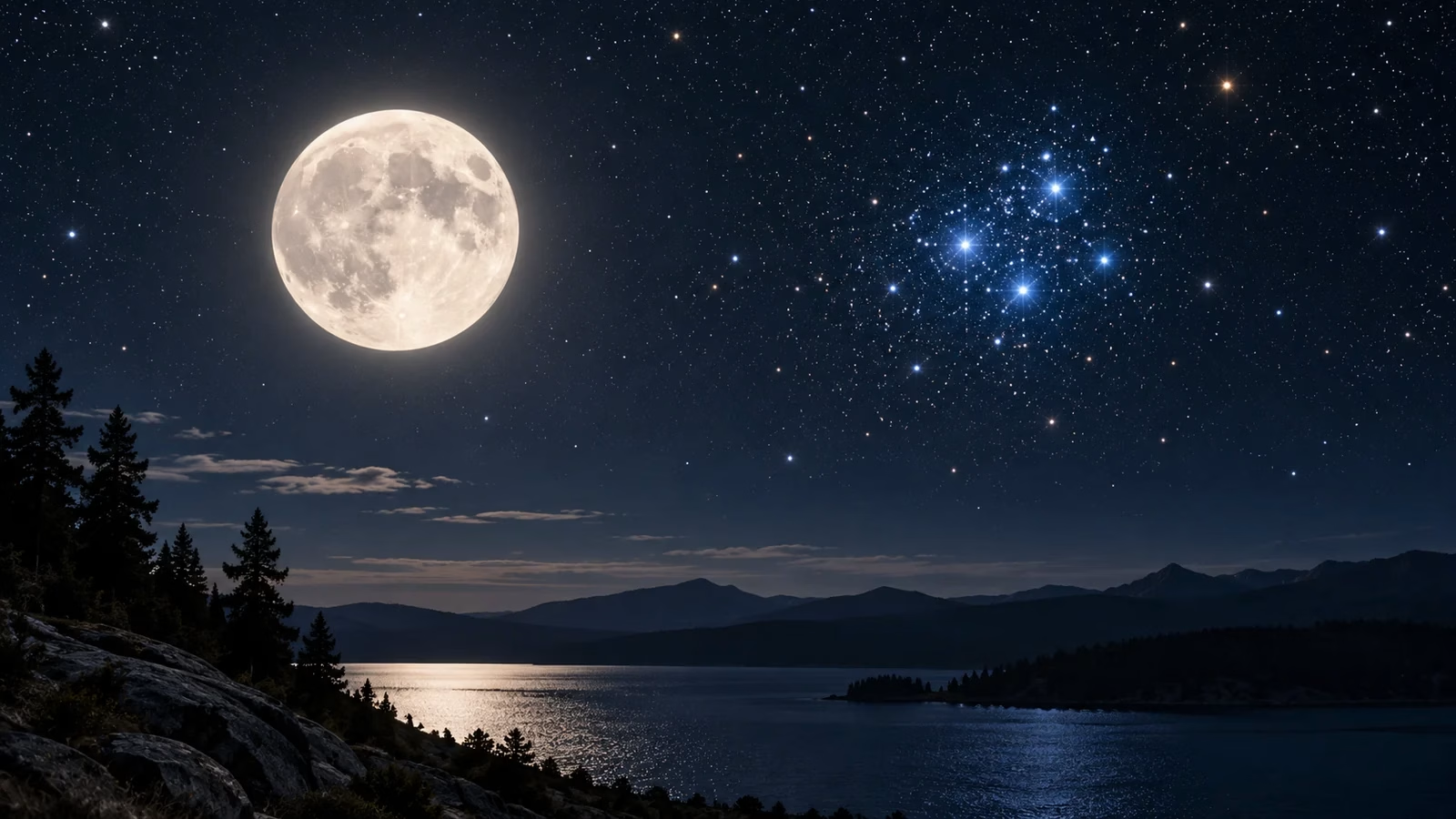
Feature image: AI-generated editorial illustration; not an observation or verified reconstruction.
The Moon near the Pleiades is one of the remaining skywatching highlights of October 2026. On the night of 27 October into 28 October, our bright neighbour passes close to the star cluster commonly called the Seven Sisters.
NASA’s October skywatching guide recommends looking east in the evening as the pair climbs. The exact view depends on where you are and when you look, so treat the date as an observing opportunity rather than a single worldwide appointment.
How to see the Moon near the Pleiades
Choose somewhere with a clear eastern view. Find the Moon first, then look nearby for a small grouping of stars. Binoculars can help reveal the cluster, although the bright Moon can make the fainter members harder to pick out.
You do not need an elaborate setup. A comfortable place to stand, a clear sky and a little patience are enough to begin. If the cluster is difficult to distinguish beside the Moon, try again on another evening when the Moon has moved away.

Close in the sky, far apart in space
This is an apparent meeting along our line of sight. The Moon has not travelled out to the stars. NASA’s Messier 45 guide places the Pleiades about 445 light-years away, vastly beyond our nearby satellite.
The cluster contains more than a thousand stars, although a handful of bright members dominate the familiar view. Its other catalogue name, Messier 45 or M45, can help you find it in a sky app.
The Seven Sisters have a wider family
There is another reason to give this small patch of sky a second look. In November 2025, NASA reported research using TESS and other observations to identify a much wider Greater Pleiades Complex.
The proposed grouping contains more than 3,000 stars across roughly 1,900 light-years. Researchers combined evidence about stellar motion, rotation and chemistry to investigate which stars share a common history.
That wider structure is not a shape you should expect to see with your eyes. It is a scientific reconstruction built from measurements, quite different from the compact cluster that draws our attention at night.
Make the most of this week’s view
Check a location-aware sky map for your observing time. Cloud, buildings and local conditions may affect the view more than any equipment choice. A photograph will also render brightness differently from your eyes.
The reward is a simple change in perspective: the Moon supplies the nearby landmark, while the cluster behind it offers a glimpse of stars whose shared history reaches far beyond the pattern we recognise.
Continue exploring
Explore more space stories at CosmicGravity
Sources and further reading

latest video



news via inbox
Subscribe to our Cosmic newsletter to get notified when we have new articles.