Ancient Proteins Give Xujiayao’s Denisovans a Clearer Identity
The Xujiayao Denisovans have become easier to identify through a microscopic record inside ancient bone. A new protein study links two fossils from northern China to the Denisovan lineage, giving researchers a molecular anchor for interpreting their physical features.
Published in Nature on 21 October, the work connects a familiar problem in human evolution with a different kind of evidence. A fragment can look suggestive. Preserved molecules can offer an independent way to test the identification.
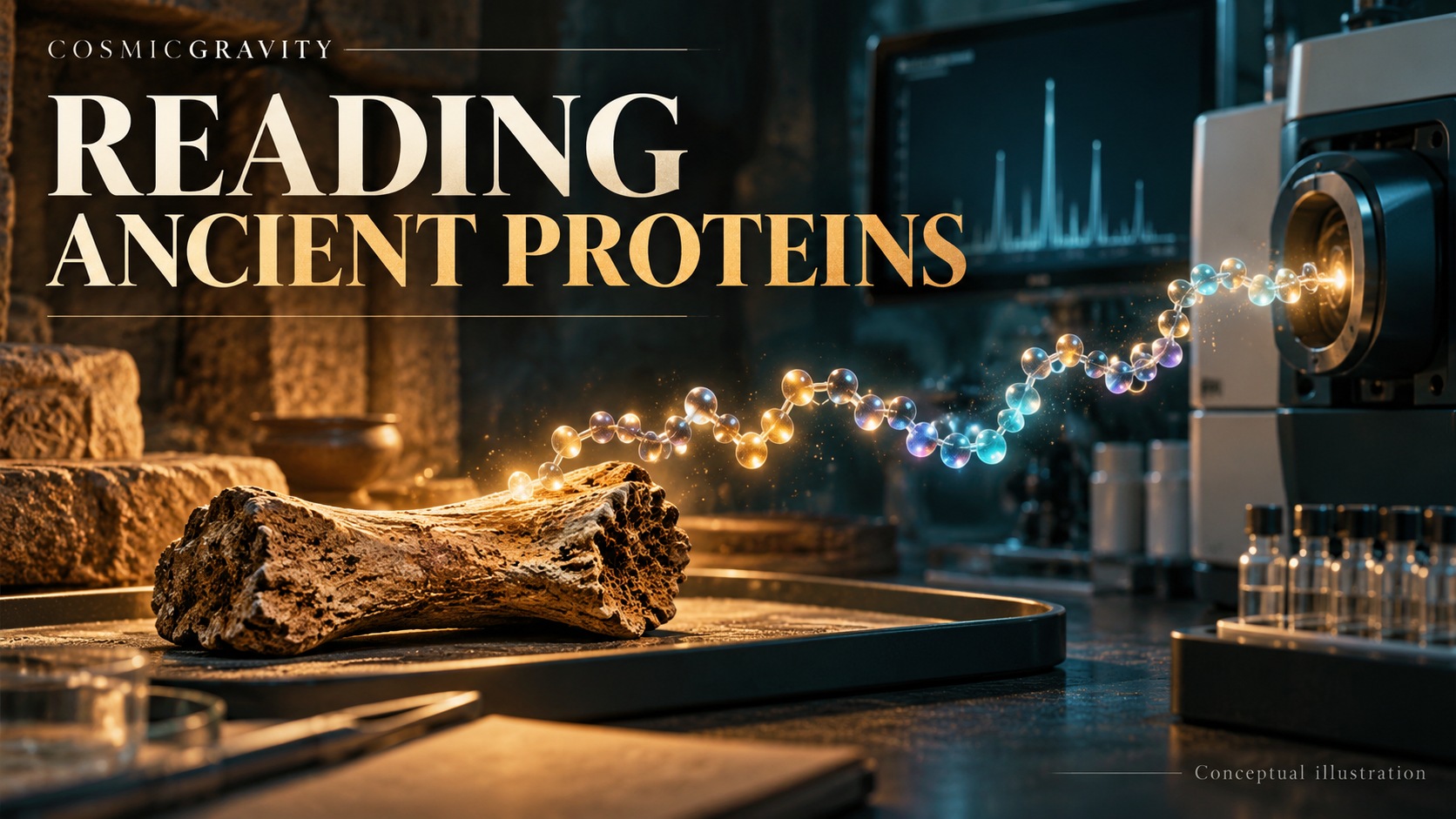
Original AI-assisted CosmicGravity magazine illustration. The scene and any inset imagery are conceptual; this is not a documentary photograph, an actual artefact or measured observational data.
What the Xujiayao Denisovans study found
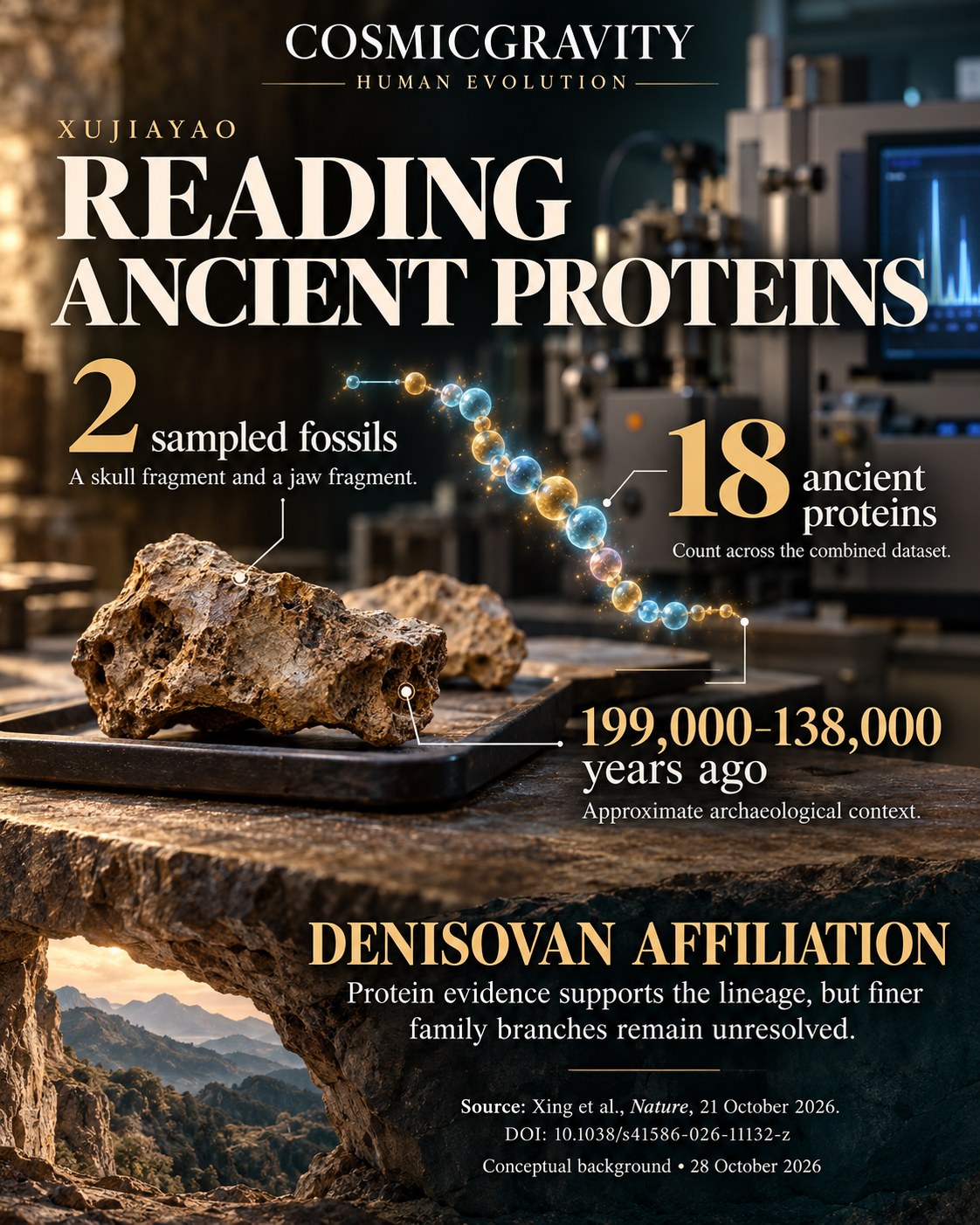
Xing and colleagues analysed a skull fragment and part of a lower jaw from Xujiayao. Their archaeological context dates to approximately 199,000–138,000 years ago. Across the combined dataset, the team identified 18 ancient proteins.
A variant in collagen supports Denisovan affiliation. The researchers also compared protein sequences to reconstruct evolutionary relationships. The Denisovan grouping was well supported, but finer relationships within it remained unstable. The result identifies a population without resolving every branch of its family tree.
Proteins are not a newly sequenced genome
Denisovans originally entered the scientific record through DNA. The 2010 genome study examined material from a finger bone found in Denisova Cave in Siberia and established a relationship with Neanderthals. That genetic starting point remains essential background to the name.
The Max Planck Denisova genome project later produced a much higher-coverage sequence from the finger fragment. A genome gives researchers a different and much larger information source than a limited set of preserved proteins.
It would therefore be misleading to describe the Xujiayao finding as a fresh full DNA sequence. Its value lies in what another molecular approach can establish from these particular specimens.
Why molecular checks matter for a fossil’s shape
A skull feature gains a different meaning when the specimen carrying it has an independently supported identity. Researchers can then compare that feature with other fossils while keeping track of which identifications have molecular support.
The authors use shared anatomy to argue for a wider Denisovan grouping among East Asian fossils. That broader proposal should be read separately from the direct protein findings in the two Xujiayao samples. The study did not protein-test every skull discussed in its comparison.
This is also why a confident facial reconstruction would go beyond the evidence presented here. Identifying a lineage does not recover an individual’s complete appearance, behaviour or life story.
Another route into the human past
Protein-based identifications have already helped the field. The Natural History Museum’s account of a Denisovan rib study explains a previous use of ancient proteins to identify a fragment that offered limited anatomical clues.
The useful change at Xujiayao is an additional point of contact between molecules and morphology. Readers can explore more of the wider field in our human-past and archaeology coverage. Here, a few surviving molecular details make an old fossil collection more informative, while leaving its unanswered questions visible.

latest video



news via inbox
Subscribe to our Cosmic newsletter to get notified when we have new articles.