Einstein Probe X-Ray Flash Leads to a Likely Supernova
The Einstein Probe X-ray flash lasted about 130 seconds. Finding out what might have caused it took much longer. Two optical telescopes picked up a faint point near a galaxy, and later observations with the Very Large Telescope showed the fingerprints of an exploding star. In a report issued on 2 November 2026, the Stargate collaboration identified the optical source as consistent with a broad-lined Type Ic supernova still on its way to peak brightness. The team considers the connection to the flash likely, while its estimate of the host galaxy’s redshift remains tentative. Einstein Probe detection report and Stargate spectroscopy report.
Where the Einstein Probe X-ray flash pointed
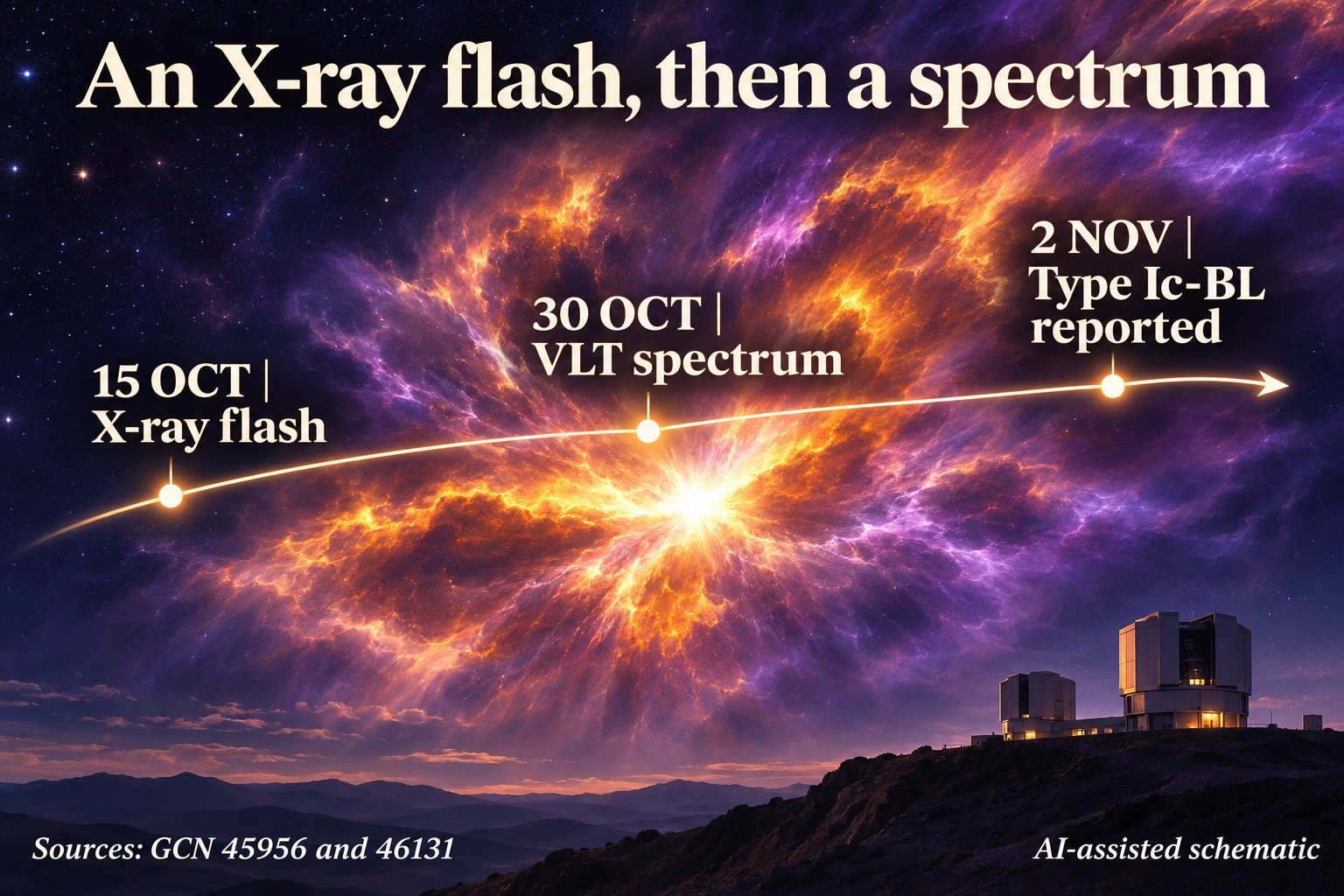
On 15 October 2026, the mission’s Wide-field X-ray Telescope recorded a burst with two peaks. The detection, called EP261015a, gave follow-up teams a patch of sky to investigate. Its uncertainty radius was three arcminutes, about one-tenth the width of a full Moon. That can contain plenty of faint sources. Because the instrument did not trigger automatically for this event, the mission team distributed a notice manually. GCN Circular 45956.
Roughly 14 hours after the flash began, the Nordic Optical Telescope and a Las Cumbres Observatory telescope in Chile picked up a faint source at matching positions. The observers subtracted reference images of the same field to make anything new easier to spot. An underlying galaxy complicated that subtraction, which is one reason the team initially called its source a candidate. Finding it independently with two telescopes made it more credible. The first optical follow-up.
Einstein Probe’s follow-up X-ray telescope also checked the field. It did not detect a source at the optical candidate’s position in that follow-up exposure. A later non-detection constrains how bright the source could have been at that time. The team would need a stronger localization or additional evidence to tie the two signals together directly. Follow-up X-ray analysis.
How a spectrum changed the Einstein Probe X-ray flash investigation
On 30 October, just under 15 days after the X-ray flash, observers used the FORS2 instrument on Antu, one of the Very Large Telescope’s four main telescopes in Chile. They aligned its slit to sample both the transient and the galaxy’s nucleus and took seven exposures of 600 seconds. Splitting the optical light into a spectrum gave them information that ordinary images could not provide.
Broad features in the spectrum were consistent with a Type Ic-BL supernova, a class of stripped-envelope stellar explosions. In this class, strong signatures of hydrogen and helium are absent, and the broad features are associated with rapidly expanding ejecta. Broad lines help identify the explosion. The width of those lines alone cannot tell you how the earlier X-rays were produced.
The team also saw faint emission features that line up at a redshift around 0.31. Redshift measures how far a pattern of wavelengths has shifted toward the red. When galaxy lines are weak, several features agreeing on the same shift is more useful than relying on any single one. An earlier exposure supplied another weak clue at the expected wavelength of a hydrogen line. The observers kept the estimate tentative.
At that redshift, a comparison with known supernova spectra returned a good match to an early spectrum of SN 1998bw. For that reason, the collaboration described the new source, named SN 2026ahoa, as pre-peak. The comparison gives a clue to the stage of the explosion at the time of the exposure. A measured date for maximum brightness would come from following the source over time. VLT spectrum and preliminary classification.
Did the same explosion produce the flash?
There are two connected questions. First, is the object seen by the optical telescopes a supernova? The spectral features make a strong case for the broad-lined interpretation. Second, was that object responsible for the X-rays? The location, timing and emerging classification are compatible with a common origin, which is why the observers favor it. However, the original X-ray position, the lack of a later X-ray detection at the exact optical position and the preliminary nature of the spectrum leave room for further investigation.
That distinction matters because an X-ray flash describes how the event appeared to a telescope. It leaves open which physical process generated the radiation. Even if the optical and X-ray signals came from the same explosion, questions about the geometry and mechanism remain. Additional brightness measurements and spectra would help test the supernova’s evolution and put the current template match on firmer ground.
Einstein Probe monitors the changing soft X-ray sky. For a brief event, the instruments that are already watching and the observers able to follow up quickly can matter as much as the size of any one telescope. Here, a flash shorter than a song set off weeks of observations in different kinds of light. Einstein Probe mission and instruments and the full observation log.
For another example of how astronomers organize rapid follow-up, see our report on the end of Swift’s science mission.


latest video



news via inbox
Subscribe to our Cosmic newsletter to get notified when we have new articles.