Hera Mission: What ESA Still Needs to Learn From the DART Impact
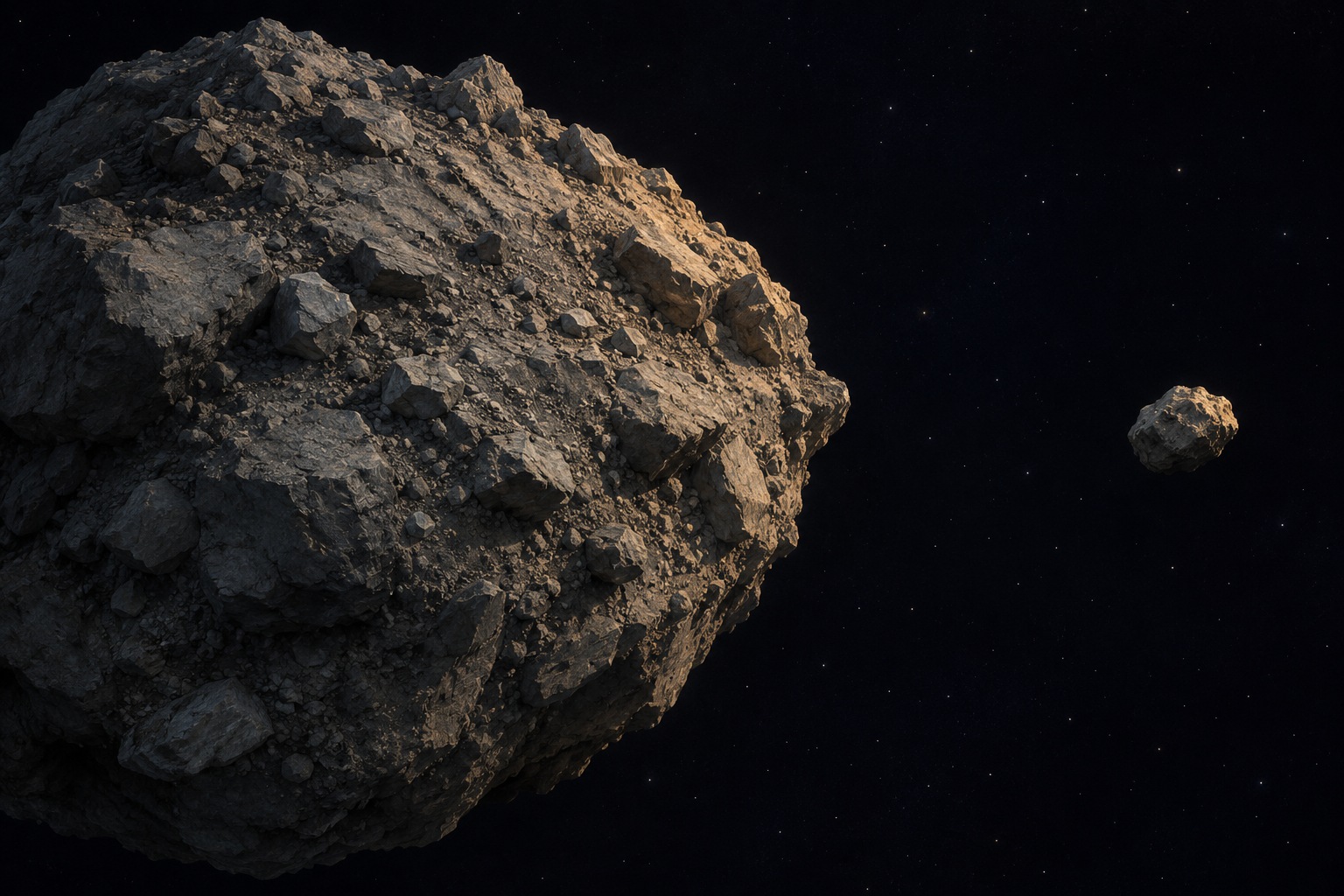
ESA’s Hera mission can now see two asteroids where its camera once saw one point of light. The larger object is Didymos. The fainter one is Dimorphos, the moonlet NASA deliberately struck with DART in 2022. Observers on Earth measured what happened to its orbit. Hera is approaching to investigate what happened to the rock. ESA’s separate detections of Didymos and Dimorphos.
The distinction matters if a future asteroid ever needs to be deflected. We know a spacecraft can alter an asteroid’s motion. However, to predict the effect of the next impact, researchers want to know how much of DART’s result came from the collision itself and how much came from the way Dimorphos responded.
What did DART measure at Dimorphos?
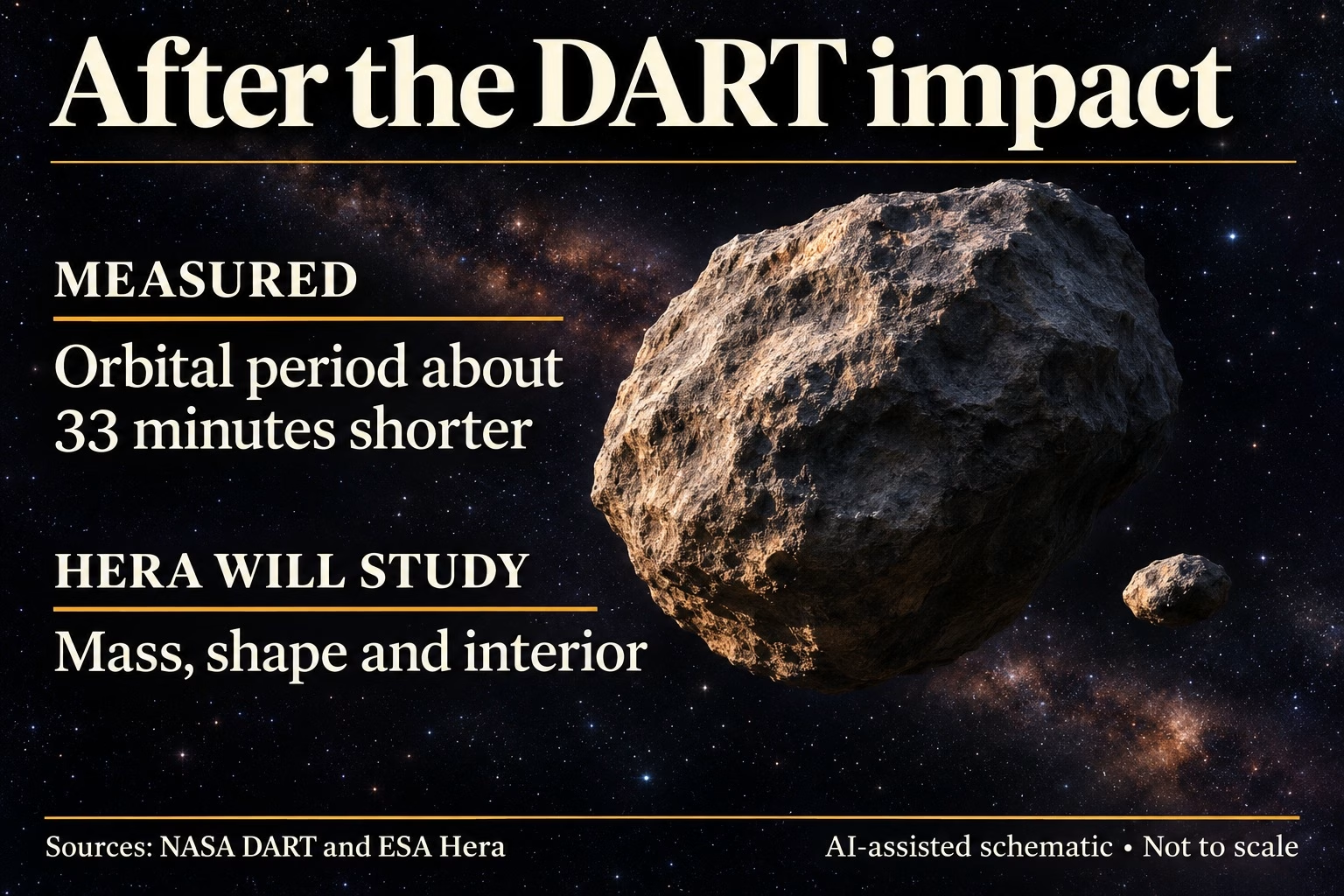
Before impact, Dimorphos took about 11 hours and 55 minutes to circle Didymos. Afterward, the period settled at about 11 hours and 22 minutes. A NASA-led analysis puts the difference at 33 minutes and 15 seconds. That is the change in the time it takes the moonlet to go around Didymos.
Earth-based telescopes could measure this change because the two objects periodically pass in front of one another or cast shadows. Those events change how much light reaches a telescope. Radar and other observations helped refine the orbit. By timing the pattern, scientists could measure the effect even when the two objects looked like a single light source. NASA’s follow-up analysis of the orbit and shape.
Why the Hera mission needs the moonlet’s mass
When DART hit, debris flew away. That outflow carried momentum, and the recoil gave the moonlet an extra push. The size of that contribution is one of the questions Hera can help answer. Researchers express the overall efficiency as a momentum enhancement factor, often written as beta.
To infer how much momentum was transferred, researchers need to know the mass of the body whose motion changed. Imagine seeing two carts pick up the same change in speed. The heavier one received more momentum. Likewise, the observed shift at Dimorphos leaves room for different estimates of the total push until its mass is better known. NASA’s explanation of the DART momentum analysis.
ESA plans to track features on the asteroid surfaces and measure changes in radio signals caused by tiny changes in motion. Both can constrain how the bodies move under one another’s gravity. The observations are planned for close range. For example, an approach image showing two separate objects helps the mission get there, while the mass measurement needs a longer record of their motion. ESA’s Hera mission overview and the mission team’s payload and operations summary.
What will Hera look for at the impact site?
Hera will study the moonlet’s shape and the area where DART hit. One possibility is that the collision left a distinct crater. Another is that it rearranged a substantial fraction of the small body. Images from DART show the terrain before the collision, while measurements from Earth constrain what followed. Close-up imaging and the Juventas CubeSat’s radar can help test different accounts of the surface and interior. ESA’s November mission briefing.
The next close views are still to come. ESA’s 27 October update announced plans to unveil detailed Dimorphos images on 25 November. For now, the two separate points tell us that the spacecraft can distinguish its targets. Once it is close enough, the surface and the motion of the pair can help explain how one collision changed that orbit.
For another example of how observers combine telescopes, cameras and other evidence to reconstruct what happened to a space rock, see our account of the Ribbeck fireball.



latest video


news via inbox
Subscribe to our Cosmic newsletter to get notified when we have new articles.