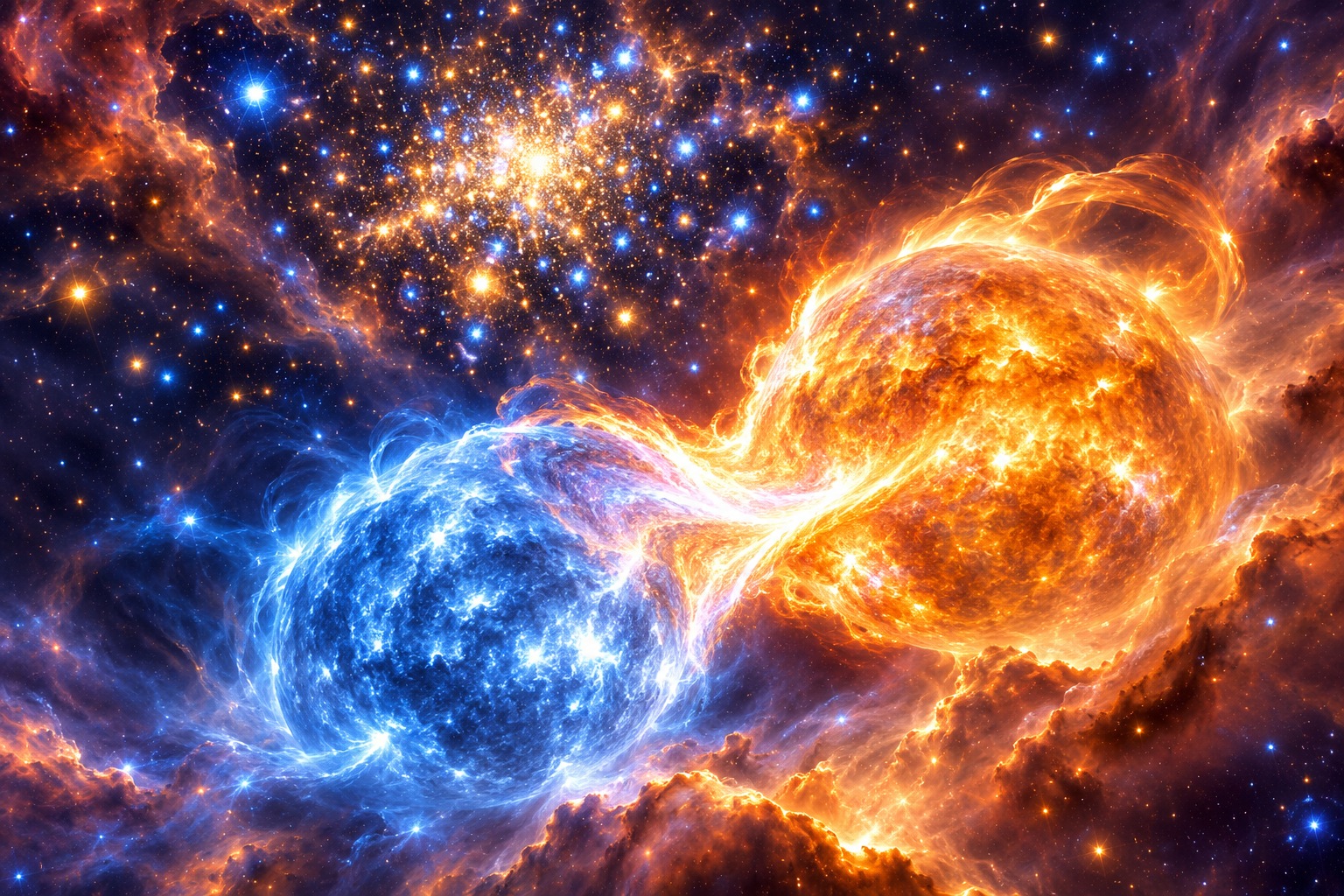
Stellar collisions offer a new route to the first giant black holes
Stars usually have plenty of room to miss one another. But stellar collisions may have helped build some of the universe’s first massive black holes, according to a new study that follows what happens when a young star cluster becomes an exceptionally crowded place.
The interesting part is the fork in the story. A collision can add material to a growing star. A more violent encounter can tear material away. The same crowded environment can therefore build a future black-hole seed or surround an existing black hole with gas.
A paper led by Claire E. Williams, published on 26 October 2026 in The Astrophysical Journal, explores those possibilities. Its connection to Webb’s mysterious little red dots is a proposed explanation to test, rather than an announcement that astronomers have identified every one of these objects.
What the stellar collisions study actually does
The researchers developed an analytical framework that tracks conditions at different distances from a cluster’s centre. They checked its predictions against Monte Carlo simulations and used high-resolution cosmological simulations to place the clusters in a broader early-universe setting. Both clusters with a central massive black hole and clusters without one enter the calculation. The open-access research paper explains the methods and assumptions.
That combination matters. An average density for a whole cluster can conceal a much busier central region. Likewise, the presence of a black hole changes the speeds at which nearby stars meet. Asking only whether a cluster is “dense” leaves out part of the physics.
This is a model of physical pathways. It is not a movie reconstructed from observations of a particular ancient cluster. The distinction lets us appreciate what it adds: a way to connect plausible starting conditions to outcomes that telescopes might eventually distinguish.
How stellar collisions can build or dismantle a star
Two stars are balls of hot gas held together by gravity. Their encounter need not resemble two solid objects bouncing off one another. The outcome depends on their motion and on how much material remains gravitationally bound after they meet.
In the study, relatively gentle collisions can produce mergers. Further mergers may then create a very massive star. Its eventual collapse offers a route to a heavier black-hole seed. By contrast, stars accelerated near an existing massive black hole can meet destructively, releasing gas into the central environment. UCLA’s account of the research describes these two branches.
Neither branch is a rule that every collision must follow. The starting population, the cluster’s structure and the time available all affect the result. A useful picture is a race: can a growing object acquire enough material before stellar evolution, mass loss or changes to the cluster interrupt the process?
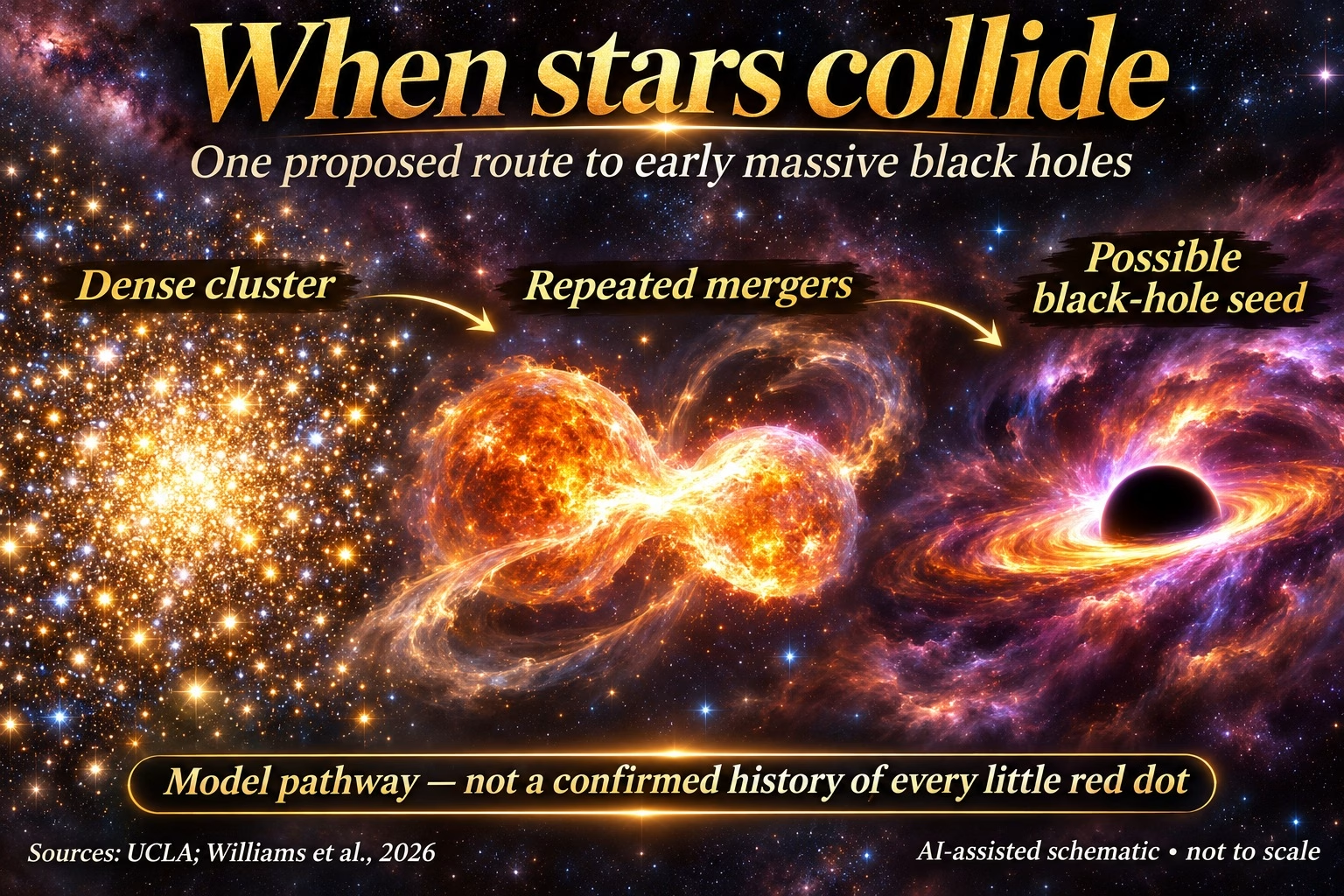
Stellar collisions and the little red dots connection
Little red dots are compact reddish sources in observations of the distant universe. Their appearance gives them a convenient name, but it does not by itself identify the engine producing their light. Reading an unresolved source requires spectra, size constraints and physical modelling together.
The paper’s abstract makes a specific connection: frequent destructive encounters could build extremely dense gas around a massive black hole, providing a possible analogue for little red dots. Elsewhere, repeated mergers in a cluster can help form a massive star before a black hole exists. These are related stages and environments, not interchangeable descriptions of one confirmed object.
This also complements our guide to proposed black hole stars. That article examines an enshrouded accretion engine. The new collision work asks how a crowded stellar neighbourhood might produce a seed or supply its surroundings with gas.
It is possible for more than one mechanism to matter across a population. Two sources with a similar broad appearance can have different histories. A successful explanation must account for the observations without assuming in advance that every red dot follows the same route.
A promising pathway with important unfinished physics
The paper explicitly leaves black-hole accretion and feedback outside part of its gas-buildup model. Gas released near a black hole is not automatically the same as gas swallowed by it. Some material may remain nearby, and some may be expelled. The authors also discuss the limited time for collisions and the effects of cluster disruption.
That boundary matters for the growth problem. Making a heavier seed helps, but a seed’s later development still depends on its environment. One cannot take a calculated gas supply and treat all of it as a measured increase in black-hole mass.
Model agreement is useful evidence of internal consistency. It does not replace a comparison with real sources. The next challenge is to connect predicted environments to observable signatures that competing explanations would struggle to reproduce.
What would make the case stronger?
For readers following future announcements, three questions are particularly useful. Do improved observations support the required compactness? Can the inferred gas properties fit a collision-rich environment? And does the explanation still work when the cluster’s evolution and the black hole’s response are treated in greater detail?
Those questions turn a dramatic phrase such as “stars colliding in the early universe” into a research programme. They also avoid a false choice between treating a model as proven and dismissing it because it is unfinished.
Astronomers already study black holes through many different signals. Our LOFAR deep-field report shows a different approach: tracing radio-emitting structures in a large population of sources. Here, the task is to understand how the earliest dense systems could have assembled their central engines.
The new work’s appeal lies in connecting those beginnings to ordinary gravitational physics under extraordinary conditions. A crowded cluster can be both a construction site and a source of debris. Which role dominates is something the model makes possible to investigate.
Sources and research details
- Williams, C. E., et al. (2026), A Cosmological Framework for Stellar Collisions at High Redshift in Proto-globular Clusters, Nuclear Star Clusters, and Little Red Dots, The Astrophysical Journal 1012, 1. DOI: 10.3847/1538-4357/aea577. Open access, CC BY 4.0.
- UCLA research announcement, 26 October 2026.


latest video



news via inbox
Subscribe to our Cosmic newsletter to get notified when we have new articles.