Project Capella: the UFO Database Plan Built Around Better Evidence
Project Capella tackles a question that sits underneath almost every UFO debate: what can investigators learn when the reports they want to compare use different definitions, different standards and different ways of counting an event?
A December 2008 proposal, released in the government’s seventh PURSUE tranche on 23 October 2026, offers a surprisingly practical answer. It sets out a data warehouse for Bigelow Aerospace Advanced Space Studies, or BAASS. Its most revealing passages concern source checking, selection bias and a reviewer who would be free to challenge the rest of the team.
The document deserves attention as a research plan. It does not, by itself, establish the origin of any reported object or demonstrate that every proposed capability was implemented.
What the Project Capella document is
The released record, DOW-UAP-D167, contains a proposal dated 10 December 2008 and three appendices. The cover identifies Documatica Research and calls it Report No. 001 to BAASS. The released version redacts personal names.
The official release description places the contractor record within the Defense Intelligence Agency’s Advanced Aerospace Weapon System Applications Program, AAWSAP. That context matters: a contractor’s suggested methods, an agency’s contractual objectives and an independently demonstrated discovery are different kinds of evidence.
For readers following the wider release, our examination of the Skinwalker Ranch investigation files concerns another part of that record. Capella’s central subject is the information system through which reports might become useful research material.
Why Project Capella proposed a warehouse
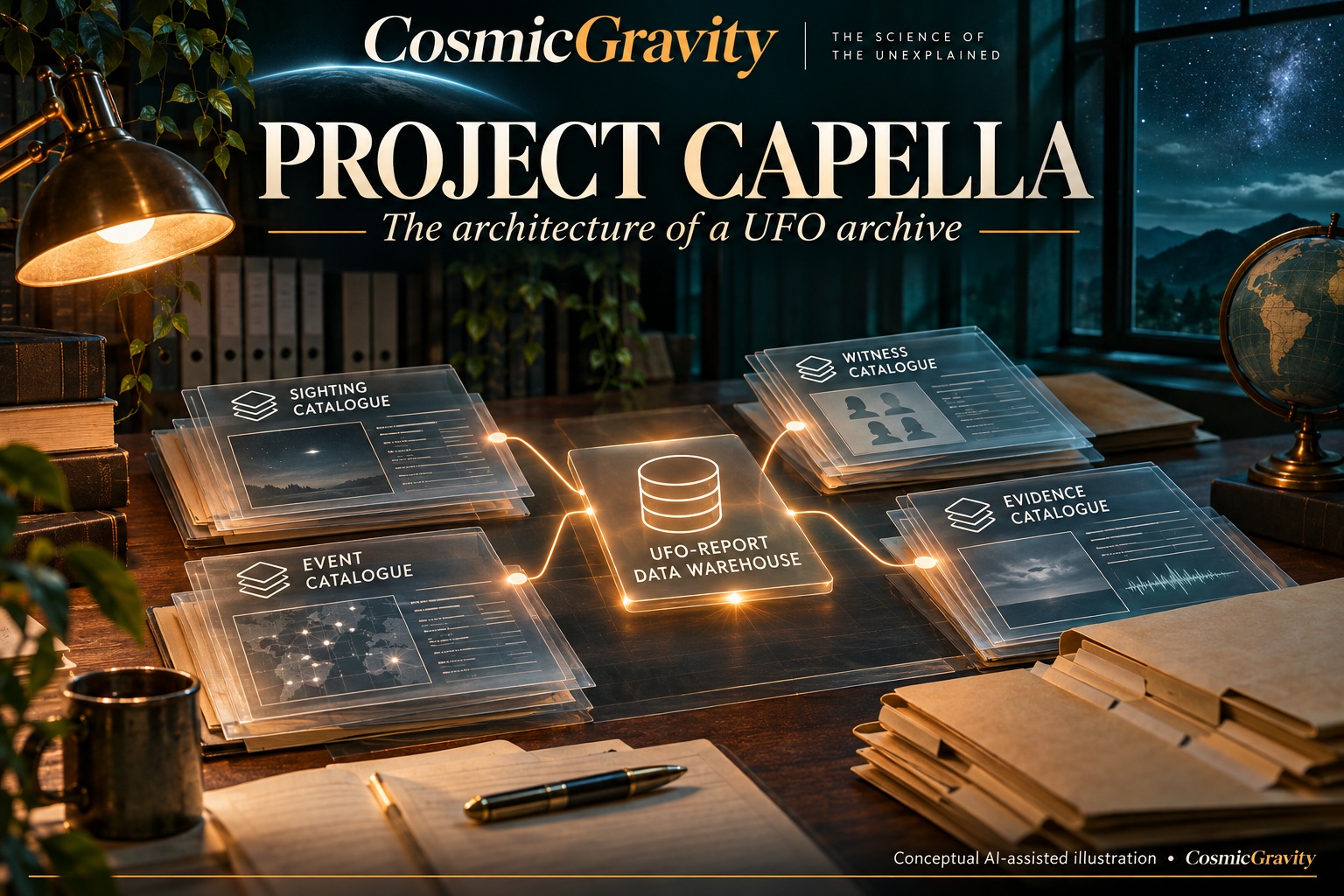
The report describes a fragmented field. Researchers had assembled catalogues about pilots, physical traces, particular countries and other specialised subjects. Yet their coding schemes and investigative standards differed. Files could become difficult to maintain when the people who built them moved on.
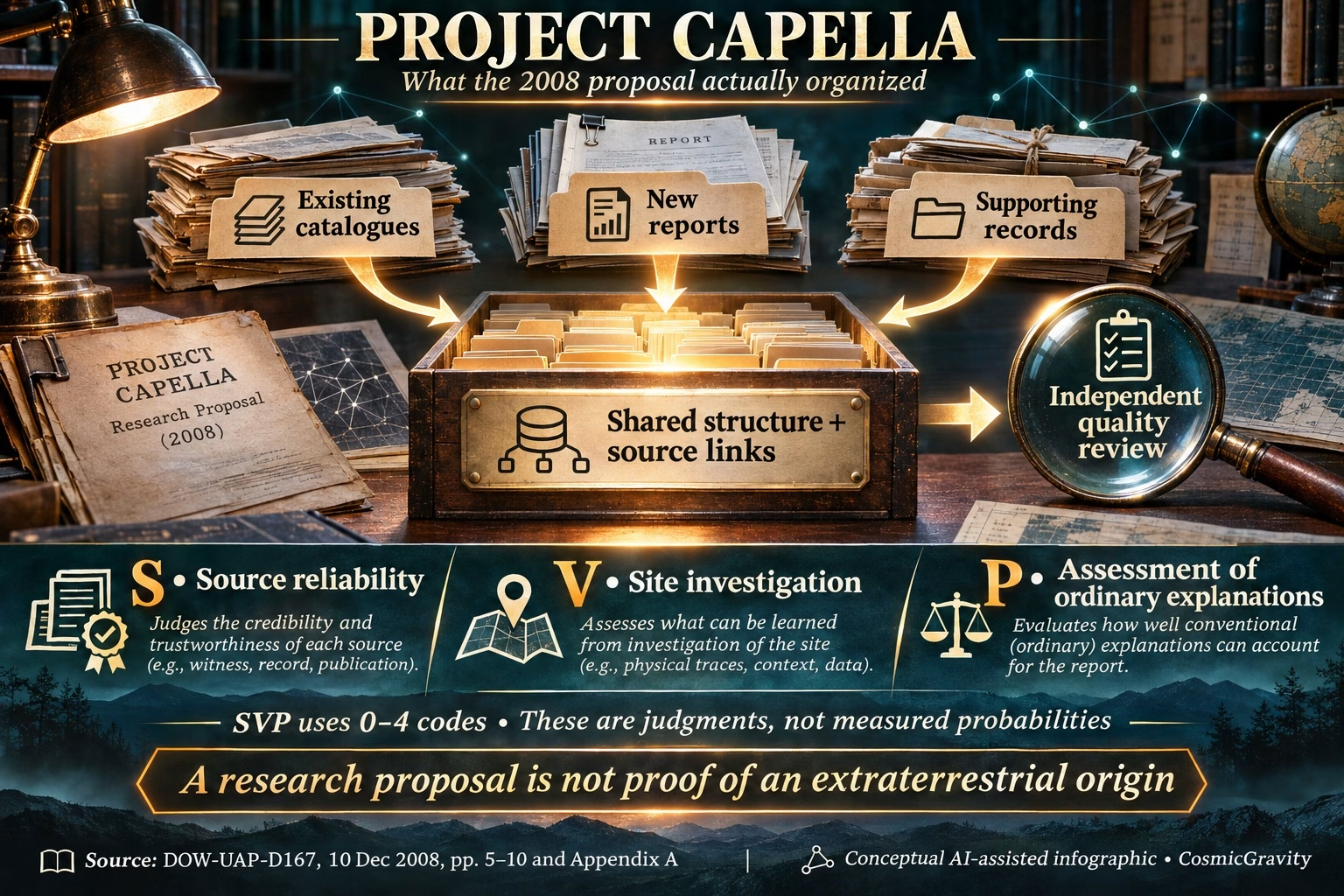
The Project Capella solution was more careful than simply pouring everything into one enormous list. The author argued that existing catalogues reflected different communities, interests and selection practices. A shared structure would sit across a family of files, allowing researchers to compare information while retaining links to its supporting material.
That distinction remains useful. A newspaper retelling, an interview and a radar record can all concern one event without being interchangeable observations. A good archive should make those relationships visible. Otherwise, repetition can look like independent corroboration, and a large collection can appear more conclusive than its contents justify.
In practical terms, Capella proposed starting with ordinary commercial software, including Excel. The text acknowledged that Excel was not a database system. Its attraction was accessibility: staff could sort, search and tabulate flat files without an elaborate custom platform. More ambitious collaboration tools and rules-based screening were presented as possible later extensions.
The independent reviewer in the plan
One of the strongest passages appears in the personnel section. Alongside a database administrator and a data analyst, the proposal called for a quality-control coordinator. This person would check sources and codes, look for inconsistencies and challenge the completeness of a file.
Crucially, the proposed reviewer would not report to the other warehouse team members and would be protected when questioning the data. That is a concrete organisational safeguard, rather than a vague promise to remain objective.
The plan also envisaged later statistical expertise and a further analyst to work through the multilingual literature. The distinction between collecting records and examining patterns is sensible. Before a pattern deserves an explanation, investigators need to know whether it survives corrections, duplicate detection and changes in the selection of cases.
This is our methodological reading of the proposal, not a claim that the released document proves the safeguard operated exactly as designed. Implementation would need to be assessed against later progress records and the resulting files.
How Project Capella’s reliability codes worked
Appendix A sets out an SVP credibility system, with each of its three positions assigned a value from zero to four. The positions concern the source, the level of site investigation and the investigator’s assessment of possible natural explanations.
These are ordinal judgments. They are not measured probabilities that a case is extraterrestrial. In particular, a high score for difficulty finding an ordinary explanation depends on the evidence available and the judgment of the person applying the code. It cannot turn missing information into a positive identification.
The appendix separately classifies reported behaviour, including close encounters, manoeuvres and flybys. Its text explicitly avoids assuming that a witness’s description is physically correct merely because an investigator has assigned it a category. This distinction is essential when catalogues contain both comparatively ordinary observations and much stranger claims.
A comparable lesson appears in GEIPAN’s approach to UFO investigation and classification: a label describes an assessment under a particular method. Readers still need to inspect the case evidence and the limits of the investigation.
Unusual experiences still need separate tests
Capella’s scope extended beyond an object’s apparent flight. Another appendix discusses six layers of information, ranging from physical descriptions to psychological, physiological, claimed psychic and cultural effects. It also advances speculative ideas about how anomalous experiences might be interpreted.
Those discussions are part of the authors’ framework. Their inclusion in an officially released contractor record does not establish that the proposed mechanisms exist. Equally, preserving a witness’s account need not mean dismissing it or accepting every interpretation attached to it. An archive can retain testimony while keeping it distinct from independently measured effects.
The same care applies to witness privacy. The proposal recognised that access controls could protect personal information and that cooperation with other catalogue owners would require attention to permissions. A useful research collection is more than a list of dramatic incidents.
What the released proposal can actually tell us
Project Capella documents an effort to make dispersed UFO reports more comparable, searchable and open to internal challenge. It gives readers a tangible way to ask better questions about later claims concerning large databases: how were entries counted, which sources were preserved, and who checked the coding?
It does not answer those questions for every subsequent version of the warehouse. Nor does the proposal alone establish the collection’s final size, present custody or scientific results. Those claims require their own records.
The most durable idea here is straightforward. Taking UFO reports seriously includes taking their weaknesses seriously enough to record and test them. Capella’s proposed independent reviewer understood that an interesting pattern is only as reliable as the observations that produced it.
Source note: this article distinguishes the December 2008 proposal from the October 2026 release. The official record and its page-by-page transcription and scan viewer allow readers to check the overview, personnel section and Appendix A. Machine transcription can contain errors; the released scan remains the underlying record.

latest video



news via inbox
Subscribe to our Cosmic newsletter to get notified when we have new articles.