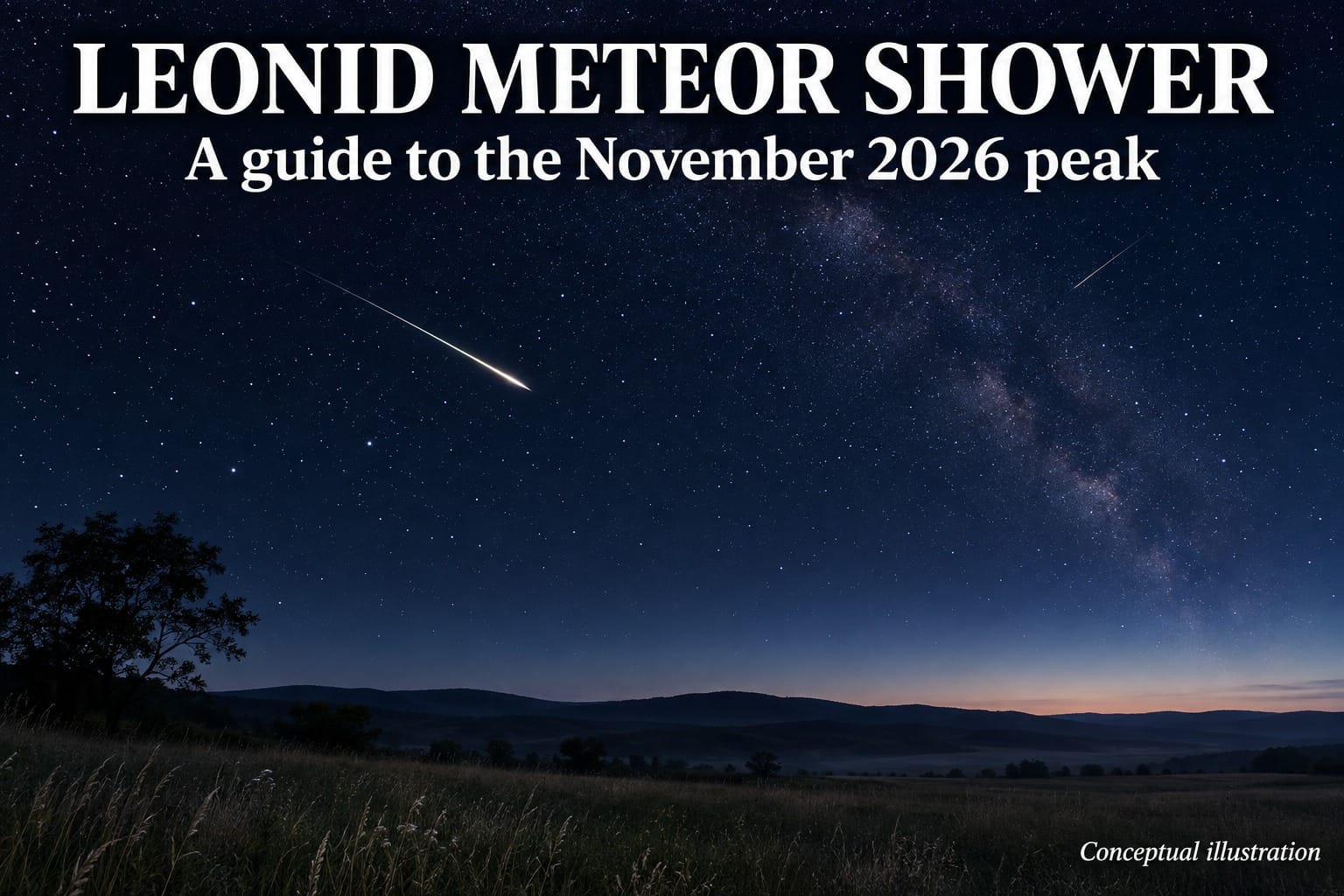
When and Where to Watch the Leonid Meteor Shower in 2026
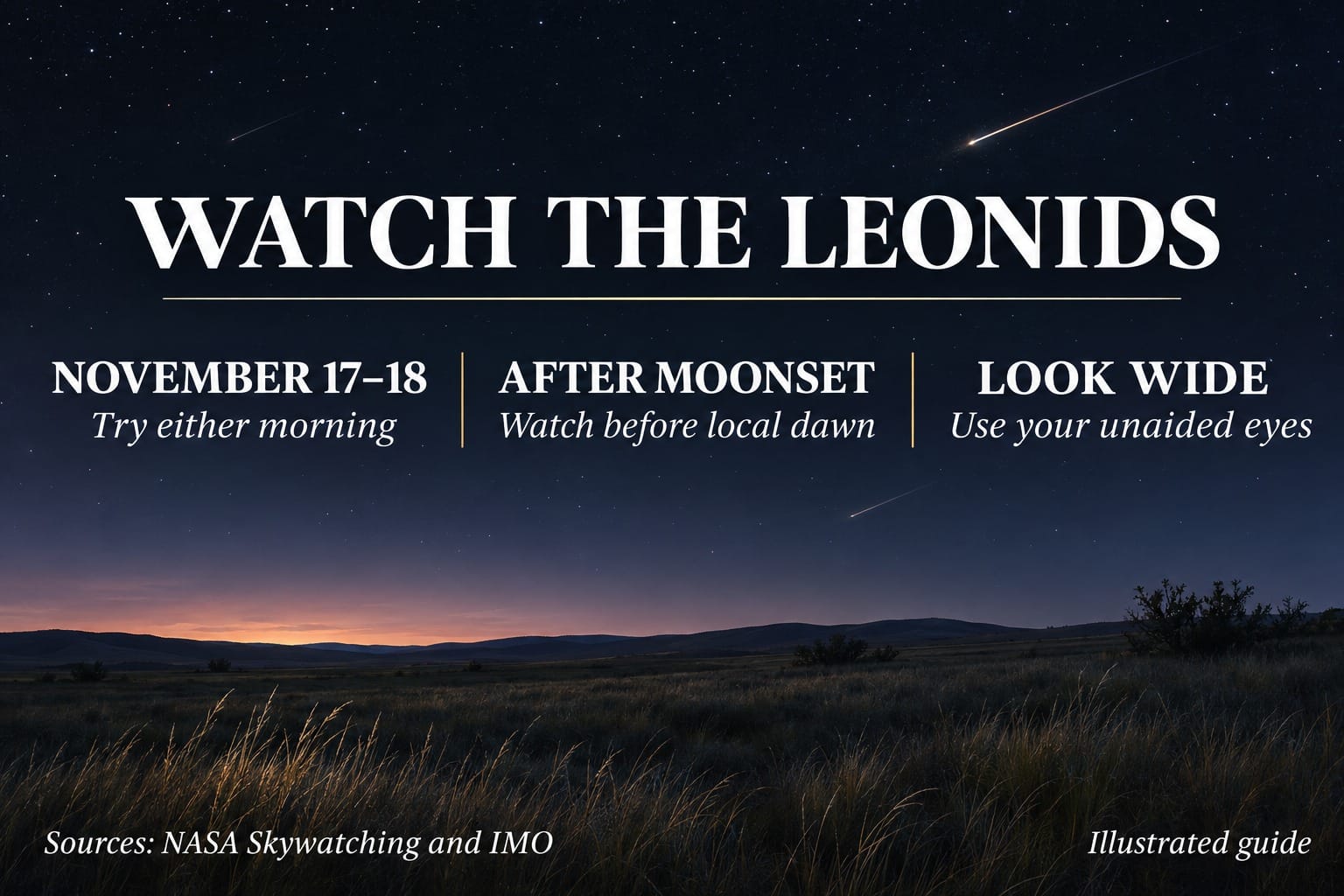
The Leonid meteor shower in 2026 gives skywatchers two good mornings to try. Set aside time before local dawn on 17 or 18 November, ideally after the Moon has set. The hours when Leo is up and the sky is still dark matter more for a casual observer than the exact minute of the predicted peak. NASA’s November 2026 skywatching guide.
When does the Leonid meteor shower peak?
The International Meteor Organization’s technical calendar puts the regular crossing near 23:45 UTC on 17 November. The same calendar cites another forecast that places a maximum earlier that day, and it lists several possible encounters with sparse trails. These are forecasts of when Earth meets denser parts of the stream. They do not put a dark sky or the shower’s radiant above every observer at once. IMO technical calendar, Leonids section.
For the Netherlands, the technical calendar’s 23:45 UTC time is 00:45 CET on 18 November. Even if you can start then, the time before dawn gives Leo longer to climb. In another time zone, use 17 and 18 November as local observing mornings and check when moonset and dawn occur for your town. Cloud cover can make the choice between those mornings for you.
Where should you look?
Go somewhere with an open view and limited artificial light. Once your eyes have adapted, watch a broad stretch of dark sky with your unaided eyes. Binoculars narrow the view. If you know where Leo is, look some distance away from it. A Leonid’s track, extended backward, points toward the radiant in Leo, but the streak itself can appear elsewhere. Meteors close to the radiant tend to show shorter trails because you are looking closer to the direction they are travelling from. NASA’s Leonids viewing tips.
Give yourself time to settle in. Pick a spot where you can sit or lie back and see a large area of sky without craning your neck. A bright phone display can spoil your dark adaptation. If the Moon is still up and you want to start early, keep it outside your field of view and watch the darkest part of the sky. Spain’s National Geographic Institute observing guidance.
How many meteors could you see?
The technical calendar gives a zenithal hourly rate of roughly 15 around the usual maximum. That is a standardised rate for a very dark sky with the radiant overhead. A lower radiant, a bright sky or a bank of cloud reduces the number visible from any one place. Actual meteors can also arrive in bunches with quiet gaps between them. If you are planning an outing, expect a modest shower with a chance of a bright, fast streak.
The Leonids come from dust shed by comet 55P/Tempel–Tuttle on past visits to the inner Solar System. Historical Leonid storms occurred when Earth crossed especially dense trails. The trails listed for 2026 are expected to be weak. If you see a bright meteor, note the local time, where you were and the start and end directions of the streak. That record can help distinguish a Leonid from a stray meteor or another active shower. How observers identified and tracked a different fireball over Ribbeck.



latest video


news via inbox
Subscribe to our Cosmic newsletter to get notified when we have new articles.