The FBI’s 2026 UAP Videos: Credible Witness, Unresolved Lights
A bright light near the horizon can be almost anything: an aircraft approaching head-on, a planet seen through unstable air, a drone, a flare or a distant tower. Two lights that rotate around one another are harder to dismiss—but they are not automatically extraordinary.
In June 2026, the FBI released a small group of UAP videos and related records through the growing federal disclosure process. The footage was recorded in the northeastern United States by a witness the FBI described as highly credible. The incidents occurred in an area familiar to that person, reducing the chance that an ordinary landmark was simply unknown to them.
The description strengthens the case. It does not solve it. The FBI 2026 UAP videos remain an example of evidence that deserves attention while still falling short of a definitive identification.
What PR-001 reportedly shows
FBI-UAP-PR001 was recorded in November 2021 at around five in the morning. According to the FBI-derived description published with the release, the witness saw a bright source near the horizon at an estimated distance of roughly 2,000 feet.
The light first appeared to be a single intense object. It then resolved into multiple lights that seemed to move erratically in relation to one another. The group drifted slowly from left to right.
The witness used an iPhone 12 Pro. That detail matters because a smartphone applies automatic exposure, focus, stabilisation and digital processing. These features can help produce a viewable clip in darkness, but they can also distort small bright objects.
What PR-002 adds
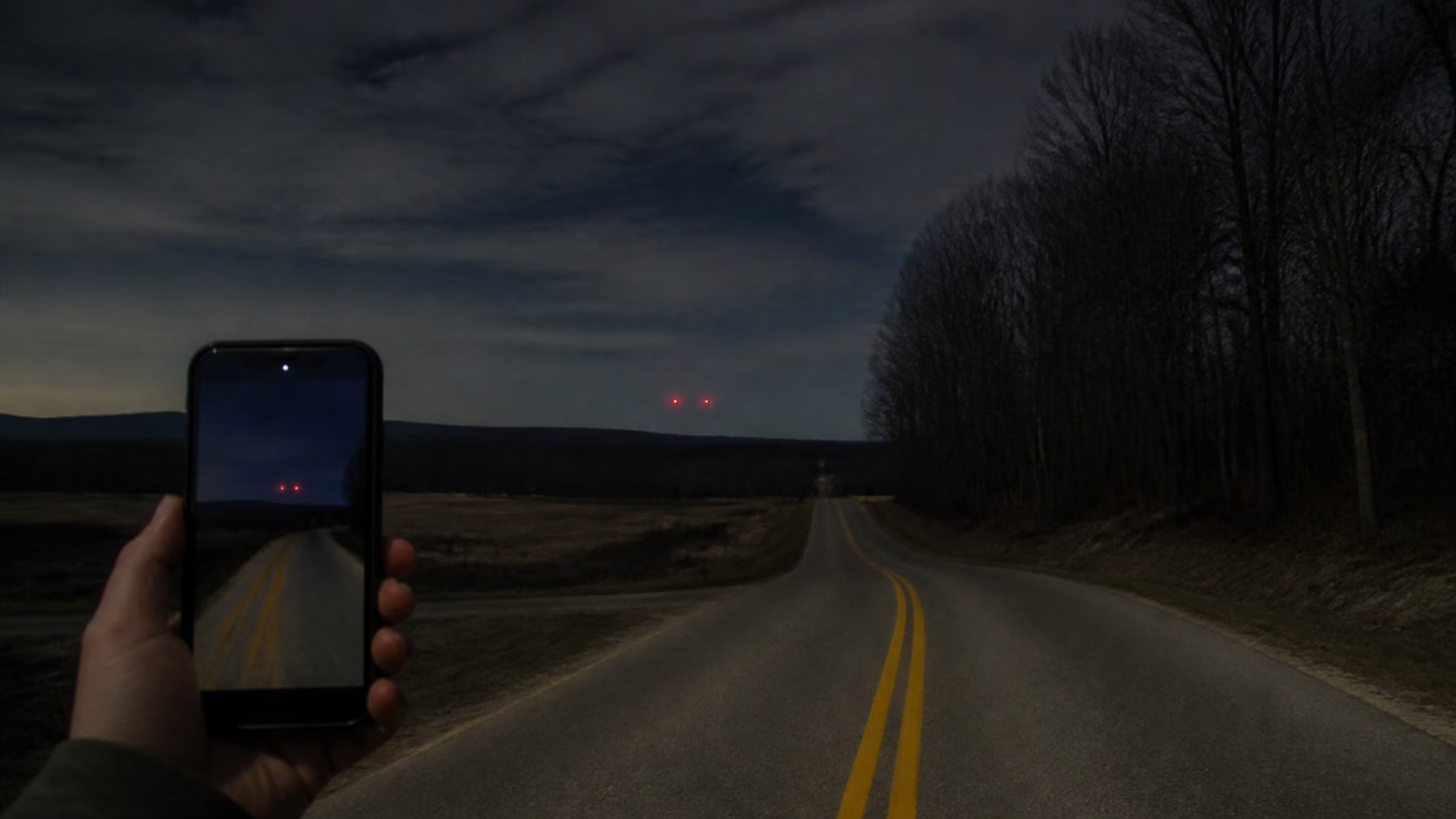
A second incident occurred in March 2022 at about 7:20 in the evening. The witness observed two bright red light sources near the horizon, estimated to be approximately 2,500 feet away.
The lights remained generally stationary. The lower source appeared to rotate slowly around the upper light, moving from a six-o’clock position to beyond nine o’clock. No sound was reported.
The two events reportedly came from the same general area, and the FBI connected the videos with several related documents. Repetition in a familiar location can improve the evidential value, especially if environmental and astronomical conditions differ between nights.
It can also point to a recurring conventional source. A fixed flight path, distant approach corridor or regularly launched device could produce similar observations. The location deserves investigation precisely because both possibilities exist.
What “highly credible” means
Credibility is often misunderstood in UAP discussions. A credible person can accurately report what they saw and still misidentify its cause. The FBI’s assessment tells us that the witness was taken seriously and that the account was not dismissed as a prank.
It does not mean the Bureau certified the lights as non-human technology. Credibility applies to the witness; identification applies to the phenomenon.
That said, witness quality matters. Someone who knows the terrain, normal aircraft traffic and fixed lights has a stronger baseline than a tourist seeing the area for the first time. Multiple observations by the same credible witness justify a structured effort to reproduce and explain the event.
The problem with estimating distance at night
A lone light against a dark sky provides almost no scale. Without a known object beside it, the same angular size could describe a small nearby drone or a large distant aircraft. Human vision often supplies a distance based on intuition rather than measurable cues.
If the estimated 2,000 to 2,500 feet is wrong, calculations of size and speed change completely. A source near the horizon could be kilometres away. Apparent motion between lights could come from camera movement, atmospheric distortion or separate objects at different distances.
This does not make the observation imaginary. It limits which physical claims can be derived from it.
Why the rotating motion is interesting
The reported rotation is the most distinctive feature. Multiple lights changing position relative to one another can indicate a structured object, several coordinated objects or the optical blending of independent sources.
Smartphone autofocus can make a bright point expand, contract and split. Hand movement can cause one light to trace a path around another, especially when electronic stabilisation treats the brighter source as an anchor. Atmospheric turbulence can also make low-altitude lights flicker and shift.
These possibilities should be tested against the original full-resolution files, including frame timing and image metadata. If the relative movement remains after stabilising the background, it becomes much harder to attribute to simple camera shake.
What a proper investigation would need
The most useful next step would be a reconstruction from the original observation point. Investigators could map the horizon, identify towers and roads, check commercial and military flight tracks, examine satellite positions and review weather data.
They could also place calibrated cameras at the location and wait for recurrence. A wide-field camera would preserve the surroundings while a second instrument captured detailed light. Passive radar or radio-frequency monitoring could add independent information.
If the phenomenon appears again, simultaneous observation from two locations could establish distance through triangulation. That single improvement would transform the analysis.
Why the FBI release matters
The footage is not the strongest UAP evidence ever published. Its importance lies in origin and context. The FBI retained the material, described the witness as highly credible and transferred the files into an official release system.
This adds another institutional strand to the disclosure record. Military agencies are not the only bodies holding UAP material. Civilian law enforcement, aviation, intelligence, nuclear regulators and diplomatic services have all produced or preserved relevant records.
The accumulation is significant. It shows a phenomenon reported by serious people across different systems. That does not force every case into one explanation, but it makes blanket dismissal increasingly difficult.
Unresolved is a beginning, not a conclusion
The videos leave us with two avoidable mistakes. One is to label the lights alien because the witness was credible. The other is to dismiss them because smartphone footage can be deceptive.
The correct response is investigation. Preserve the original files. Reconstruct the viewing geometry. Test conventional explanations. Publish the method and show which questions remain.
Something unusual was reported more than once from the same region. The FBI considered the witness credible enough to document. That is not the final answer, but it is more than a story without a source.
Related reading


latest video

news via inbox
Subscribe to our Cosmic newsletter to get notified when we have new articles.