How Scientists Search for Life in Alien Atmospheres
We cannot scoop air from a planet hundreds of light-years away. We cannot send a probe there, and even the most powerful telescope sees most exoplanets as little more than changes in light. Yet astronomers are beginning to ask what those distant atmospheres contain—and whether their chemistry could reveal life.
The search focuses on exoplanet biosignatures: gases or chemical patterns that may be produced by biology. The word “may” is essential. Oxygen, methane and other interesting molecules can also arise without life.
A credible detection will probably not arrive as one dramatic signal. It will emerge from several pieces of evidence that make sense together and resist non-biological explanations.
Reading an atmosphere through starlight
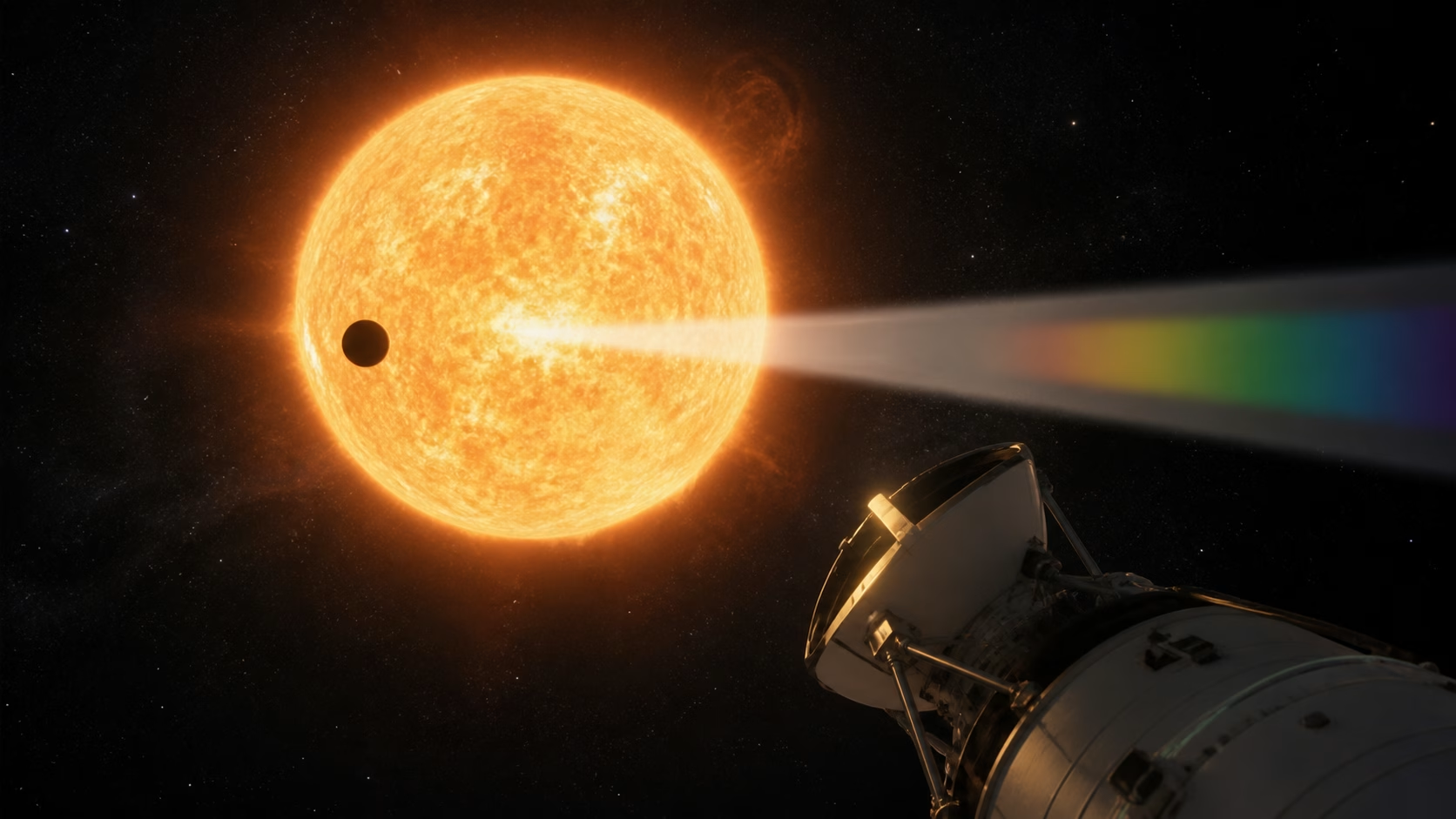
When a planet passes in front of its star, a small fraction of the starlight filters through the planet’s atmosphere. Molecules absorb particular wavelengths, leaving narrow features in the spectrum.
This technique is called transmission spectroscopy. It allows instruments such as the James Webb Space Telescope to detect gases including water vapour, carbon dioxide and methane under favourable conditions.
The measurement is delicate. The atmosphere may alter only a tiny fraction of the already small dip in starlight caused by the planet. Stellar activity, instrument noise and clouds can hide or imitate the signal.
Why one gas is never enough
Oxygen sounds like an obvious sign of life because photosynthesis maintains much of Earth’s atmosphere. But ultraviolet light can split water or carbon dioxide and leave oxygen behind on a lifeless planet.
Methane is produced by many organisms on Earth, yet geological reactions can also create it. Water is necessary for life as we know it, but a wet planet is not automatically inhabited.
The more useful clue is chemical disequilibrium: gases that should rapidly react and disappear but remain present together. On Earth, the combination of oxygen and methane requires continuous replenishment.
Even that pattern needs context. Researchers must understand the star, planet, surface and atmospheric chemistry before calling it biological.
The star can fool us
A planet’s spectrum is measured against light from its star. Starspots, flares and bright regions can alter that light. If the planet crosses one part of the stellar surface while the telescope uses another part as a reference, the resulting signal may resemble molecules in the planet’s atmosphere.
Small red-dwarf stars are especially active. They are attractive targets because an Earth-sized planet blocks a larger fraction of their light, but stellar contamination can be severe.
Repeated observations and models of the star are therefore part of biosignature science. The planet cannot be interpreted in isolation.
Clouds, haze and hidden surfaces
Clouds can flatten atmospheric spectra, concealing the deeper layers where important gases reside. Haze can produce slopes that are difficult to distinguish from other effects.
A detected gas also says little about conditions on the surface unless temperature and pressure are known. Water vapour can exist above a gas giant or a world with a runaway greenhouse. Carbon dioxide can accompany a temperate climate or a crushing Venus-like atmosphere.
Researchers combine mass, radius, orbit and stellar energy to estimate which scenarios are plausible.
What Webb can and cannot do
Webb has already demonstrated that it can identify molecules in exoplanet atmospheres. It detected clear carbon dioxide in the hot gas giant WASP-39 b and has measured methane and carbon dioxide in other worlds.
Gas giants provide strong signals because their atmospheres are large. Rocky planets are much harder. Their atmospheres are thin, their signals are weak and many orbit active stars.
Webb may identify promising chemistry in selected nearby systems, but confirming an Earth-like biosphere will probably require future observatories designed to directly image rocky planets and suppress the overwhelming light of their stars.
Why possible DMS made headlines
Dimethyl sulfide, or DMS, became widely discussed after observations of K2-18 b. On Earth, much DMS is produced by marine microorganisms. Early analyses reported a possible signal, followed by debate and additional observations.
The case shows how frontier science works. A tentative feature is not a discovery. Researchers test different data reductions, compare instruments and ask whether other molecules could produce the same pattern.
Even a secure DMS detection would need an understanding of unfamiliar non-biological chemistry on a planet unlike Earth.
A ladder of confidence
Scientists increasingly describe biosignatures as levels of confidence rather than a yes-or-no label. First comes a signal. Then confirmation that it belongs to the planet. Next comes identification of the molecule, followed by tests of biological and non-biological production.
Other gases, climate models and geological context build or weaken the case. Independent teams must reproduce the result.
A strong claim might combine water, a temperate environment, multiple gases in disequilibrium and the absence of credible abiotic sources. None of those alone is conclusive.
What discovery would mean
The first accepted evidence may describe microbes rather than intelligence. Even so, it would transform our understanding of life. Two independent origins in one galaxy would imply that biology can emerge more than once and may be widespread.
A non-detection also teaches us. If many apparently habitable planets show sterile atmospheres, life’s origin may be rare or difficult to sustain.
The search is slow because the question deserves caution. False certainty would damage the field. Excessive skepticism could cause a genuine signal to be overlooked.
Somewhere between those risks lies the scientific path: gather better spectra, state uncertainty clearly and let multiple lines of evidence converge.
Related reading

latest video

news via inbox
Subscribe to our Cosmic newsletter to get notified when we have new articles.