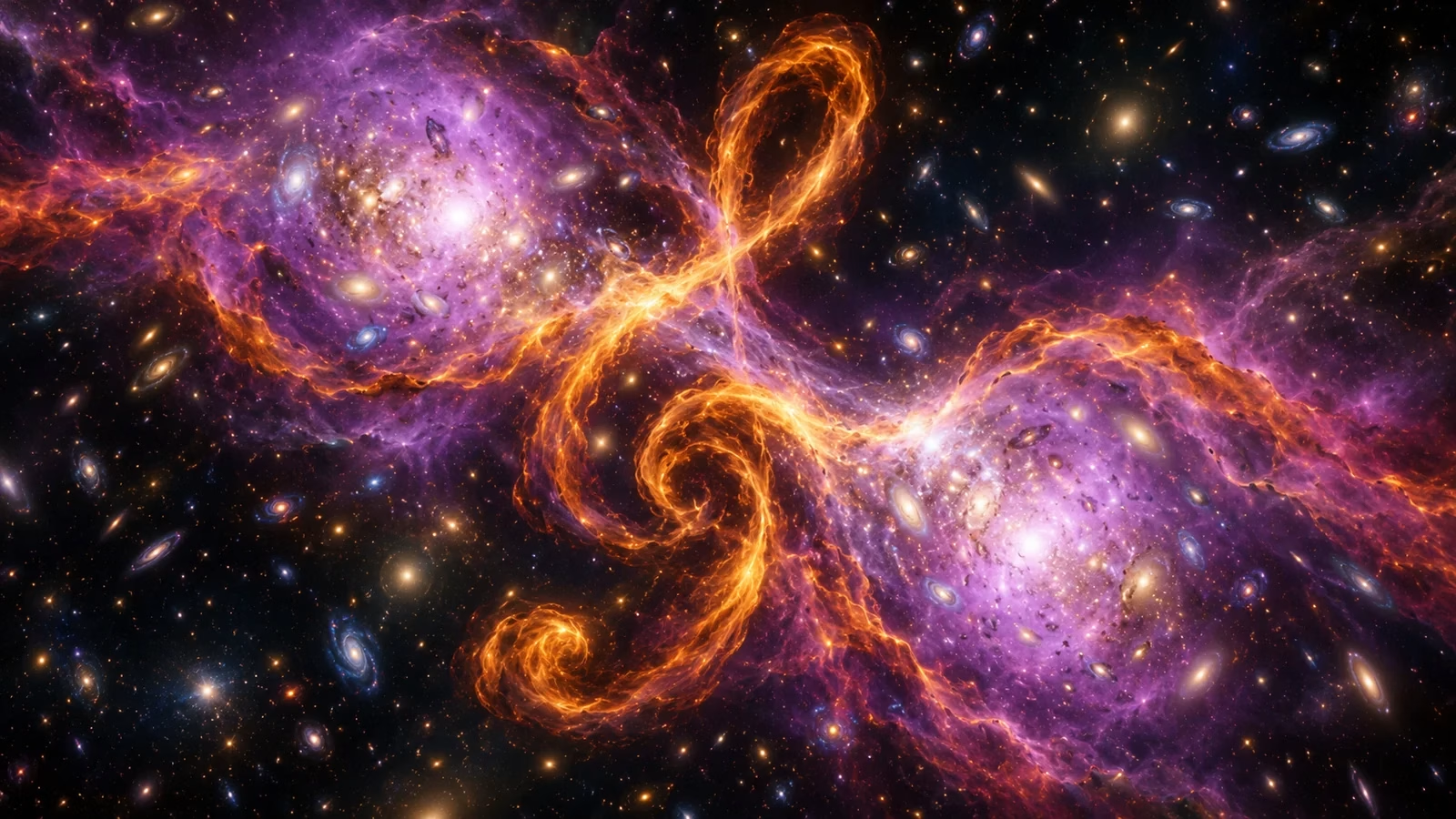
A Cosmic “Treble Clef” May Be the Echo of Two Violent Events
Feature image: AI-generated editorial illustration; not an observation or verified reconstruction.
The Treble Clef galaxy cluster has given astronomers a striking shape to explain. In radio observations, a curling structure resembles the symbol at the start of a musical score. A new analysis points to a possible history involving a black hole outburst and a collision between galaxy clusters.
NASA highlighted the research on 14 October 2026. The proposed explanation is that old radio-emitting material became bright again as the clusters merged. NASA’s account describes the two-stage interpretation.
What the Treble Clef galaxy cluster observations reveal
The view is difficult because the object lies behind the plane of our Milky Way. Combining observations at different wavelengths helps astronomers work around that obstruction. Chandra and eROSITA trace hot gas; radio observations reveal the unusual filaments.
Each dataset answers a different question. A single colourful image can hide that division of labour. The colours in a composite are a way to display measurements that human eyes cannot see directly.

Why researchers call it a radio phoenix
The research paper, led by Andrea Botteon and colleagues, classifies the source as a radio phoenix in a massive, merging cluster. The name describes ageing radio-emitting plasma that becomes observable again after its environment changes.
In the proposed sequence, a supermassive black hole first expelled energetic material. That material faded as its particles lost energy. Later, the cluster merger compressed or reenergized it. The spectacular shape may therefore record more than one episode in the cluster’s history.
A good explanation still leaves questions
The paper treats the role of merger-driven gas motions in shaping the intricate filaments as an interpretation to investigate. It also identifies this source as a useful target for future high-resolution observations at very low radio frequencies.
That makes the result more interesting than a tidy resemblance. Further observations could test whether the proposed physical history explains the detailed structure, rather than just its broad appearance.
Does the musical shape mean anything?
The nickname is memorable, but resemblance does not establish a connection to music. Humans are good at finding familiar outlines in unfamiliar scenes. Here, the scientific questions concern the emitting material and its environment.
The image is the invitation. The measurements are what let astronomers begin reconstructing the story behind it.
Continue exploring
A dark-matter-dominated galaxy candidate
Sources and further reading



latest video



news via inbox
Subscribe to our Cosmic newsletter to get notified when we have new articles.