A Bronze Ring From Sunken Alexandria Carries a Lost Wonder’s Image
A Lighthouse of Alexandria bronze ring has brought one of antiquity’s great landmarks into view on a much smaller scale. Underwater excavators found the seal-ring in the submerged palace area on Antirhodos, an island in the city’s ancient royal harbour. Its relief depicts the famous Pharos lighthouse.
The European Institute for Underwater Archaeology announced the discovery on 7 October 2026. The find invites two questions: what can its image tell us about the lost structure, and why was a lighthouse seal in a palace?
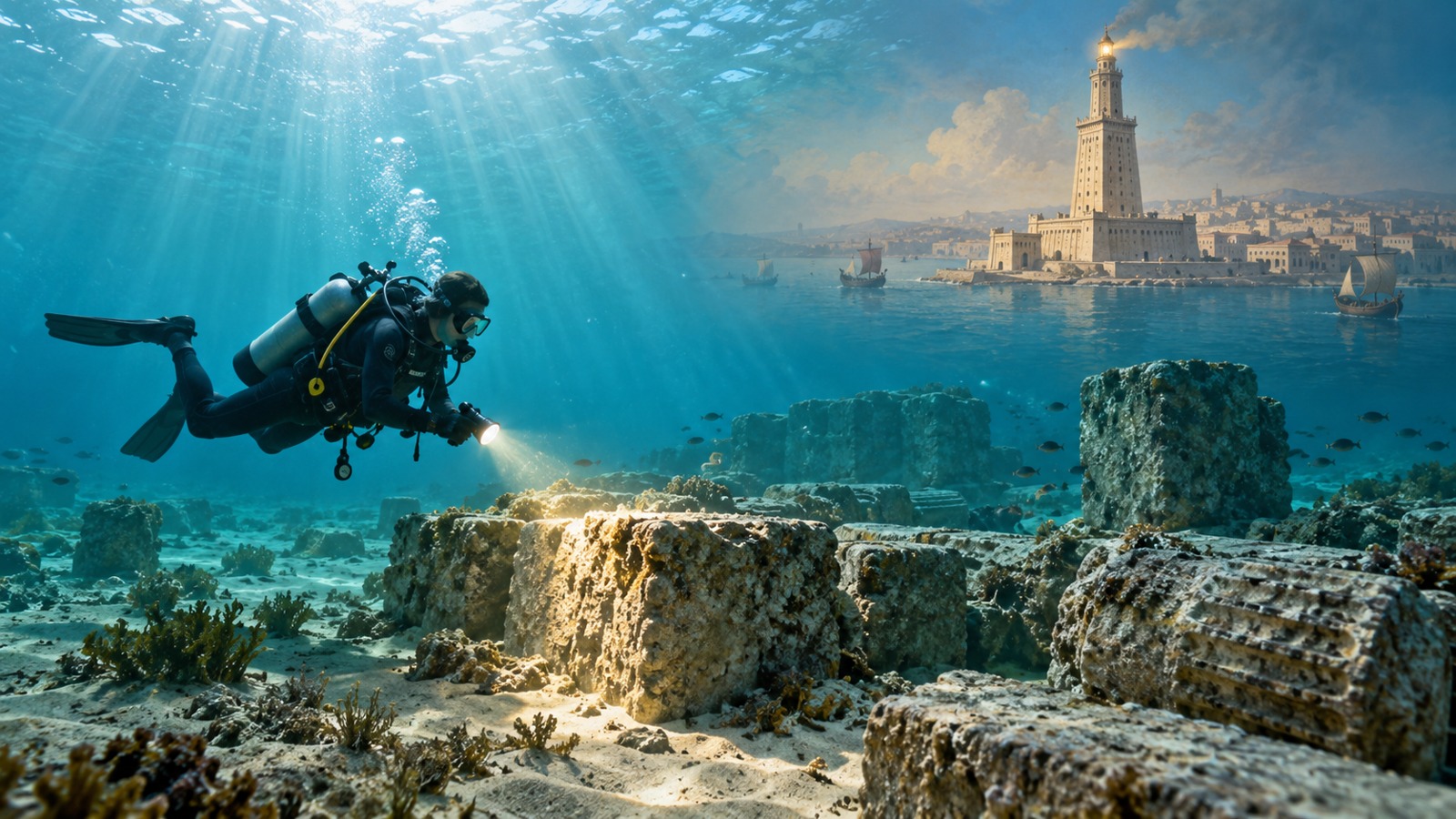
Original AI-assisted CosmicGravity illustration of underwater archaeology and an imagined Pharos. It does not depict the excavation, the recovered ring or an established reconstruction of the lighthouse.
What the Lighthouse of Alexandria bronze ring reveals
In the excavation team’s announcement, the object is described as the first known ring-signet depicting the lighthouse. Its imagery resembles representations on some second-century AD coins. A small pierced tab on the opposite side allowed suspension from a cord.
However, that is a more specific discovery than finding the first ancient picture of the monument. Other representations already exist. The interest here is the combination of the image, the seal’s function and its archaeological setting.
The announcement includes photographs of the actual object. Readers can compare those with the team’s description; our feature illustration supplies context rather than replacing the artefact record.
Dating the Alexandria bronze ring
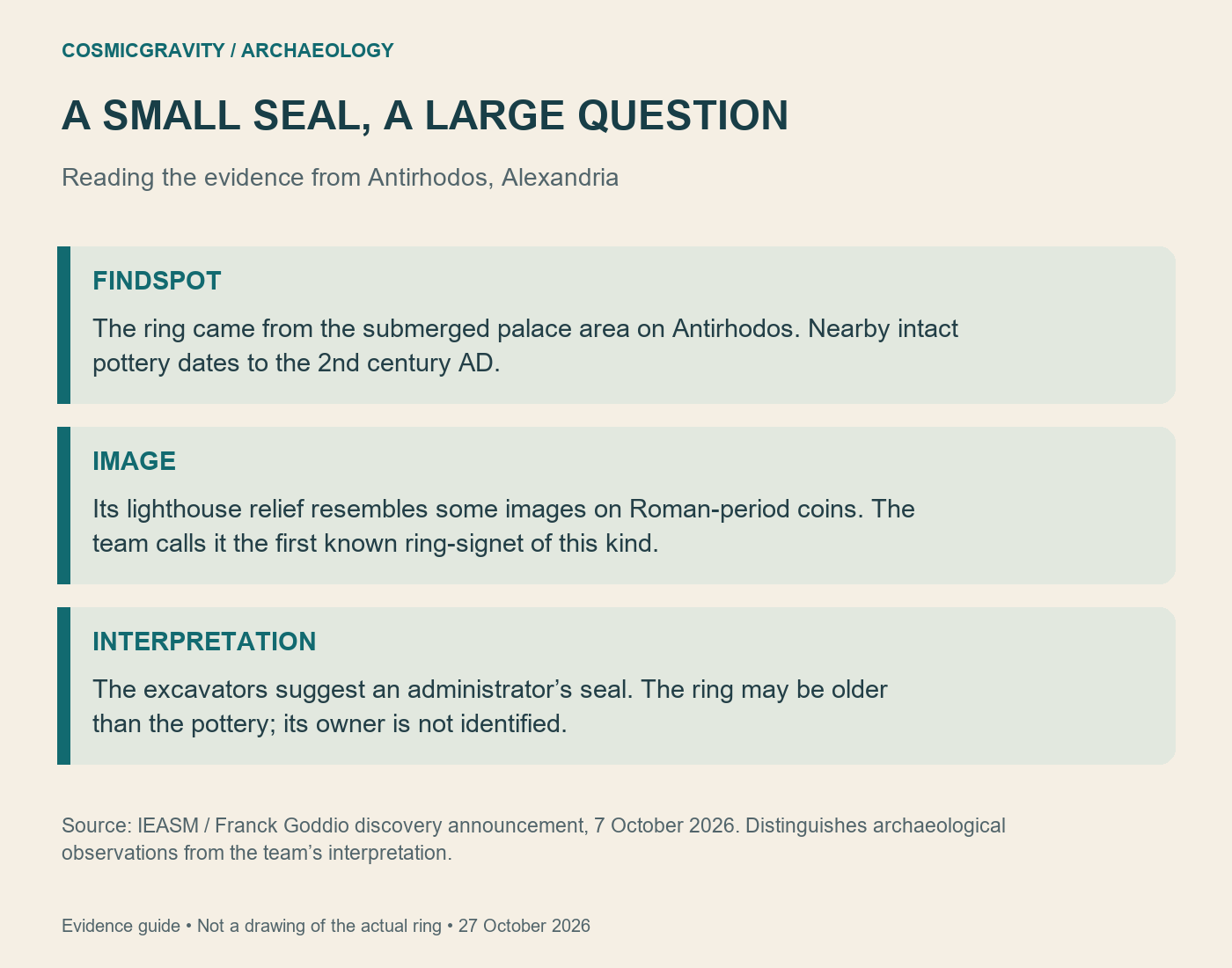
The ring lay closely associated with intact ceramics from the second century AD. The team says the ring could be older, while interpreting the context as evidence of its use in that period.
Those are different propositions. An object can remain useful long after its manufacture. Consequently, dating nearby material does not, by itself, identify the year someone made a ring or the person who wore it.
This distinction helps keep a small discovery from acquiring an unnecessarily precise story. A seal can connect an object with an activity without supplying a complete biography.
Did a lighthouse administrator work in the palace?
Franck Goddio’s team proposes that part of the former Ptolemaic palace housed administrative functions during Roman occupation, possibly including an office connected with the lighthouse. That is the excavators’ interpretation of the findspot and imagery. Yet the announcement does not name an owner.
The appealing possibility is practical: behind a celebrated monument stood people who managed a working harbour. The ring may help explore that less visible history, alongside the familiar question of what the lighthouse looked like.
A royal waterfront beneath the sea
The Alexandria project’s background account places Antirhodos within the Portus Magnus, the city’s eastern harbour. Its royal quarter included palaces, temples, gardens and harbour structures. Natural processes, including earthquakes, helped submerge parts of this coastline.
IEASM began exploring the area in 1992 with Egyptian antiquities authorities. Electronic surveys and targeted archaeological work have helped map remains beneath the sediment. An isolated find gains meaning through that larger record of places and relationships.
For more discoveries that connect objects with the societies around them, browse our ancient civilizations coverage. Here, the strongest story is already compelling: a tiny seal has survived in a drowned royal district, carrying an image of a landmark that no longer stands.
editor's pick



latest video


news via inbox
Subscribe to our Cosmic newsletter to get notified when we have new articles.