Sanxingdui Silk Reveals the Softer Side of Ancient Shu Rituals
Sanxingdui Silk: The Hidden Work Behind Ancient Shu Rituals
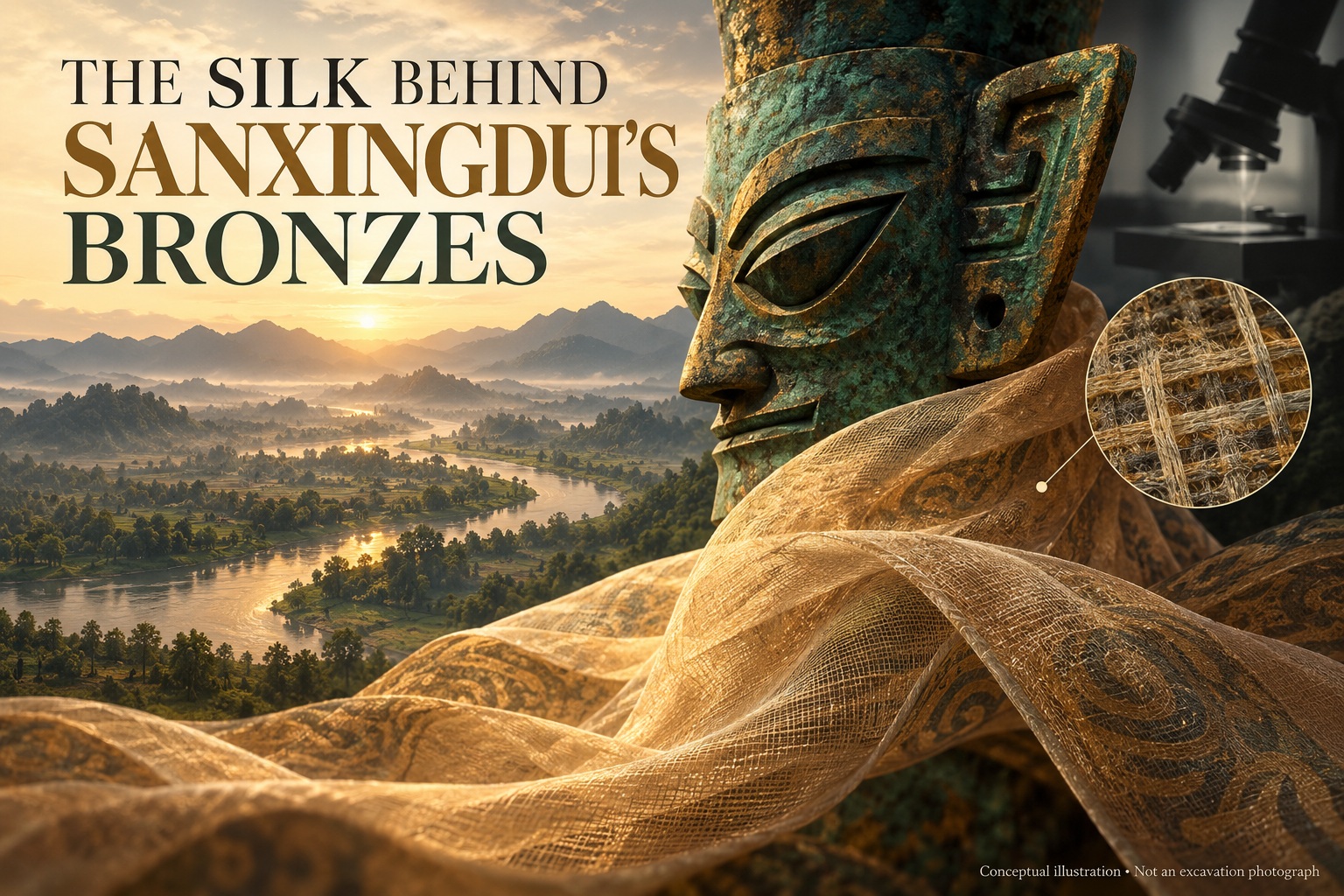
Sanxingdui silk is bringing a softer material back into a civilisation usually pictured in bronze. The huge eyes and bold shapes of ancient Shu masks command attention. Almost invisible textile traces ask us to imagine what once surrounded those objects: cloth, colour, skilled hands and the work of preparing an offering.
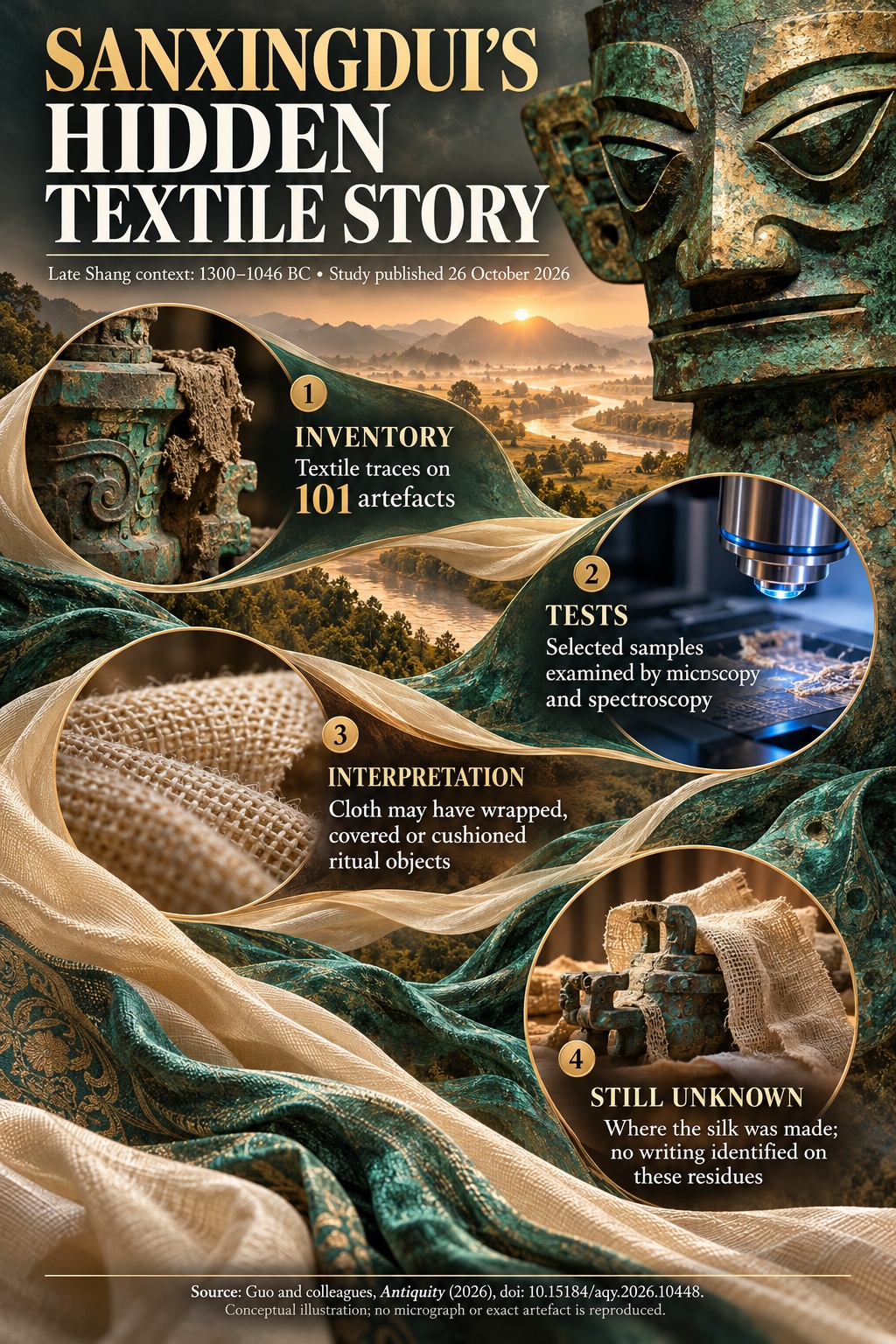
A study published in Antiquity on 26 October examines residues from the Sichuan site. Jianbo Guo and colleagues argue that silk belonged within its Late Shang ritual practices. Their work expands a history of investigation; it is not the discovery of a complete robe this week. Read the research paper.
Sanxingdui silk changes what we notice
The researchers examined selected samples using microscopy and chemical analysis. The proposed uses include wrapping, covering or cushioning objects, alongside the possibility of cloth offered in its own right. Evidence of textile use does not settle where the fabric was manufactured. Nor were written texts identified on the residues. Those distinctions leave room for a substantial discovery without turning a possibility into a recovered manuscript.
A bronze mask on a clean museum mount can appear to be a self-contained object. Archaeologically, it may have belonged to an arrangement of materials that survived very unevenly. The question becomes larger than how a metalworker cast a face. Who prepared the objects for deposition? What did that preparation require? Which parts of the scene are missing because they decayed?
The earlier experiment that found silk in ash
This week’s paper follows a different kind of investigation published in Scientific Reports in 2024. That team studied mineralised fabric and material from an ash layer, developing an antibody-based enrichment method to concentrate scarce silk-protein residues before further analysis. The problem was practical: a tiny surviving signal could be diluted among soil, ash and other degraded matter. The earlier paper explains the method and its results.
The work illustrates why textile archaeology cannot depend on finding recognisable clothing. Heat and burial can remove the familiar appearance of cloth while leaving traces accessible to specialised tests. A fabric impression, surviving fibre structure and a protein result answer related but different questions. Their value increases when methods and excavation context support one another.
It is worth keeping the date of an excavation separate from the date of an analysis. A laboratory can produce new knowledge from material recovered years earlier. That is real archaeological news, even when there is no fresh trench opening and no complete object to hold up for a camera.
For another example of tiny biological traces informing a much larger history, see our report on ancient proteins and the Xujiayao Denisovans. The materials and questions differ, but both investigations show why the methods deserve a place beside the headline.
Where ancient Shu fits in China’s Bronze Age
Sanxingdui lies at Guanghan in the Sichuan Basin. China’s Ancient Shu submission to UNESCO’s Tentative List places it alongside Jinsha and Chengdu’s boat-shaped coffin tombs within a regional archaeological history. It describes a walled urban centre with specialised spaces, rather than an isolated cache of mysterious masks. Tentative-list status is a nomination framework, not the same as inscription on the World Heritage List.
The submission also stresses cultural interaction. Ancient Shu’s distinctive objects developed within a world of connections to other parts of China. Distinctive style and outside exchange are compatible. A community can borrow techniques and materials while producing imagery that remains recognisably its own.
That setting helps keep the human story in view. Monumental bronzes required planning, resources and skilled work. Cloth adds another kind of labour to the picture. Even when its maker cannot be named, its presence broadens the range of activities that an account of the site needs to explain.
Sanxingdui silk and the wider world of ancient Shu
The National Museum of China’s 2026 ancient Shu exhibition announcement brings Sanxingdui and Jinsha together through more than 200 objects or sets. Its themes include the worlds of people and gods, and exchanges between cultures. That is a useful wider frame for research that makes a less visible material newly noticeable.
The new results invite a change in how we look, rather than a rush to fill every gap. There is a difference between imagining fabric around a bronze and claiming to know its exact colour, pattern, wearer or ceremony. The former can help readers understand the evidence. The latter needs details that the surviving record may not supply.
For a comparison in another setting, our Kekova shipwreck investigation follows containers that survived after the vessel disappeared. At Sanxingdui, the imbalance runs between durable objects and perishable materials. In both cases, the missing part matters—but archaeology progresses by testing its traces.
What to watch next: better links between textile traces and particular objects, clearer evidence of production and further analysis of deposition contexts. The story is compelling because it brings ancient work into focus. It does not need an intact silk archive or a perfectly reconstructed ritual to matter.



latest video



news via inbox
Subscribe to our Cosmic newsletter to get notified when we have new articles.