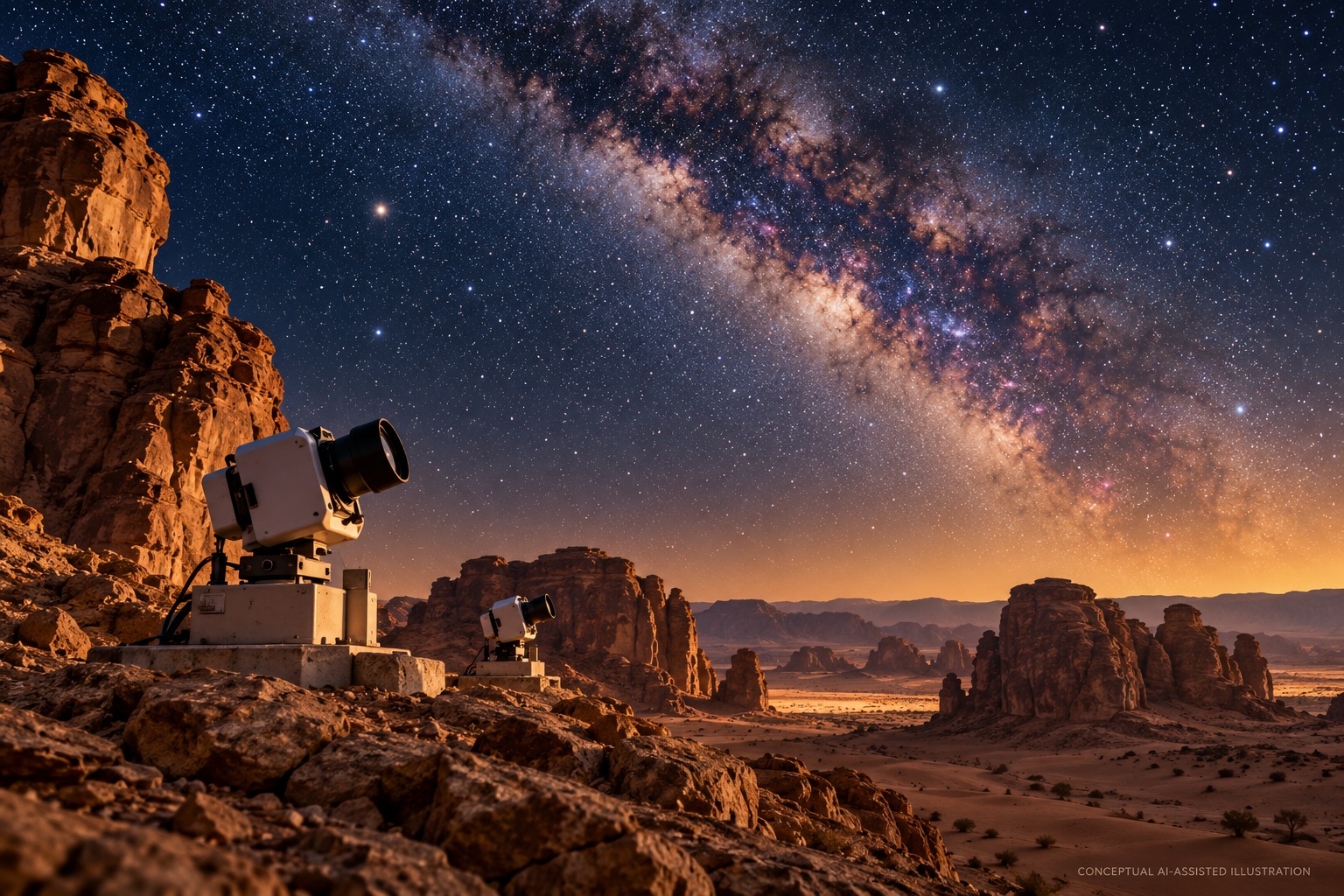
LaserSETI in AlUla Opens a New Window in the Search for Alien Technology
A flash can be over before a conventional telescope turns towards it. That is the problem behind LaserSETI in AlUla, where two newly commissioned stations are expanding a search for short optical events—including possible signs of technology beyond Earth.
The SETI Institute announced the operational stations on 22 October 2026. The advance is practical: another observing location, another stretch of sky and more opportunities to compare a fleeting event. The announcement describes a search capability, not the discovery of an extraterrestrial signal.
What LaserSETI in AlUla adds
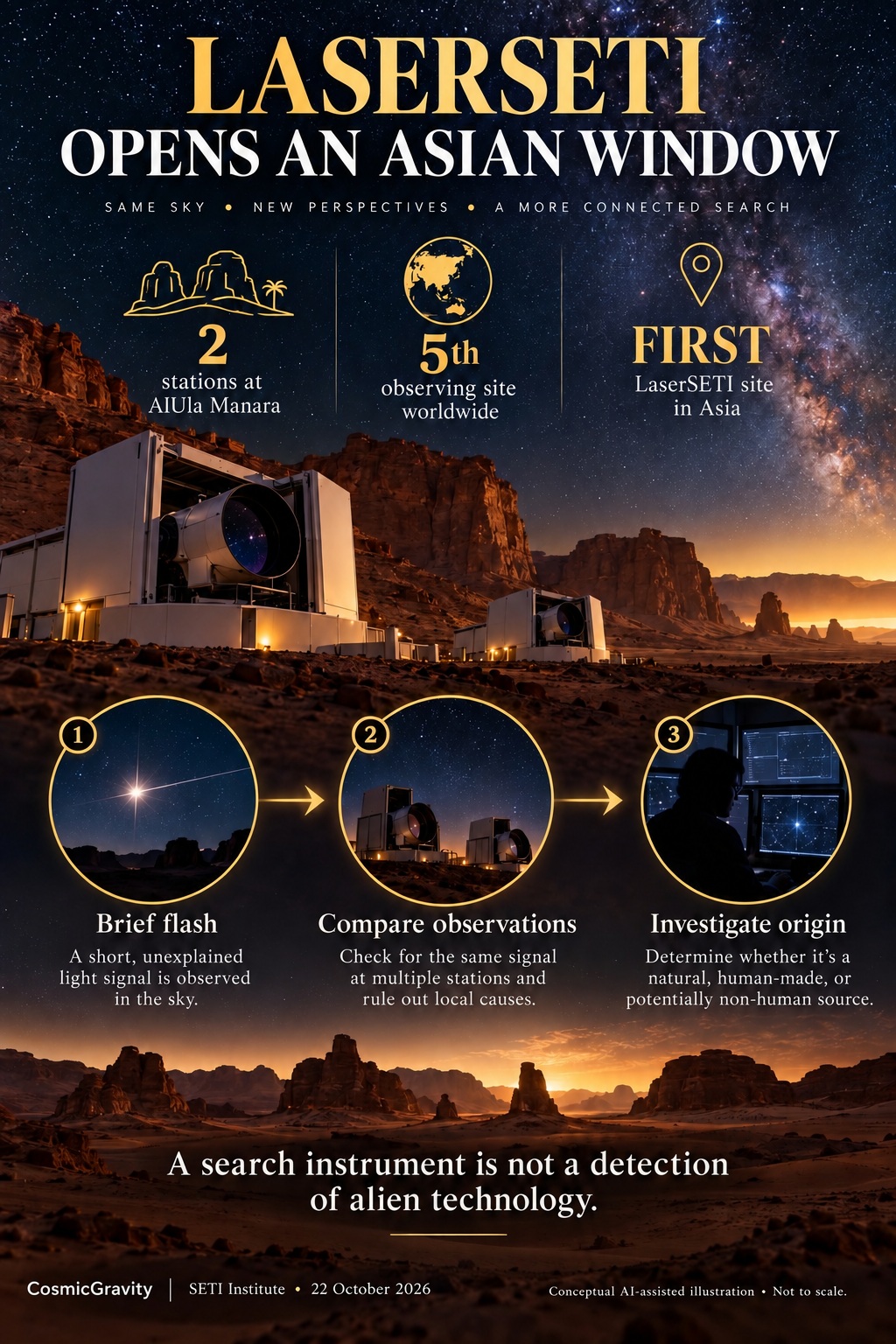
According to the SETI Institute’s deployment announcement, AlUla Manara in northwest Saudi Arabia is the network’s first observing site in Asia and its fifth worldwide. The two stations were installed on 19 August and were described as fully operational in the October release.
Putting an instrument in a new region changes more than the number of cameras. Night falls at different times around Earth, weather closes some windows while leaving others open, and some directions are accessible from one latitude more easily than another. Geography is part of an observatory’s design.
The distinction between two stations and a fifth site is worth keeping clear. Stations are pieces of observing infrastructure; the site is the location housing them. Counting those terms interchangeably would exaggerate the network’s geographic reach.
How do cameras search for laser flashes?
The project’s technical overview describes wide-angle cameras combined with diffraction gratings. A grating spreads incoming light into its constituent colours. A star provides a broad spectrum; an idealised laser concentrates its light within a much narrower range.
That difference offers an identifiable pattern. Instead of needing every interesting event to look like a bright point in a photograph, the instrument can examine how its light is distributed. The project also describes paired cameras rotated relative to one another, helping reject false events such as a particle hitting a detector.
These are optical measurements. The cameras are receiving light, not sending a greeting into space. Our technosignature guide explains where this kind of observation fits alongside radio searches and other proposed indicators of technology.
Why a single flash would not settle the question
Imagine an unusual signal appears in one camera. The first question is whether anything occurred in the sky at all. A detector artefact can resemble an event without having an astronomical source. A second instrument provides a way to test that possibility.
Next comes origin. Even a real sky event does not immediately reveal its distance or cause. The observing conditions, position, timing and spectrum would need to be considered together. Comparing observations from different places can add constraints that a single image lacks.
This is why the network matters as much as an individual lens. It creates opportunities for independent checks. It does not guarantee that every event will be seen at multiple sites, or that every flash will have enough information for a confident identification.
LaserSETI, UFO reports and the same evidence problem
A search for optical technosignatures and an investigation of a nearby unidentified object are different activities. LaserSETI’s expansion should not be presented as confirmation of any UFO encounter. Its relevance to that wider conversation lies in a shared need for timed, calibrated and independently checkable observations.
That is a useful distinction when following a dramatic headline. “Unusual” describes how something compares with expectations. “Artificial” proposes a cause. “Extraterrestrial technology” adds an origin. Each step needs evidence of its own; none follows automatically from the previous word.
The SETI Institute’s June 2026 detection principles place scientific confirmation and accurate communication at the centre of the process. The point is to make a potentially important result open to serious scrutiny, rather than let its interpretation outrun the observation.
What to watch for after the AlUla announcement
The next valuable updates will concern observations and analysis: how the stations perform, how candidate events are filtered and what can be learned by comparing locations. A commissioning milestone and a published scientific detection would be different achievements.
For readers following the debate around a supposed 2027 UFO event, this is a concrete example of progress that does not depend on a predicted disclosure date. Instruments can be installed, their operation checked and their findings evaluated as evidence becomes available.
AlUla adds another place to look. Whether anything extraordinary is found remains an observational question.



latest video

news via inbox
Subscribe to our Cosmic newsletter to get notified when we have new articles.