GS18660: The Ring Galaxy That May Preserve an Ancient Collision
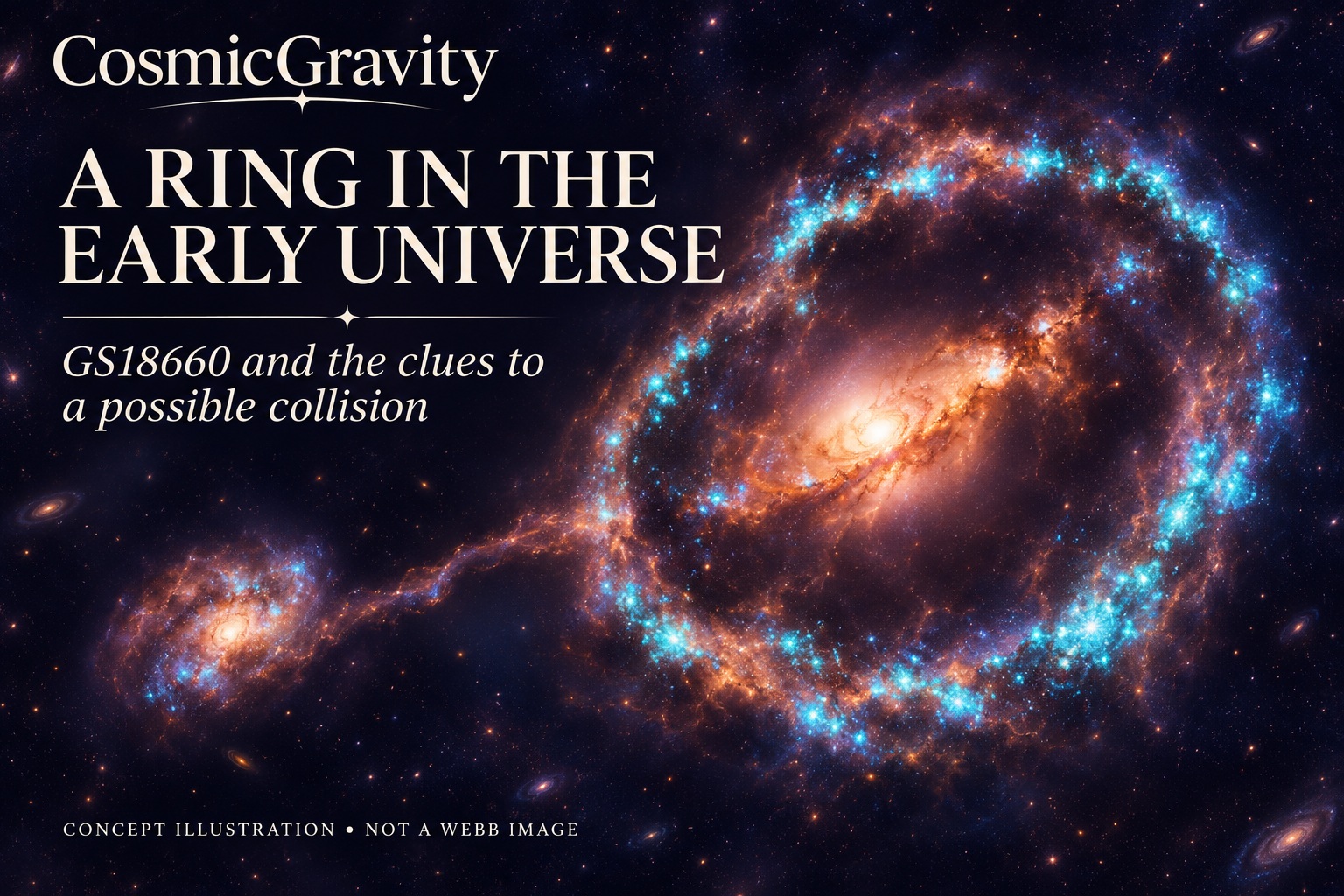
The GS18660 ring galaxy looks like a cosmic question mark written as a circle. Bright star-forming regions trace a ring, while a smaller neighbouring galaxy offers a possible explanation for how it got there. Did an intruder pass through a larger galaxy and set a wave moving through its gas?
A study led by Michele Perna, published in Astronomy & Astrophysics on 8 September 2026, favours that interpretation. The interesting part is how the researchers built their case. They combined the galaxy’s shape with measurements of gas movement and stellar populations. A dramatic image started the puzzle; spectroscopy made it possible to investigate.
What Webb measured in the GS18660 ring galaxy
The published paper places the system at a redshift of about 3.076. In other words, astronomers are examining light stretched substantially by the expansion of the universe. The view belongs to an early chapter in galaxy evolution, rather than to the galaxy as it would appear at the present cosmic time.
The observations came from Webb’s Near-Infrared Spectrograph, NIRSpec, through the GA-NIFS programme. Crucially, the researchers used integral-field spectroscopy: a way of recording spectra across an extended object instead of treating the whole galaxy as one unresolved point.
As ESA’s explanation of Webb spectroscopy describes, this creates a data cube: spatial information combined with wavelength information. A familiar photograph answers where the light is brightest. A cube lets researchers ask how the spectrum changes from one patch to another.
That difference is central here. Light from glowing gas contains emission lines. Their positions and shapes provide clues to motion and physical conditions, helping astronomers test whether a ring is simply a visual pattern or part of a more complicated dynamical system.
The moving gas behind the collision argument
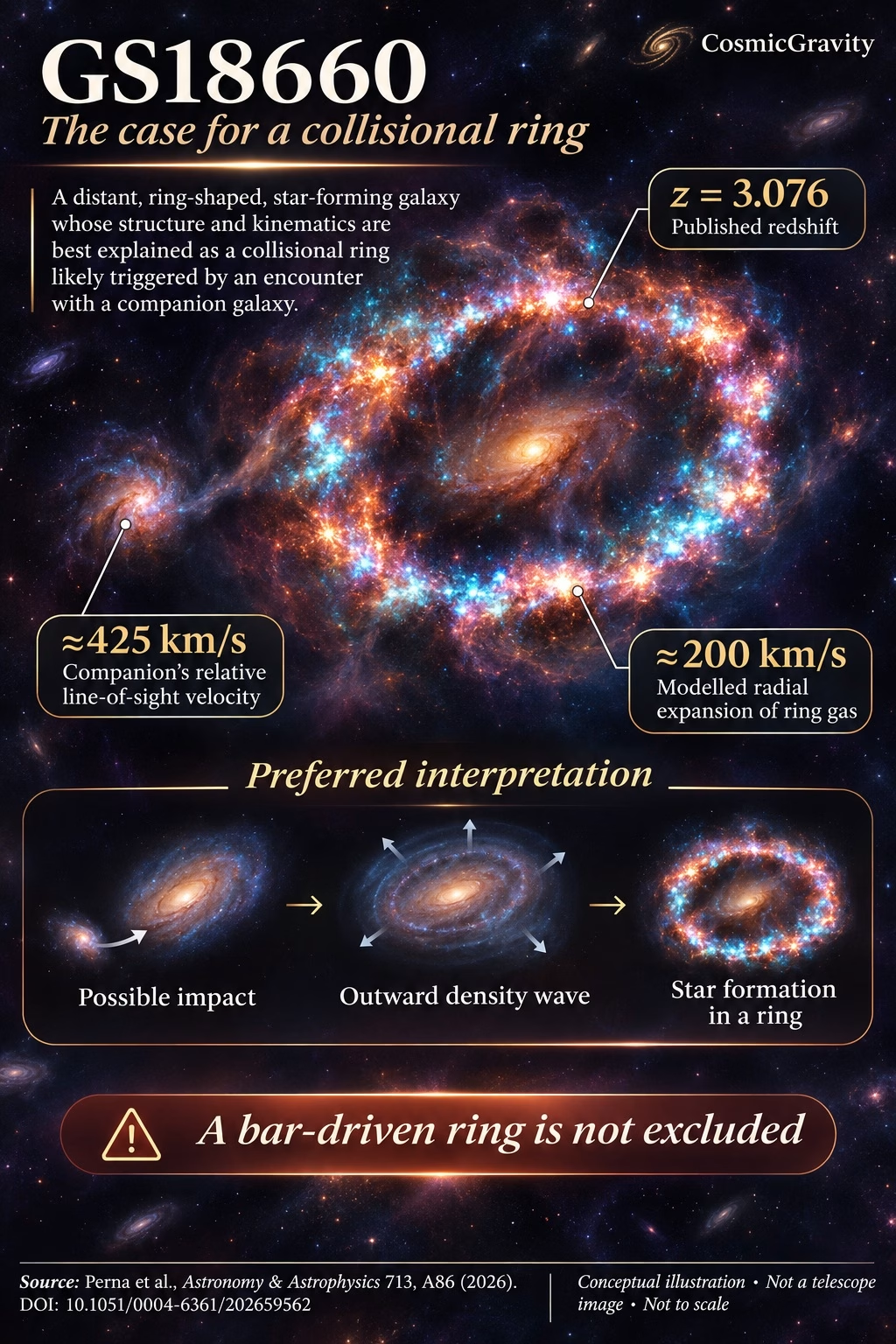
The authors report a rotating disc with an additional outward component of gas motion, modelled at roughly 200 kilometres per second. They also identify a compact companion with a relative line-of-sight velocity of about 425 kilometres per second. A bridge-like structure extends towards the main galaxy.
These are different measurements. The first describes radial expansion within the model of the ring system. The second comes from the companion’s spectral offset along our viewing direction. Neither is a complete three-dimensional film of the encounter.
Nevertheless, the clues fit together. A ring, outward motion and a nearby potential intruder are easier to understand within a collision scenario than any one of those features alone. The researchers also find evidence of recent star formation concentrated in the ring. That gives them another aspect of the system’s history to compare with its dynamics.
How a collision can make a ring
The nearby Cartwheel Galaxy provides a useful comparison. ESA explains its expanding rings as the aftermath of a smaller galaxy’s passage through a larger one. The disturbance travels outwards through the disc, compressing gas and encouraging new stars to form.
The pond-ripple analogy is helpful as long as it remains an analogy. The ring is not a solid bracelet thrown out by an explosion. It is a changing pattern in a vast collection of gas and stars responding to gravity. Bright young stars can make the pattern especially conspicuous.
Nor does calling an encounter a “collision” mean that two hard objects smashed together like vehicles. The scale and structure of galaxies make their interactions a different kind of event. The useful questions concern how gravity rearranges material and how gas responds.
Why the GS18660 ring galaxy still has an alternative explanation
The paper leaves a bar-driven ring on the table. A stellar bar is an elongated structure within a galaxy; its gravitational influence can help organise material into a ring. If that mechanism explains this system, the ring need not record a head-on impact.
The authors’ earlier public manuscript also discusses that alternative. It is part of the same research, not an independent confirmation. Keeping the distinction between a favoured model and an excluded alternative is particularly useful when a striking picture seems to supply an instant answer.
There is another reason to read circular cosmic images carefully. Some rings are effects of gravitational lensing, in which foreground mass bends the light of a more distant object. That is a different phenomenon from a ring of star formation. A round appearance alone cannot settle which physics produced it.
What this adds to Webb’s picture of early galaxies
The GS18660 ring galaxy offers a way to test how quickly galaxies could develop organised structures and how interactions reshaped them. The value lies in matching several kinds of evidence, rather than treating visual resemblance as a verdict.
For the wider context, our guide to James Webb discoveries explores the telescope’s growing view of the universe. Our explanation of Webb’s unusual black-hole and stellar systems tackles another example where an observation and its proposed explanation need to be read together.
Here, the next decisive evidence would sharpen the comparison between the collision and bar scenarios. Until then, the ring is compelling because the researchers can test its story. Its beauty draws the eye; the moving gas gives that story something solid to answer to.
Research checked 2 November 2026. The study was published in September; this article is an explanation of its evidence, not an announcement of a discovery made today. Original illustrations are labelled conceptual.

latest video



news via inbox
Subscribe to our Cosmic newsletter to get notified when we have new articles.