Ryugu Nucleobases: Five Ingredients, No Evidence of Life
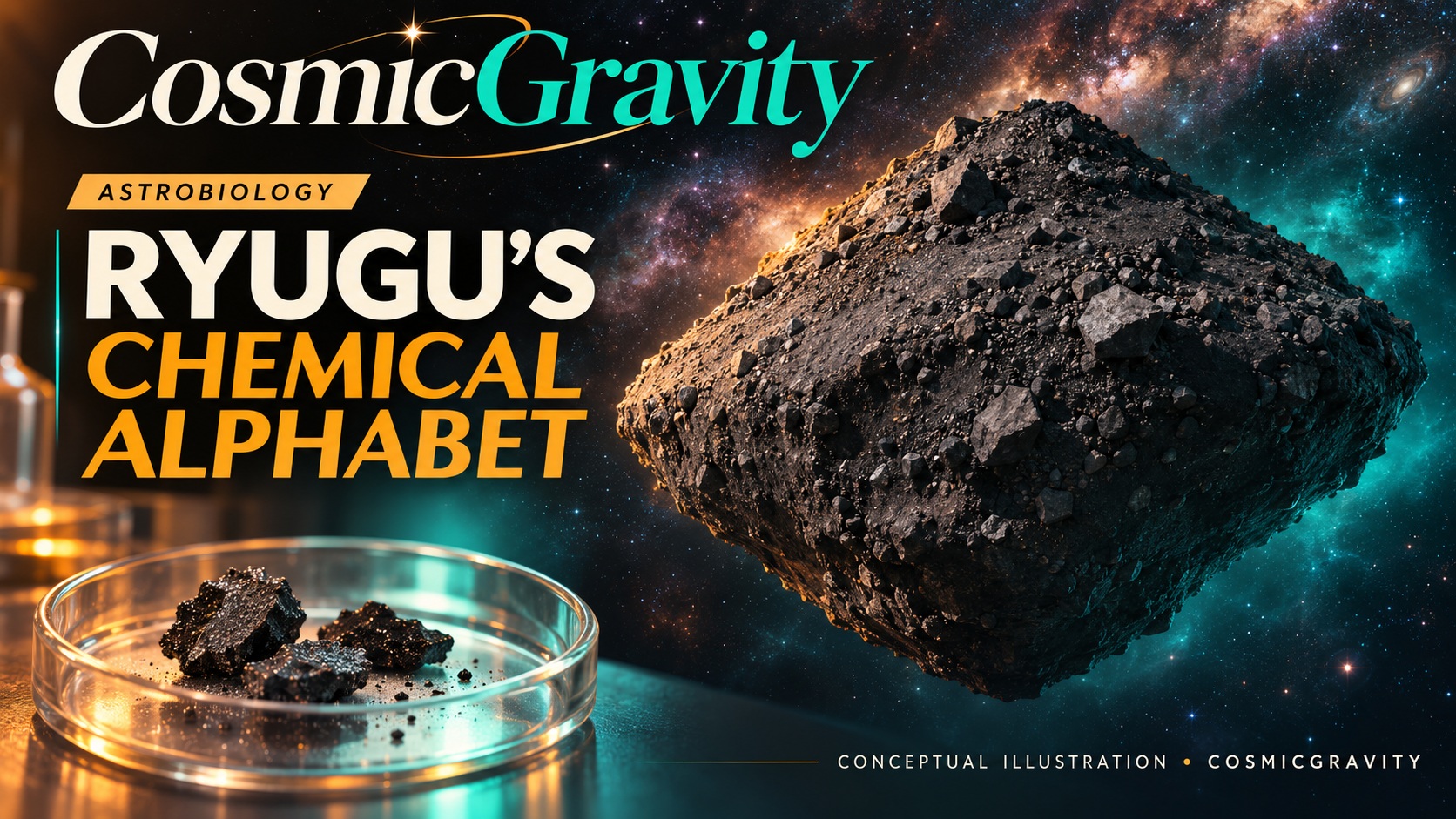
A few dark grains from an asteroid can carry a surprisingly rich chemical story. The Ryugu nucleobases study identified all five canonical bases used across DNA and RNA in material brought home by Japan’s Hayabusa2 mission. That is an important result for the origins-of-life question. It is also a result that deserves careful wording: these are molecular ingredients, not genetic material or living things.
The paper appeared in Nature Astronomy on 16 March 2026. This is an explanation of that research, rather than a claim that a new discovery happened today. Its enduring question is compelling enough: how much of the chemistry that life uses was already available beyond Earth?
What the Ryugu nucleobases study actually found
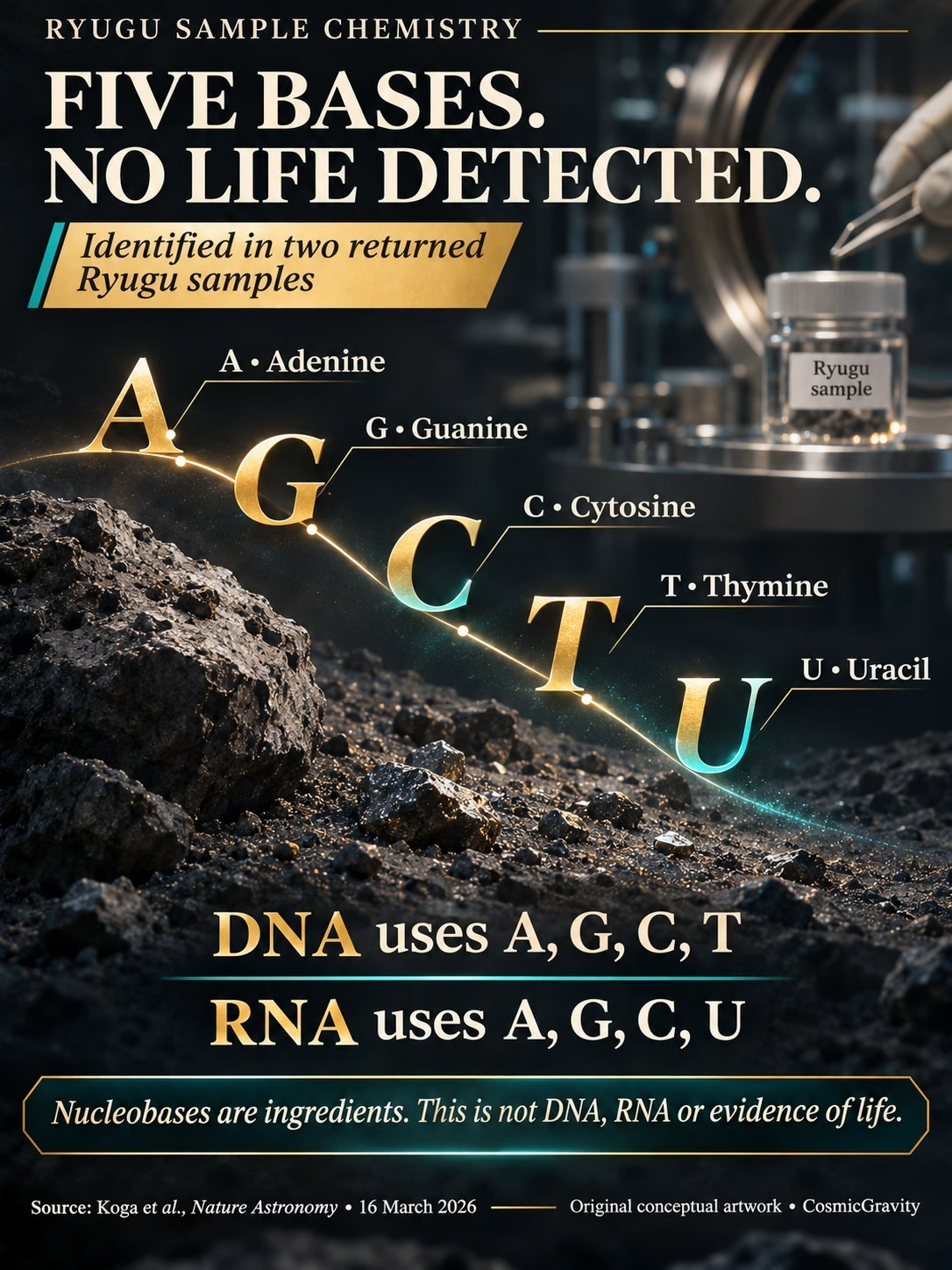
Toshiki Koga and colleagues analysed two returned aggregate samples, A0480 and C0370. They identified adenine, guanine, cytosine, thymine and uracil. The researchers also examined the Orgueil meteorite for comparison. Their open-access paper reports the analytical evidence, concentrations and limitations.
These names are familiar because terrestrial biology uses them. Adenine and guanine belong to the purine family; cytosine, thymine and uracil are pyrimidines. Finding the set in asteroid material strengthens the case that familiar prebiotic ingredients can arise in extraterrestrial environments without biology making them.
“All five” does not mean that DNA has five standard letters. DNA normally uses A, G, C and T. RNA normally uses A, G, C and U. The five-name list is the combined inventory across the two systems.
Ingredients are a long way from a genetic system
A nucleobase is one part of a nucleotide. A nucleotide also includes a sugar and phosphate. DNA and RNA require those units to be connected into chains. A functioning biological system involves much more again: chemistry that maintains itself, copies information and operates within a suitable environment.
Consider the difference between finding individual letters and finding a readable instruction manual. The letters matter, but their presence does not tell us that a message was written. Likewise, a familiar base does not establish a genome, an organism or an extraterrestrial author.
This distinction makes the result more useful. Instead of asking the sample to prove life, researchers can ask a narrower question that laboratory measurements can answer: which chemical starting materials were available, and in what proportions?
Why bringing the sample home matters
Meteorites offer valuable access to space material, but their terrestrial histories can complicate interpretation. Exposure to weather, soil and handling creates opportunities for contamination. A sample-return mission gives researchers a much more controlled starting point.
JAXA records the Hayabusa2 sample return as 6 December 2020. Its account of Ryugu’s organic material explains how returned particles support several complementary investigations. A single mission can therefore continue producing new results years after the capsule lands.
That long timescale is sensible. Precious grains must be documented, allocated and studied with methods suited to small amounts of material. “Returned in 2020” and “published in 2026” describe different stages of the evidence, not a contradiction.
How researchers identified the Ryugu nucleobases
The team used chromatography coupled to high-resolution mass spectrometry, compared signals with reference compounds and used capillary electrophoresis with mass spectrometry as another check. Different separation methods help distinguish compounds that can otherwise look deceptively similar.
They also processed blanks through the laboratory procedure to assess background signals. Clean working conditions and these controls support the interpretation that the detected compounds belong to the samples. The paper describes where the available material limited additional tests; it does not pretend every compound received every possible measurement.
For a reader, the important lesson is that an impressive molecule name is only the beginning. Confidence comes from the identification method, comparison standards and controls considered together.
What Ryugu nucleobases reveal about asteroid chemistry
The relative abundance of the Ryugu nucleobases offers another clue. The balance between the two base families varies between extraterrestrial samples. Ryugu’s measured purine and pyrimidine amounts were roughly balanced, whereas comparison materials showed different patterns. The authors explore whether ammonia availability and parent-body chemistry helped shape those distributions.
JAMSTEC’s research announcement highlights this relationship as a clue to nonbiological chemical evolution. A correlation offers a direction for testing; it does not reconstruct every reaction that happened inside an ancient asteroid.
This is where sample comparison becomes particularly valuable. Two objects can share broad mineral characteristics while preserving different molecular histories. The differences may be as informative as finding the same ingredient twice.
What this changes about the search for life
The Ryugu nucleobases finding adds to evidence that space supplied a chemically interesting inventory to the early Solar System. It leaves open how such material reached suitable environments, survived delivery and participated in later chemistry. Those steps should be investigated individually.
It also clarifies the distinction between prebiotic chemistry and a biosignature. Our guide to biosignatures in exoplanet atmospheres explores why context matters when interpreting a possible sign of life. The questions surrounding Enceladus and its plumes make a useful comparison: interesting ingredients invite closer examination, rather than settling the biological question.
Ryugu’s contribution is a concrete one. We now have a fuller inventory of familiar bases in carefully studied asteroid samples. The distance between that inventory and living chemistry remains a research problem—and that distance is exactly what makes these grains worth studying.


latest video



news via inbox
Subscribe to our Cosmic newsletter to get notified when we have new articles.