Caltech ASTRA Builds a Truss Bay in Orbit—and Tests a Bigger Idea
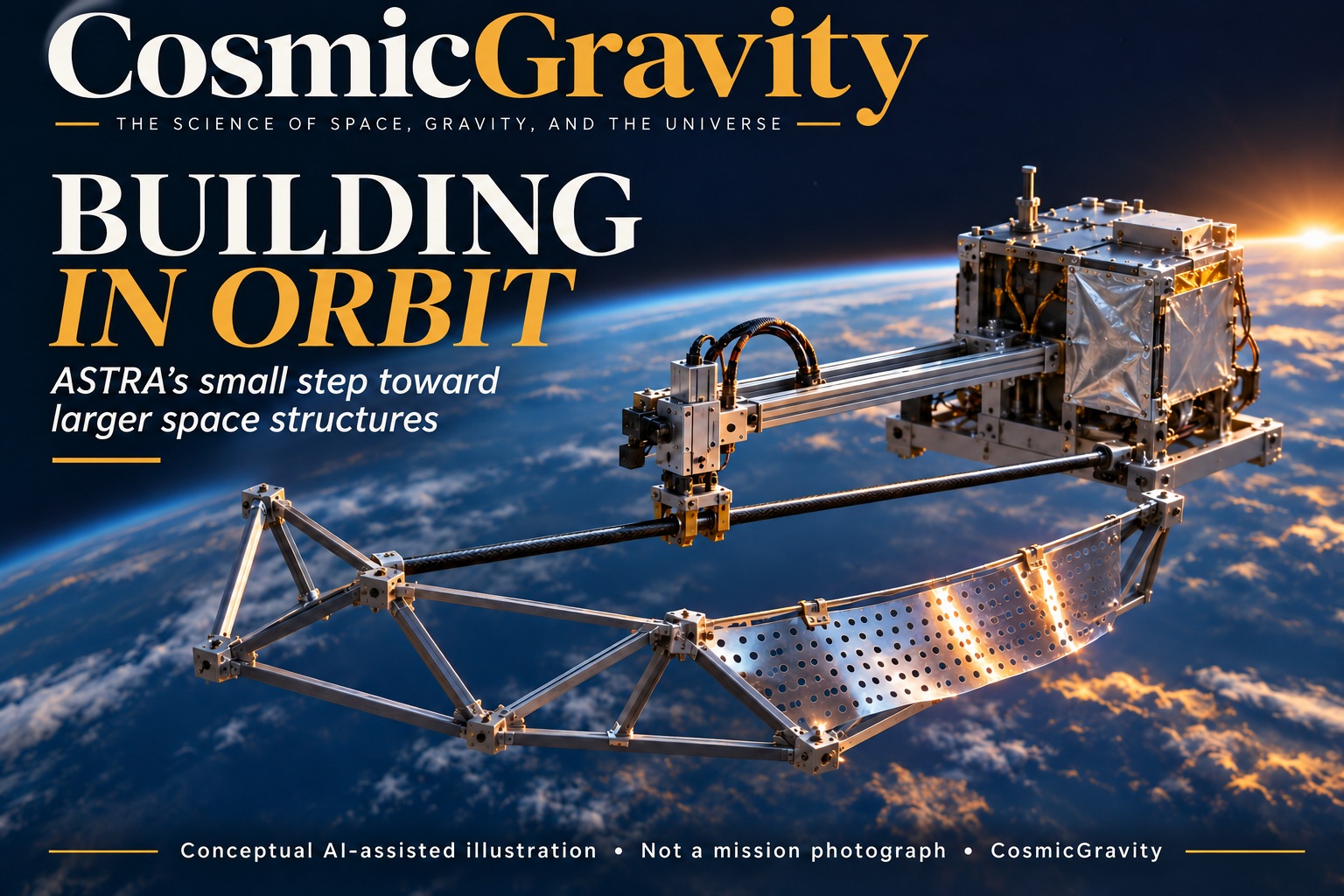
Caltech ASTRA has taken a small but meaningful step toward constructing large structures where they will operate: in space. The robotic demonstration assembled a new section of a lightweight truss in orbit, testing an approach that could eventually change how engineers package antennas and other large equipment for launch.
The important word is section. This was a construction experiment, with a partially completed structure and practical lessons still to absorb. It was not the unveiling of an operational giant telescope.
What Caltech ASTRA actually built
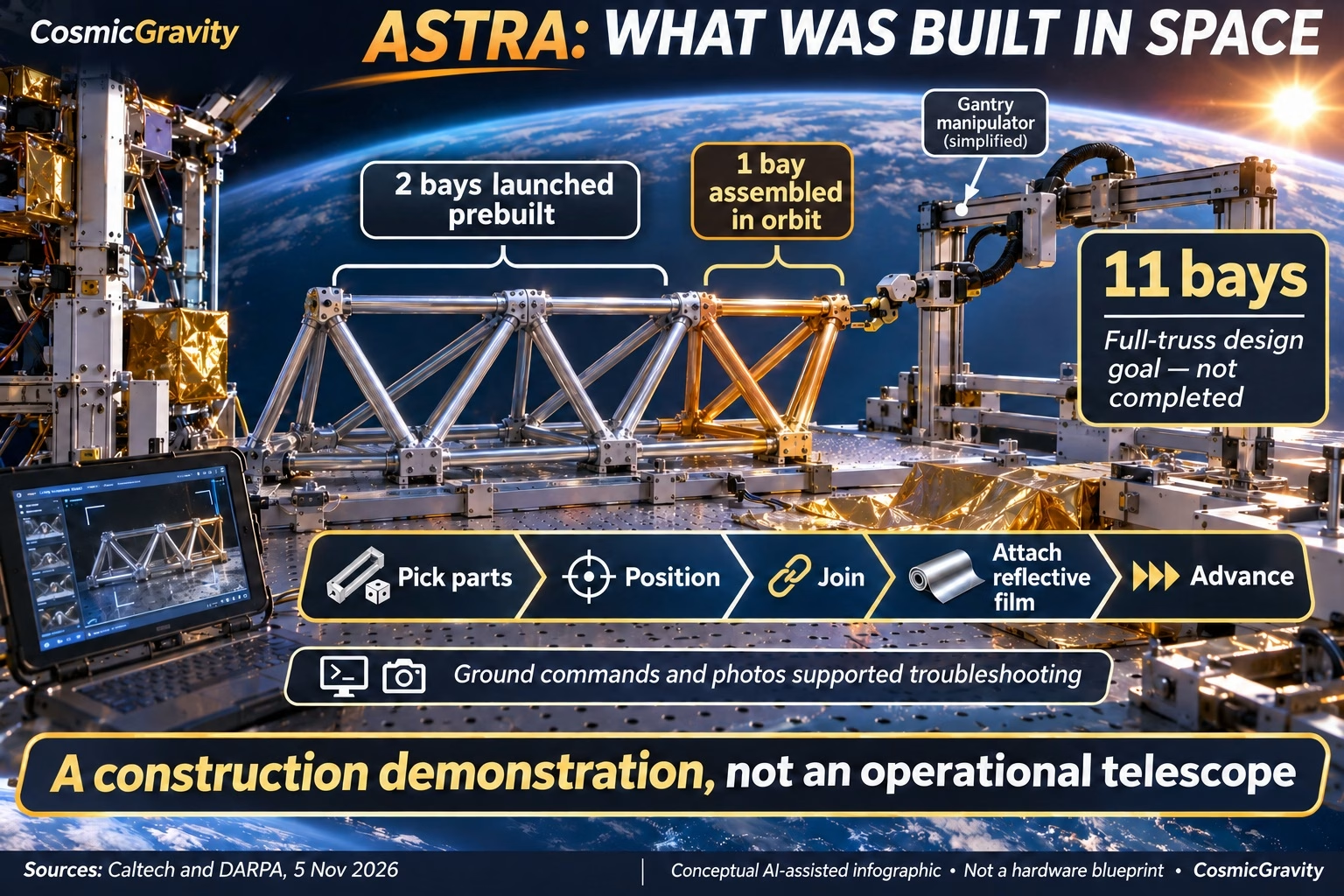
In its 5 November announcement, the university reports that Caltech ASTRA launched with two prebuilt truss bays and constructed a third in orbit. The full design called for eleven bays supporting a 1.4-metre reflector. Time limitations left that larger assembly unfinished.
ASTRA stands for Autonomous In-Space Tensioned Reflector Assembly. The university describes its demonstration as the first autonomous construction of a structure in space. That claim concerns this assembly capability; readers should not confuse it with a claim that nobody had previously built or deployed space hardware.
The distinction between the completed bay and the intended reflector makes the achievement easier to assess. For Caltech ASTRA, joining a new structural unit under orbital conditions is a result worth reporting. Completing and qualifying a useful antenna would be a further result.
Why building after launch changes the problem
A spacecraft must pass through a rocket’s fairing before it can do anything useful in orbit. For a large structure, that creates a familiar trade-off: shrink the structure, fold it, or divide it into separate pieces. Each choice shifts difficulty into another part of the mission.
Folding allows a comparatively large surface to travel in a smaller volume, but the deployed shape still depends on the launch package and its mechanisms. Assembling components after launch offers another route. A finished framework can extend beyond the shape of the container that carried its parts.
The DARPA announcement explains that ASTRA belongs to its NOM4D programme. The demonstrator uses a gantry robot to join structural members while deploying a thin reflective surface. The agency frames this as a proof of concept for scalable construction, particularly large, lightweight structures.
That does not remove launch constraints altogether. The components, joints, robot, electronics and support systems still need a ride. The engineering question becomes whether the mass and complexity of the assembly equipment pay off in the size and usefulness of the resulting structure.
How Caltech ASTRA tests repeatable assembly
Caltech ASTRA tests a repeatable sequence. A truss divides a larger framework into relatively simple elements. If a machine can reliably position and connect those elements, it may be possible to extend the structure through repeated operations instead of launching its final outline.
DARPA’s description emphasises combining relatively straightforward motions and joining operations. The important advance is making the sequence work in its operating environment. A clever assembly motion on a laboratory bench becomes more valuable when engineers can reproduce it after launch.
In mechanical terms, a truss gains stiffness from the arrangement of its members and connections. A light framework can therefore support a much larger surface than a solid slab of similar mass. Yet joints matter: a connected structure must do more than look complete. It must keep its intended geometry under the loads and temperature changes relevant to its task.
For our reading of the demonstration, this is the central test: can a repeated operation produce a dependable structure, rather than a single successful connection? The orbital result establishes progress along that path without answering every question about a much larger machine.
Watch the team’s demonstration
Caltech published the following video with its announcement. It provides the team’s own explanation of the assembly demonstration. Read it alongside the reported outcome above, which distinguishes the third bay from the unfinished full reflector.
Video: Caltech’s official NOM4D–ASTRA assembly demonstration, embedded from its YouTube channel. Watch on YouTube.
What the experiment does not yet establish
An assembly demonstration and a working observatory have different success criteria. A telescope also needs suitable optical surfaces, precise alignment, stable pointing and instruments that can turn incoming light into measurements. A radio antenna has its own requirements for shape, feed systems and performance. A structural concept is one part of those systems.
Similarly, showing that a process can extend through repeated units is not the same as showing that every larger design will remain practical. Reliability, inspection, repair and the handling of errors become more consequential as the number of operations grows.
Those are engineering questions to investigate, rather than reasons to wave away the result. A small demonstrator earns its place by revealing which assumptions survive contact with real conditions. It can also show where a design needs to become simpler.
Our article on ESA’s Hera mission and the measurements still needed after DART explores a related distinction: performing an impressive action is only part of learning how a space system behaves.
What comes after Caltech ASTRA?
DARPA identifies larger antennas, solar arrays and other orbital infrastructure as possible future beneficiaries of its construction programme. These are potential applications, not completed ASTRA products. The next useful evidence would concern more extensive assembly, repeatability and the performance of the resulting structures.
For astronomy, the appeal is clear. Larger collecting surfaces can create opportunities that a compact instrument cannot. But useful science depends on the complete measurement chain. Our examination of FLIP exoplanet imaging shows another part of that chain: extracting a faint planet’s signal from the light that reaches a telescope.
Caltech ASTRA addresses an earlier question: how might some future instruments acquire their physical size? Its new truss bay is a modest object with a much larger idea behind it. Keeping the demonstrated result separate from the ambition gives both their proper weight.


latest video



news via inbox
Subscribe to our Cosmic newsletter to get notified when we have new articles.