What the Aguadilla UFO video shows when the camera’s motion is accounted for
Watch the Aguadilla UFO video once with your eyes on the dark shape near the crosshairs. It seems to race over buildings, reach the coast and disappear against the sea. Now play it again and watch the ground instead. The camera is on an aircraft in motion. What looked like a track across the landscape is a succession of views from different places. That distinction changes the reading of almost every dramatic moment in the clip.
A U.S. Customs and Border Protection aircraft recorded the infrared footage near Rafael Hernández Airport in Puerto Rico on April 26, 2013. The All-domain Anomaly Resolution Office (AARO) presented its reconstruction to the U.S. Senate in November 2024 and issued a case report dated March 20, 2025. Those dates matter because the clip has circulated again alongside newer UAP releases. See the slides presented to the Senate.
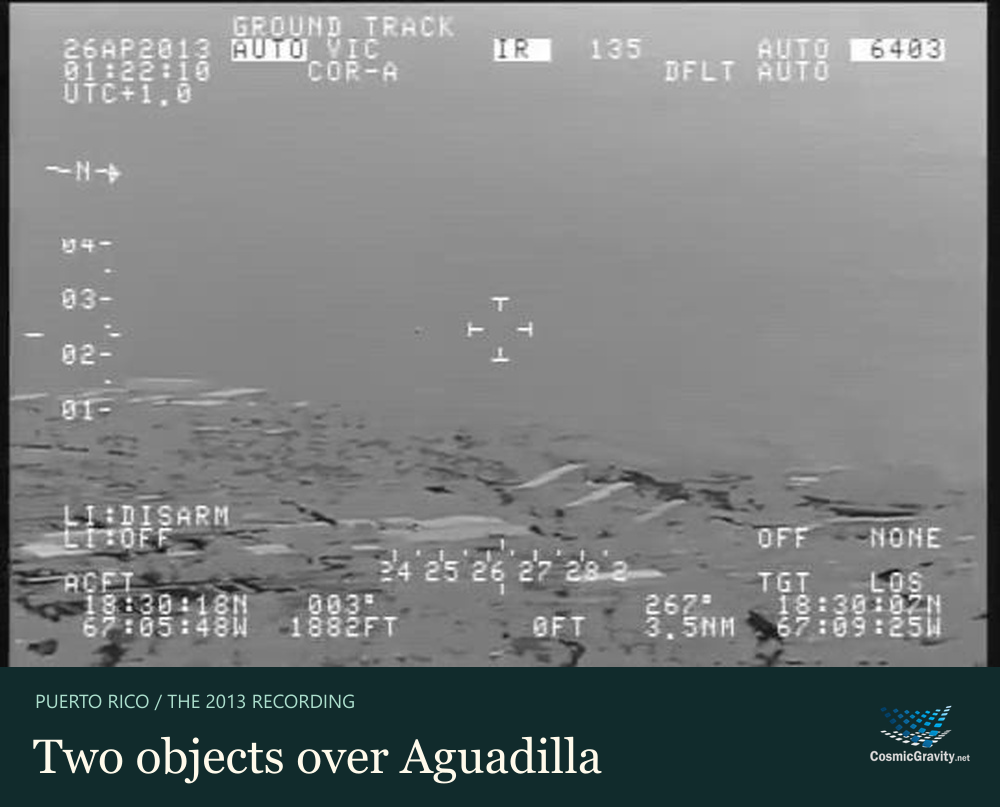
Feature image. Still from the U.S. Customs and Border Protection recording of April 26, 2013, distributed by DVIDS. The public-domain footage is available in full below. Image source.
What moves in the Aguadilla UFO video?
Start with the part the camera measures well. A dark patch occupies a particular place in a frame. The tracking system keeps it near the centre even as rooftops and open ground slide through the background. The camera gives us a direction from the aircraft. To place the patch on a map, we would also need to know how far away it was along that direction. A roof directly behind it in the picture can be hundreds of metres farther away in the world.
A train window offers an easier version of the problem. A fence beside the line seems to sweep past a distant hillside, though both stand still. At Aguadilla the airborne observer changed position while keeping a drifting object in view. An intelligence partner used the aircraft’s motion and the sensor’s viewing angles to reconstruct a path. AARO reports that the footage fits two objects moving close together on a straight course over land at a speed consistent with the wind. Watch the public CBP recording and read the official release notes.
Did something split apart or enter the water?
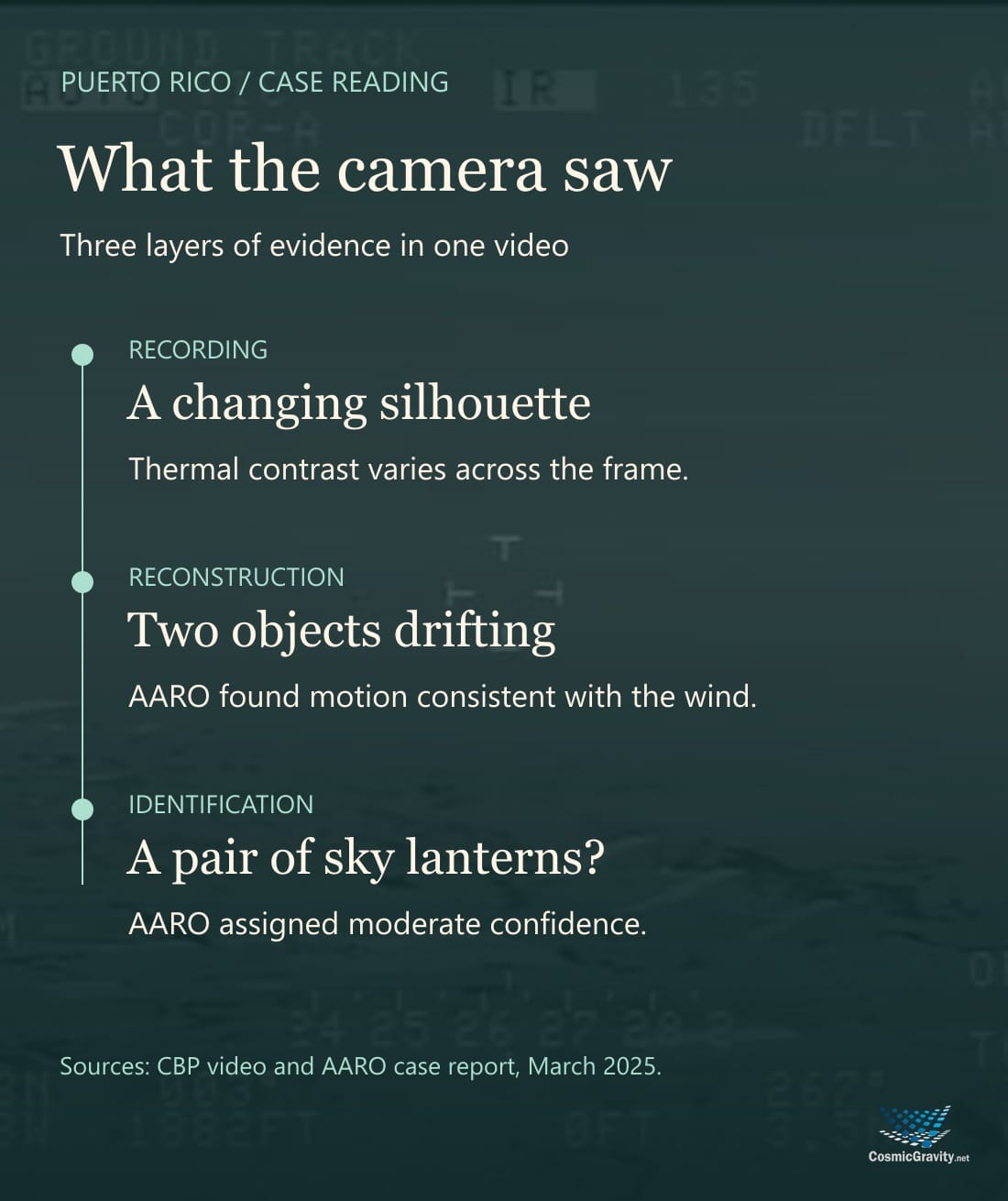
Two dots become distinguishable during the sequence. An object breaking in two is one possible reading if you assume the earlier patch was a single solid object. The office’s reconstruction favours two objects that were already there. Viewed close together, their outlines could occupy much the same part of the image. A small change in viewing angle could then make the gap between them visible.
The apparent splashdown raises a slightly different question. An infrared instrument builds an image from differences in the thermal signals it receives. A target can fade against its surroundings when their signals become similar. There is no requirement for its physical surface to disappear. And a sea background tells us what lies beyond the target along the camera’s line of sight. By itself it supplies no point of contact with the water. AARO’s reconstructed track kept the objects over land throughout the observation. Read the detailed Puerto Rico case resolution.
Why the lantern identification carries less certainty
AARO expressed high confidence that the objects showed no anomalous flight or passage between air and water. Its identification of the objects as a pair of sky lanterns carries moderate confidence. There is a good reason for the difference. Reconstructing a wind-compatible track tests a claim about motion. Several kinds of lightweight object can share that motion. Assigning a particular identity asks more of the same images.
That leaves the footage worth watching even for a reader who accepts the reconstruction. You can see the dark marks become distinct. You can also see how hard it is to judge depth at the instant they appear to reach the shore. The office gives an account of both observations and tells the reader where its certainty falls away. For a comparison with a case in which the distance and timing still leave very different speeds on the table, see the radar file behind the conditional 1,650 mph estimate.



latest video



news via inbox
Subscribe to our Cosmic newsletter to get notified when we have new articles.