How ALMA weighed the hidden black hole in W2246-0526
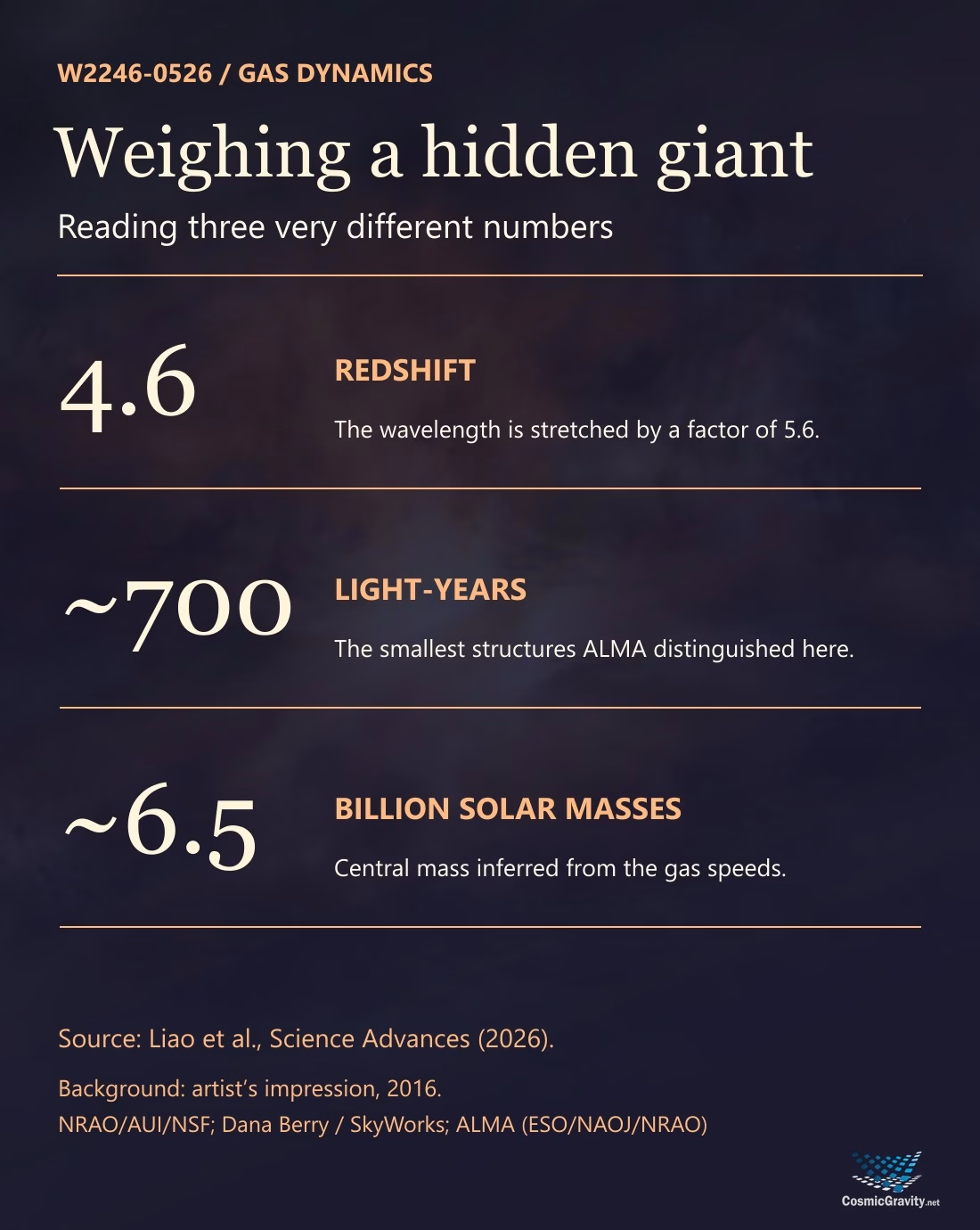
Fast-moving gas is easy to find near a quasar. The difficult part is working out what set it moving. In the dust-covered galaxy W2246-0526, gas is streaming away from a brilliant central source even as gravity draws material inward. Mai Liao and colleagues used the ALMA telescope array in Chile to disentangle those motions. The mass they infer at the centre is about 6.5 billion times that of the Sun. ALMA’s report and maps of the gas.
Two signals from W2246-0526
ALMA tuned in to radiation emitted by two ingredients of the galaxy, carbon atoms that have lost one electron and molecules of carbon monoxide. Each produces light at a characteristic wavelength. If the emitting material moves toward or away from us, its signal shifts. Gas moving at a range of speeds along the line of sight spreads that light over a range of wavelengths. The width of a line can therefore carry information that a photograph of the same gas would miss.
Across an entire galaxy there is another shift. Space has expanded while this light has been travelling, stretching its wavelength by a factor of about 5.6. Astronomers write that as a redshift of 4.6. The light left W2246-0526 when the universe was about 1.3 billion years old. Within that overall shift, the much smaller differences from one patch of gas to the next reveal the local motion.
Finding where one mass takes over
The team mapped how the spread in gas speeds changes with distance from the centre. An outflow can broaden a line even far from the black hole. If all that fast gas were assigned to gravity, the inferred central mass could be too large. After accounting for the outflow, the researchers still found a sharp increase in the spread of speeds toward the centre. That radial pattern carries the signature of a large, concentrated mass. Liao and colleagues’ study in Science Advances.
The relevant boundary is called the black hole’s sphere of influence. Inside it, the black hole’s gravitational pull matters more to nearby motions than the surrounding galaxy does. ALMA distinguished features roughly 700 light-years across in its sharpest observations. That number describes the telescope’s resolving power at this distance. The event horizon, the boundary beyond which light cannot escape, is a different and much smaller target.
Why astronomers wanted this particular measurement
Quasar brightness and the widths of emission lines already give astronomers a way to estimate distant black hole masses. Those estimates use relationships established closer to home. A measurement built from the changing motions of gas across a resolved region gives astronomers a chance to check that calibration in a much younger universe. According to the team, this is the first such resolved dynamical measurement beyond redshift two in a galaxy seen without significant magnification by a foreground gravitational lens.
The dust that conceals the quasar may have helped. Liao and colleagues suggest it shields gas near the nucleus from intense X-rays, allowing detectable carbon emission to survive close enough to register the black hole’s pull. That is a testable idea. Observations of other dusty quasars could show whether the same advantage turns up elsewhere.
Closer to Earth, astronomers can sometimes follow individual stars around a black hole. The contrast in what can be resolved is striking in the search for stellar orbits around Sagittarius A*.
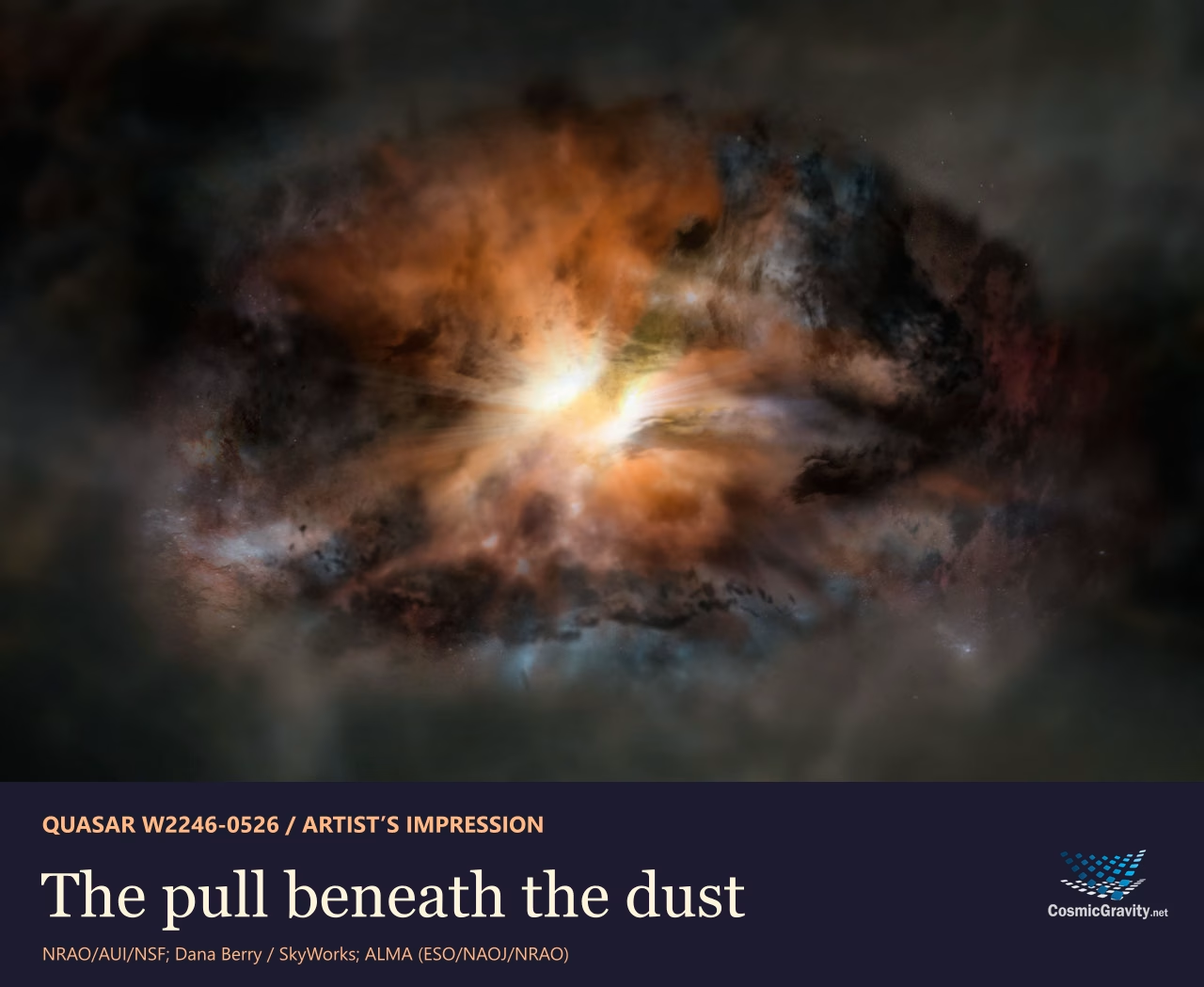
Feature image: Artist’s impression of W2246-0526 released in 2016. NRAO/AUI/NSF; Dana Berry / SkyWorks; ALMA (ESO/NAOJ/NRAO). CC BY 4.0. Editorial frame added. View the original. Licence.

latest video

news via inbox
Subscribe to our Cosmic newsletter to get notified when we have new articles.