Ancient Quasars: How Did Black Holes Grow So Fast?
Imagine seeing a lighthouse from the far side of history. Its beam began travelling before Earth existed, before the Milky Way had settled into its familiar shape and when the universe was still emerging from its cosmic infancy. That is what astronomers are doing when they detect the most distant quasars.
In July 2026, the European Space Agency announced that the Euclid mission had identified 31 previously unknown quasars. Two are older than any quasars discovered before, shining when the universe was roughly 670 million years old—about five percent of its present age.
The discovery raises one of modern astronomy’s most persistent questions. Quasars are powered by supermassive black holes, yet these black holes appear astonishingly early. How did they gain millions or billions of times the Sun’s mass when the universe had barely had time to build its first galaxies?
What is a quasar?
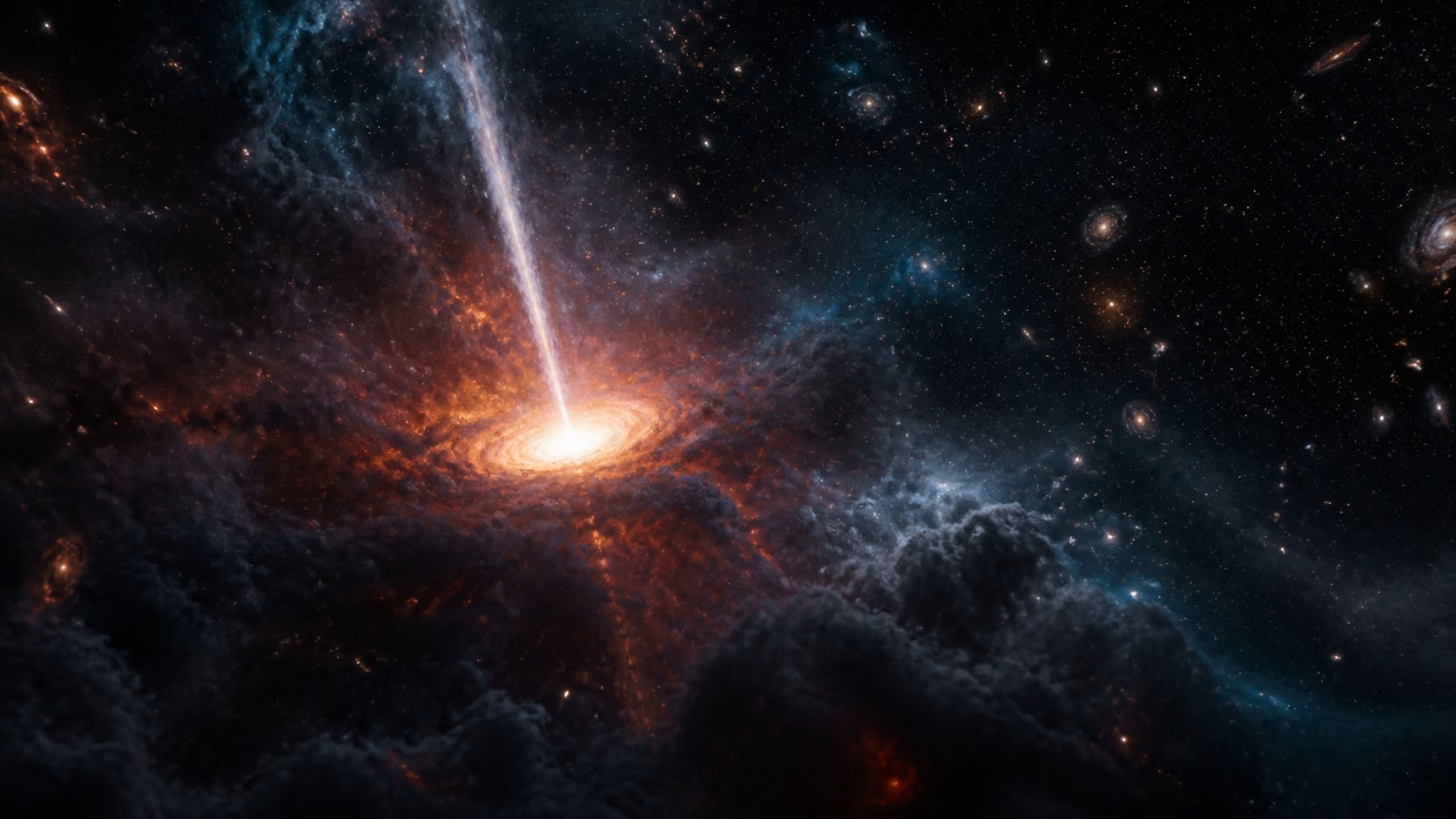
A quasar is not a special type of star. It is the intensely bright core of a galaxy whose central black hole is actively feeding. Gas and dust falling toward the black hole flatten into a hot, rapidly rotating accretion disk. Friction and magnetic fields heat that material until it releases enormous amounts of radiation.
The black hole itself remains dark. The light comes from matter in the final stage before crossing the event horizon. In the most powerful quasars, this compact region can outshine the combined stars of its entire host galaxy.
That brightness is why we can see quasars across such extraordinary distances. They act as cosmic beacons, illuminating periods of the universe that would otherwise be difficult to study.
Euclid’s unexpected talent
Euclid’s main task is to investigate dark matter and dark energy by mapping billions of galaxies across a large part of the sky. Its wide survey gives it another advantage: it can find rare objects that narrow-field telescopes might miss.
The 31 quasars emerged from that broad view. The most distant, EUCL J172902.75+641018.1, has a measured redshift of 7.77. Another reaches 7.69. Redshift records how cosmic expansion stretches light toward longer wavelengths; in this case it also tells us that the light began its journey more than 13 billion years ago.
These objects were not merely young black holes switching on. ESA describes them as shining with the light of a trillion Suns. Something had already provided enough material—and enough time—for their central engines to become enormous.
The problem of growing up too quickly
A black hole can gain mass by swallowing gas, merging with other black holes and consuming stars. None of these mechanisms is controversial. The difficulty is speed.
For long periods, the pressure from a black hole’s own radiation limits how quickly matter can fall inward. Start with a black hole formed by the collapse of an ordinary massive star and the growth schedule becomes tight. To reach supermassive scale within several hundred million years, it must feed almost continuously or pass through phases that exceed the usual limit.
The early universe was dense and rich in gas, which helps. It was also chaotic. Star formation, supernova explosions and mergers could disrupt the steady flow a young black hole needed.
Three ways to build an early giant
The first possibility is that the initial “seed” black holes were heavier than expected. Instead of beginning with a remnant tens of times the Sun’s mass, a huge primordial gas cloud may have collapsed directly into a black hole thousands or tens of thousands of solar masses. Starting farther up the ladder makes the final climb easier.
A second possibility is super-Eddington accretion. Under particular conditions, a black hole may consume matter faster than the conventional radiation-pressure limit suggests. These episodes would probably be unstable, but even short bursts could accelerate early growth.
The third route is merger-driven. Dense young galaxies may have brought black-hole seeds together repeatedly. Each merger adds mass, while the disturbed gas around merging galaxies can feed the resulting black hole.
Reality may use all three. Different quasars may have followed different paths.
Are the observations breaking cosmology?
Headlines sometimes claim that early massive objects “should not exist.” That is stronger than the evidence allows. The standard cosmological model does not forbid early quasars. It leaves uncertainty about how efficiently the first black holes formed and grew.
This is an important distinction. A surprising discovery can expose weaknesses in our models of galaxy formation without overturning the Big Bang or the expansion history of the universe.
Euclid’s quasars give researchers a larger sample. If exceptionally bright early quasars turn out to be common, growth models will need to produce them naturally rather than as rare accidents.
Light from the age of reionization
These quasars also probe the era when the first stars and galaxies transformed the universe. After the Big Bang, expanding matter cooled enough for neutral hydrogen to form. This gas absorbed energetic ultraviolet light, leaving the cosmos partly opaque.
Radiation from the earliest stars, galaxies and quasars gradually ionized that hydrogen again. This period is known as reionization. By studying how quasar light is absorbed on its journey to us, astronomers can examine the gas between galaxies and estimate how far reionization had progressed.
Quasars therefore tell two stories at once: how their own black holes grew and how the wider universe changed around them.
What happens next
Euclid is excellent at finding candidates across large areas. Other observatories can then examine them in greater detail. Spectroscopy with large ground-based telescopes and the James Webb Space Telescope can refine their distances, measure chemical elements and search for the faint galaxies hosting them.
The host galaxies are crucial. A black hole does not grow in isolation. Its mass, fuel supply and activity are connected to star formation and the assembly of the galaxy around it.
Thirty-one new quasars will not settle the mystery. They give astronomers something better: a stronger set of real objects against which competing ideas can be tested.
The oldest of them shone when cosmic history had only just begun. Their light has finally reached us, carrying a question that travelled for more than 13 billion years: how did darkness become so powerful, so quickly?
Related reading


latest video

news via inbox
Subscribe to our Cosmic newsletter to get notified when we have new articles.