
Inside AARO’s May 2026 UAP Release: What the New Mission Reports Show
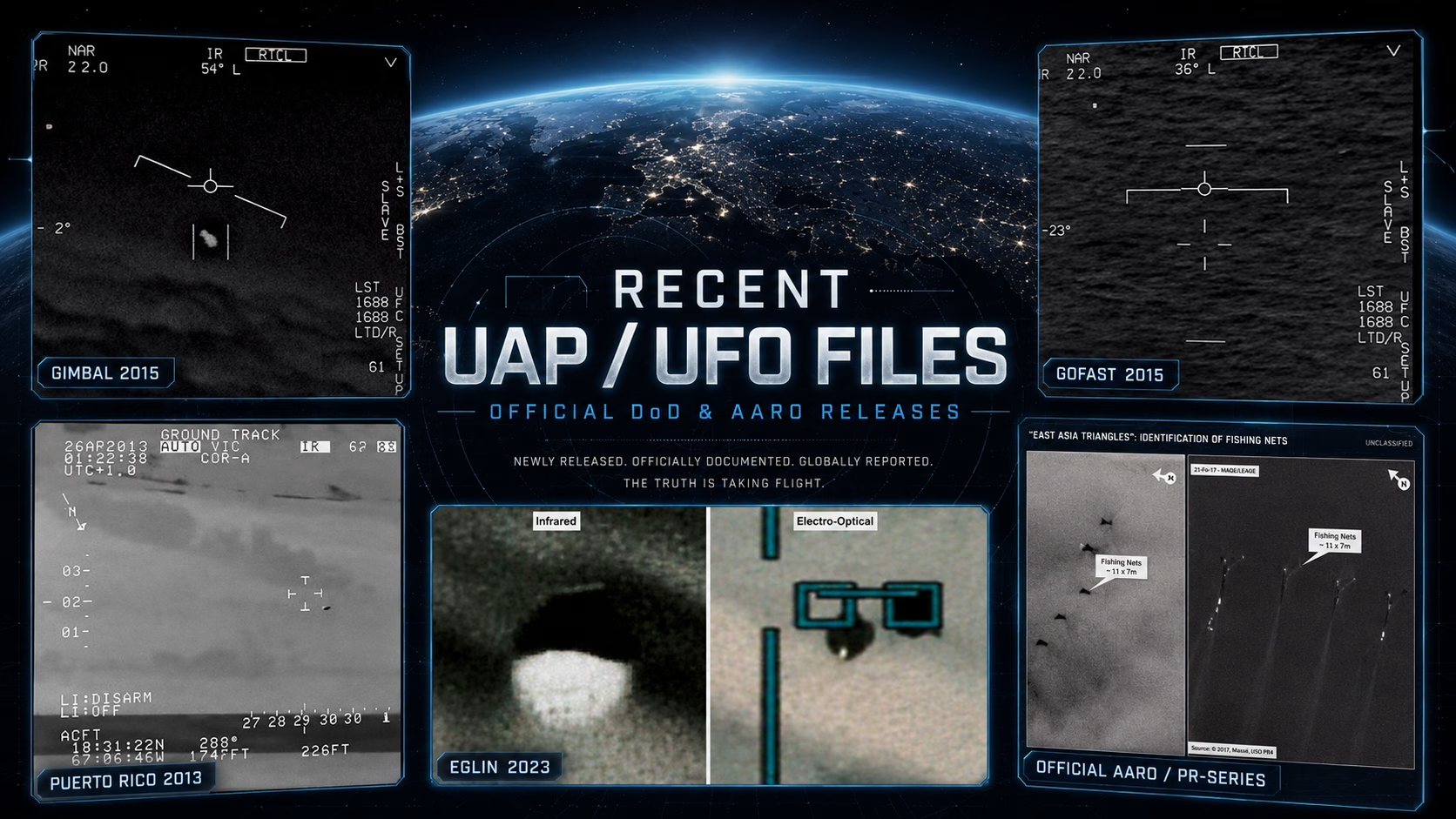
On May 8, 2026, AARO added a substantial group of military mission reports and videos to its public UAP collection. The release includes incidents from the Persian Gulf, Strait of Hormuz, Syria, Iran and the Gulf of Aden, along with short sensor recordings labelled PR-027 through PR-031.
The material does not arrive with a dramatic conclusion. Several entries contain only a narrative description and a warning that the description should not be read as an analytical judgment. That restraint can feel frustrating, but the files are valuable precisely because they expose the raw middle stage between an operational report and a resolved case.
Some observations may eventually receive ordinary explanations. Others contain features that deserve deeper analysis. The May 2026 release shows both the strength and the weakness of modern UAP evidence: sophisticated military sensors captured real events, yet the public often receives only a few seconds of imagery without the full technical context needed to identify them.
A release built from operational reporting
These are not anonymous internet clips. U.S. Central Command submitted the observations through military channels, often with accompanying mission reports. That gives the material a documented origin, incident date, region and sensor platform.
Provenance does not establish what an object was. It does establish that personnel recorded something they could not identify during operations and considered it worth reporting.
The newly listed mission reports span multiple years, including events from 2020, 2023 and 2024. Their 2026 publication date therefore marks disclosure, not the date the encounters occurred.
PR-028: the diamond-shaped object
PR-028 may be the most striking entry in the group. According to the accompanying description, a U.S. military platform recorded an area of contrast in 2024 using multiple sensor modes. The mission report described it as diamond-shaped and moving at approximately 434 knots.
The object was visible in short-wave infrared, or SWIR, but apparently disappeared when the operator switched to the visible spectrum. In the video description, it resembles an inverted teardrop with a narrow feature extending below it.
That combination is intriguing, but it raises technical questions. Was the reported speed measured from radar or estimated from the image? What was the range? Was the sensor tracking the object or holding a point in the background? Could atmospheric effects or glare account for the apparent shape?
Visibility in one wavelength and not another can reveal material properties or temperature differences, but it can also reflect contrast limits and sensor settings. Without calibration data, the switch between SWIR and visible light cannot carry the entire conclusion.
PR-029: object or reflection?
PR-029 contains 21 seconds of infrared footage from another 2024 event. The report describes an object with a vertical pole or bar beneath it. The observer also considered that it might be a reflection from something in the water.
That alternative is important. It shows that the original reporting process did not begin with a single fixed interpretation. The observer noticed an unusual form while also recording a possible environmental explanation.
A proper analysis would compare the object’s apparent motion with waves, platform movement, viewing angle and the position of surface vessels. A reflection could appear suspended or distorted in infrared. An airborne object above water could produce a similar two-part image. The short clip alone leaves room for both.
PR-031: five seconds at the edge of the frame
PR-031 is even more limited. It consists of five seconds of full-motion video from a military platform in 2024. The mission report described a misshapen, uneven ball of white light and mentioned a glare or halo near the top of the sensor feed.
The public description says a multicoloured area crosses the upper edge of the display within the first second. That location matters. Objects near the edge of an optical system can be affected by lens distortion, internal reflections and processing artefacts.
Five seconds may be enough to document that something appeared. It is rarely enough to reconstruct true distance, speed and trajectory. The case illustrates why disclosure of a clip is only the beginning of analysis.
PR-027 and the role of platform motion
PR-027 contains almost five minutes of infrared footage from a 2023 event, although the description says the first portion contains no relevant content. After the object appears, the sensor pans and zooms to keep it in view.
Later, movement of the sensor causes the area of contrast to sweep erratically across the display while the system repeatedly loses and reacquires it. That behaviour can look like sudden object acceleration if the viewer does not separate target motion from camera motion.
This does not mean the object was ordinary. It means any speed claim must account for the platform, gimbal and field of view. A stable point in the world can move violently on a screen when the camera changes direction.
What the mission reports add
The written reports are often more useful than the compressed public video. They can preserve what the crew observed, which sensor mode was used, how the object was described and whether additional systems detected it.
They also show where critical information is missing. A video without range data cannot provide physical size. A speed estimate without a clear calculation cannot establish extraordinary performance. A cropped clip may hide the moments before and after the event that explain it.
For serious researchers, these gaps are not an excuse to dismiss the case. They are a checklist for what should be released next.
Why this still represents disclosure
Critics sometimes argue that a release is meaningless unless it proves a non-human origin. That sets the threshold incorrectly. Disclosure is the process of making records available so that claims can be evaluated. Proof, if it exists, would emerge from the quality and convergence of that evidence.
The May files broaden the public record. They identify more operational encounters, expose the language used in mission reporting and provide cases that can later be compared with flight data, satellite positions, weather and additional sensor records.
At the same time, transparency remains incomplete. The public versions do not provide everything needed for independent reconstruction. Sensor specifications, full unedited footage and precise geometry may be classified or withheld.
Strong evidence requires convergence
A single infrared shape can be ambiguous. The strongest UAP case would combine calibrated infrared and visible imagery with radar tracks, known platform location, reliable range, multiple independent observers and a record of environmental conditions.
When several systems agree, explanations based on one camera artefact become less likely. When only one short clip exists, uncertainty remains large even if the source is official.
The wider UAP case rests on accumulation: trained testimony, sensor events, official records and recurring patterns across countries and decades. The May 2026 release adds real weight to that record. It does not yet tell us what every object was.
That is not a failure. It is the work still in front of us.
Related reading


latest video



news via inbox
Subscribe to our Cosmic newsletter to get notified when we have new articles.