Why UAP Videos Can Mislead Even When Witnesses Are Honest
A UAP video can be authentic and still create a false impression. The pilot may be truthful. The sensor may be functioning normally. The object may be physically present. Yet the image on screen can make it appear faster, stranger or more structured than it really is.
This is not an argument for dismissing UAP footage. It is the opposite. Understanding how cameras, infrared systems and viewing geometry can mislead us is necessary if we want to identify the cases that remain extraordinary after those effects are removed.
Good UAP video analysis begins with a simple rule: the screen shows angles and contrast, not automatic measurements of size, distance or speed.
The missing dimension: distance
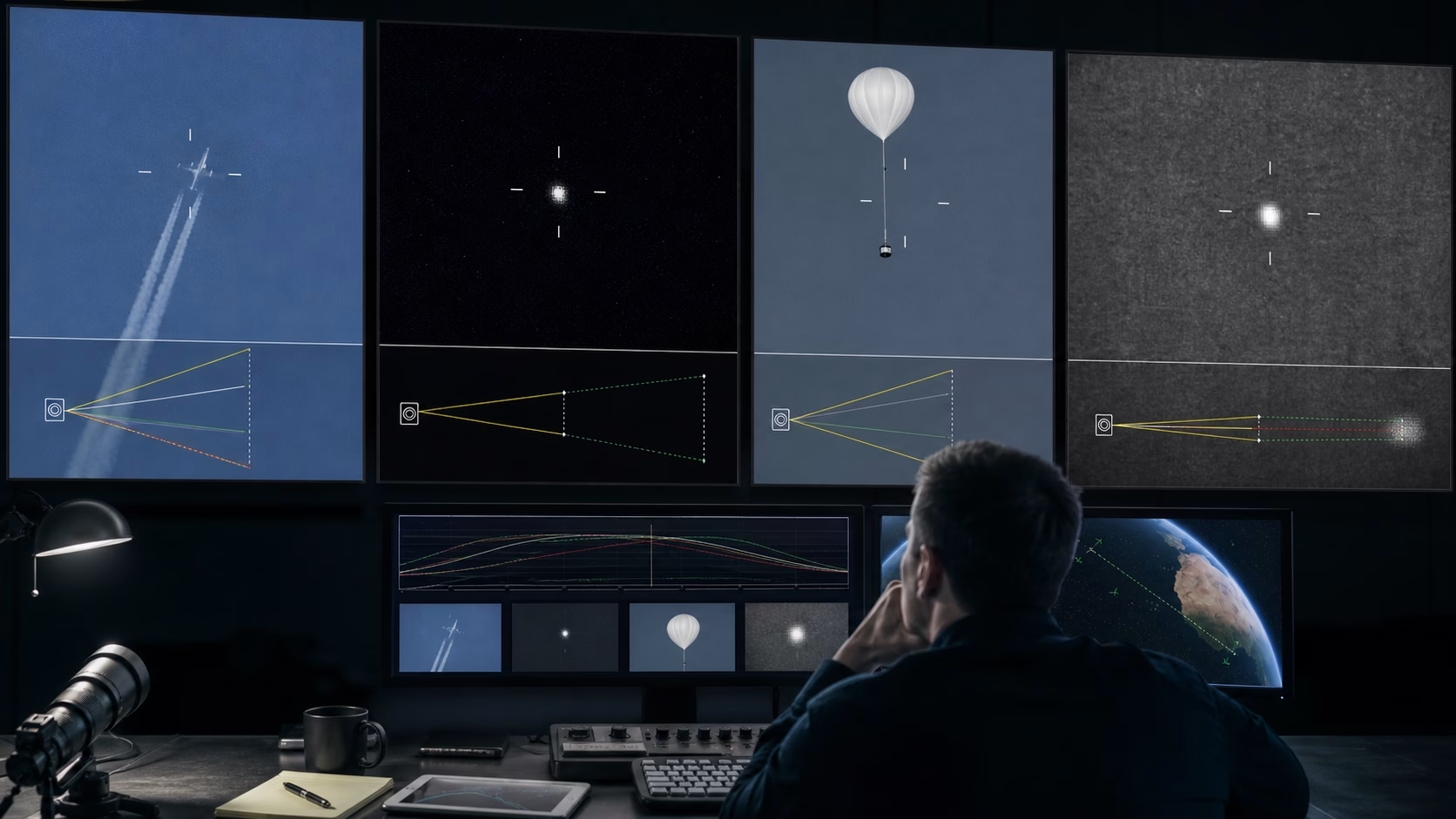
A camera records where an object appears in its field of view. Unless the system also knows the range, it cannot tell whether the object is small and close or large and distant.
This ambiguity affects every later calculation. An object crossing ten degrees of the image could be a nearby bird moving slowly or an aircraft many kilometres away travelling hundreds of kilometres per hour.
Human vision normally estimates distance through familiar size, stereo vision, atmospheric haze and movement relative to nearby objects. A zoomed sensor view of an isolated dot removes most of those cues.
Parallax can create impossible speed
Parallax is the apparent movement of an object against the background when the observer changes position. Hold a finger in front of your face and move your head; the finger seems to jump across the distant room.
The same effect occurs when an aircraft-mounted camera observes a slower object below. The aircraft may be travelling at high speed while banking around the target. A balloon can then race across the ground in the background even though its own motion is modest.
The famous GOFAST video illustrates why geometry matters. Its name encourages viewers to assume extraordinary speed, but calculations using displayed sensor data can produce a much lower target speed when range, altitude and wind are included.
Debate remains about exact assumptions, but the central lesson is sound: image motion is not ground speed.
Infrared does not show a normal photograph
Infrared sensors display differences in thermal radiation. Operators can choose white-hot or black-hot modes, adjust gain and change contrast. A hot engine can bloom into a larger shape, while a cooler object may nearly disappear against a background of similar temperature.
Glare is especially important. Bright infrared sources can spread across adjacent pixels, producing a shape larger than the physical source. Optical components can also rotate glare patterns as the gimbal moves, giving the impression that an object itself is rotating.
This does not mean every rotating-looking UAP is glare. Analysts must compare the apparent rotation with changes in the sensor’s orientation and optics.
Compression turns detail into blobs
Military and consumer video is often compressed. Compression saves bandwidth by simplifying areas that change little between frames. Tiny distant objects may occupy only a few pixels, so the algorithm can merge fine structure into blocks or halos.
A bird’s flapping wings can appear as flickering. Several nearby objects can merge into one. A point of light can develop angular edges that resemble a solid geometric craft.
Re-uploading a video makes this worse. Social-media copies may be cropped, resized and compressed repeatedly. Analysis should use the earliest available file, not a recording of a recording.
Autofocus and digital stabilisation
Smartphones perform hidden work. Autofocus searches for a sharp image. Exposure changes as a bright point enters the frame. Digital stabilisation shifts and crops frames to counter hand movement.
At night, these corrections can make a distant light pulse, split or move relative to another light. If the background is black, there may be no fixed reference to reveal what the software changed.
The witness is not lying. The camera is not “fake.” The device is solving a photographic problem in a way that alters the appearance of a scientifically interesting target.
Satellite flares and moving constellations
Satellites can reflect sunlight directly toward an observer. The result is a flare that appears suddenly, brightens and fades. Large constellations create repeated patterns, especially when several satellites share similar orbits.
To a pilot at night, distant flares can seem to appear in the same region, move in formation or remain above the horizon. Without orbital modelling, they may look like manoeuvring lights at extreme altitude.
AARO says three-dimensional satellite-flare modelling resolved hundreds of reports from its backlog. That does not reduce the importance of other cases. It improves the baseline by removing a repeating source of confusion.
What makes a strong UAP video?
The best case is not necessarily the sharpest image. A clear-looking object without range or metadata may be less useful than an indistinct object detected by several independent systems.
Strong evidence combines known time and location, calibrated sensors, continuous footage, platform telemetry, range information, radar, visible and infrared imagery, and independent witnesses. Weather, satellite positions and air-traffic data should also be preserved.
If an object displays extraordinary acceleration, analysts must show that the movement remains after camera motion, tracking changes and parallax are removed. If it appears to enter water, they must rule out line-of-sight overlap and loss of contrast.
Why debunking is not the goal
There is a difference between investigation and reflexive debunking. Debunking starts with a desired ordinary answer and searches for anything that resembles it. Investigation tests multiple explanations and asks which one accounts for all available data.
A balloon explanation is strong when size, wind, altitude and trajectory match. It is weak when “balloon” is used only because the object looks round. An unresolved label is appropriate when no explanation fits the full record.
The same standard applies to extraordinary claims. A case should not be called non-human simply because a familiar explanation has not yet been found.
Removing errors strengthens the mystery
The accumulated UAP evidence includes credible witnesses, official documentation and multisensor encounters. It is not erased when some videos turn out to show aircraft, birds or satellites.
Every resolved case improves our ability to recognise what is normal. What remains after rigorous analysis becomes more interesting, not less.
The question is not whether cameras can mislead. They can. The question is whether a case still resists explanation after the camera, observer, atmosphere and surrounding traffic have all been accounted for.
That is where the real mystery begins.
Related reading


latest video

news via inbox
Subscribe to our Cosmic newsletter to get notified when we have new articles.