The Thorium Nuclear Clock Is Working. The Breakthrough Is Its Feedback Loop.
A clock needs more than something that oscillates. It needs a way to notice when that rhythm drifts and bring it back. That feedback problem is at the centre of the thorium nuclear clock reported by researchers at TU Wien and Germany’s PTB this month.
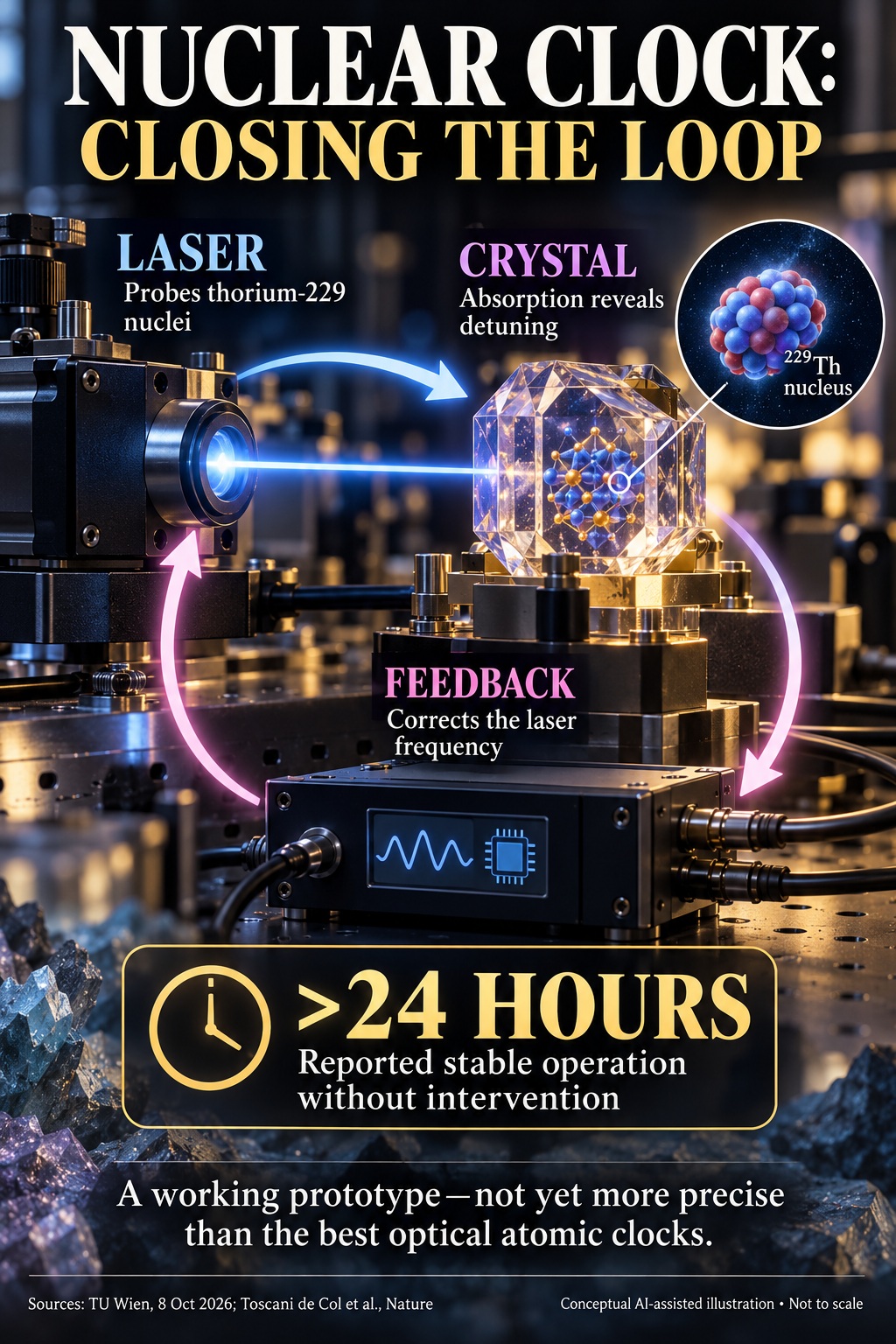
The prototype uses a transition inside thorium-229 nuclei as its reference. TU Wien’s 8 October 2026 announcement says the self-regulating system remained stable for more than 24 hours without intervention. The milestone is a working clock architecture, with substantial improvements still ahead.
What makes a thorium nuclear clock different?
Conventional atomic clocks use transitions associated with electrons. A nuclear clock instead takes its reference from an atomic nucleus. Thorium-229 is particularly useful because one of its nuclear transitions is unusually accessible to laser light.
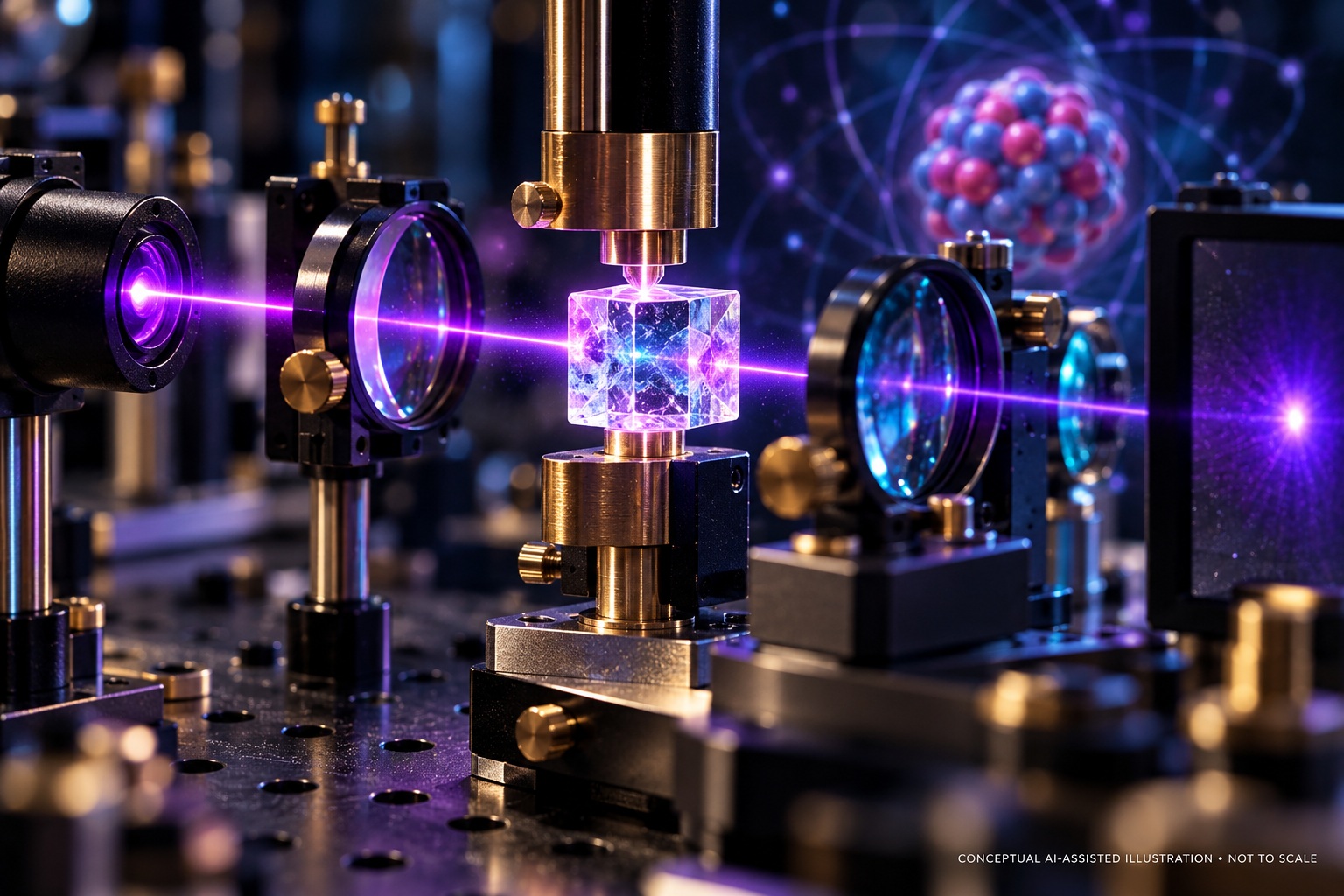
The European team’s Nature paper, published on 7 October, describes thorium nuclei embedded in a calcium-fluoride crystal and a laser stabilised to the nuclear transition through rapid feedback based on absorption measurements.
“Nuclear” therefore describes the reference being interrogated. This is a precision-measurement experiment, not a clock powered by a nuclear explosion or a tiny reactor. The scientific interest lies in what the nucleus offers as a stable physical standard.
How the feedback loop keeps time
The TU Wien explanation gives the central idea clearly. Thorium nuclei absorb the probing light when its frequency is correctly tuned. If the laser drifts away, absorption changes. That information is used to correct the laser frequency.
The loop turns a physical response into an error signal and then into a correction. A clock laser can supply regular oscillations; the nuclei provide a way to test whether those oscillations remain tied to the desired reference.
There is a useful difference between measuring a resonance once and continually using it to steer an oscillator. The first tells researchers where the transition is. The second is part of operating a clock that can keep referring back to it.
Is this already the world’s most accurate clock?
No. TU Wien explicitly says the prototype has not yet reached the level of the best optical atomic clocks. Its significance is that the nuclear-reference system operates with self-stabilisation, rather than that it has already won every precision comparison.
The report gives a day-scale precision around one part in a thousand trillion. Its comparison with roughly one second in 30 million years is a way to express that fractional scale, not a claim that a device has been tested over geological time.
Stability, systematic error and reproducibility also describe different aspects of performance. A clock that fluctuates little during one measurement interval can still need careful investigation of environmental shifts. Those distinctions matter when comparing future records.
Why two independent nuclear-clock results matter
A second Nature study, led by Shiqian Ding’s team, reports a nuclear clock synchronised to thorium-229 using a different implementation. It also compares results from independently fabricated crystals.
Independent implementations make the field more informative. They create opportunities to compare what is common to the nuclear reference with what depends on the surrounding apparatus or crystal. Agreement and disagreement can both point to useful next experiments.
That does not make the devices identical or their reported figures directly interchangeable. A fair comparison needs to ask what was measured, for how long, under which conditions and with which uncertainty estimate.
What could the thorium nuclear clock make possible?
The researchers present the platform as a route towards better timekeeping and precision tests of fundamental physics. Those possibilities remain development goals. A laboratory prototype is not automatically a portable instrument ready to replace existing clocks.
The potential is nevertheless striking: a different physical reference can respond differently to perturbations and to possible changes in fundamental parameters. Comparing clocks with different sensitivities is one way to ask questions that a single clock cannot answer alone.
For the wider scientific context, see our guide to using clock networks as quantum sensors. Our report on single-atom nuclear-spin control explores a distinct experiment involving nuclei; it should not be confused with the thorium clock demonstration.
The next chapter will be written in stronger lasers, improved crystals and better-characterised uncertainties. For now, the important result is that the feedback loop closes—and the nuclear reference can help keep the clock on rhythm.



latest video



news via inbox
Subscribe to our Cosmic newsletter to get notified when we have new articles.