How a Fireball Meteor Was Traced From Space to Stones on the Ground
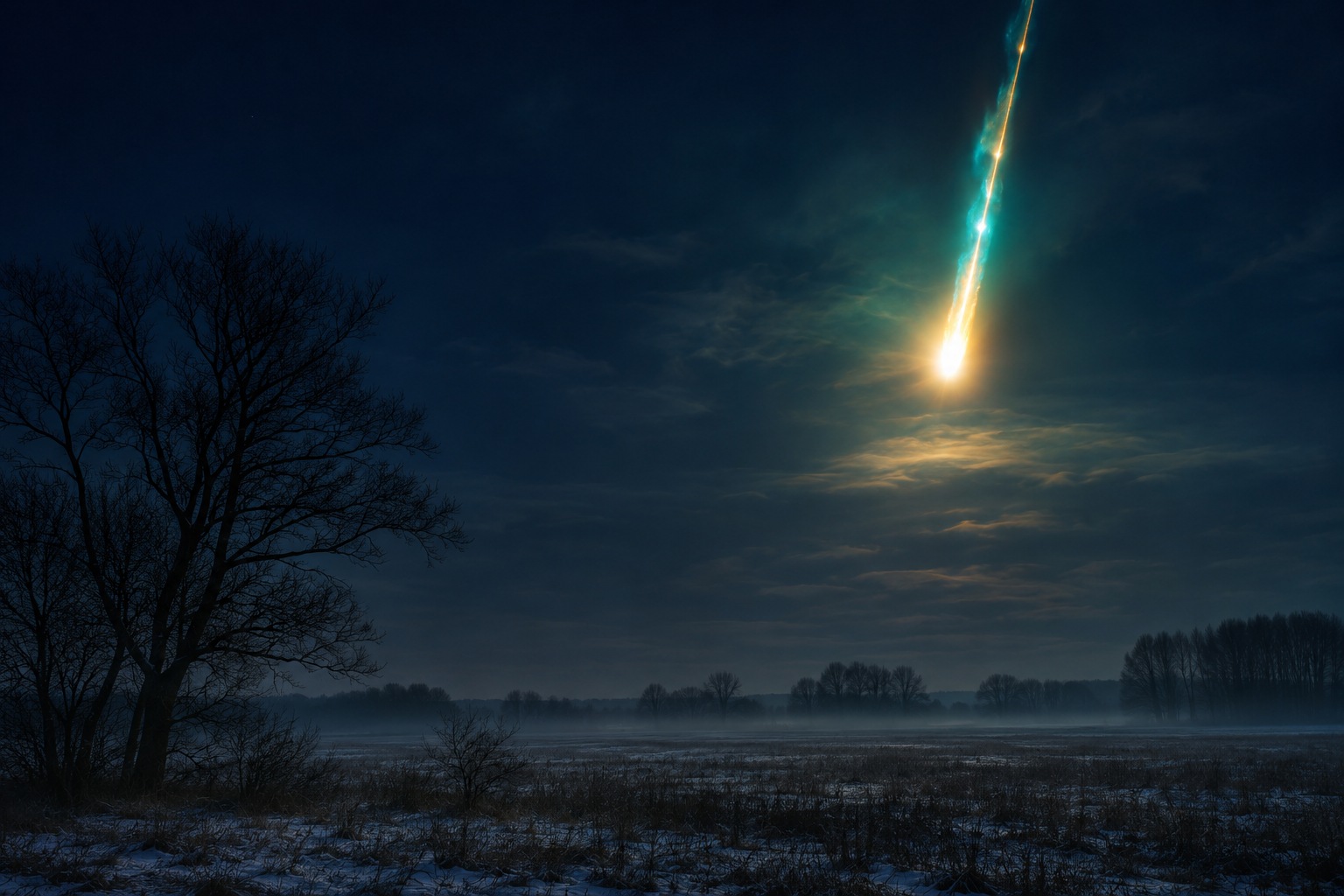
A fireball meteor can light up a landscape in seconds. The evidence it leaves behind can take days to assemble. In January 2024, astronomers in Hungary spotted a small incoming asteroid roughly three hours before it produced a brilliant fireball over Germany. Cameras caught the light, and searchers later recovered meteorites near Ribbeck. The unusual thing was how much researchers could learn about the same object before, during and after entry. ESA’s 2024 BX1 case record.
Researchers discussed that chain of observations at the European Commission and ESA workshop on meteor observations for planetary defence, held 3–5 November 2026 in Sicily. It also helps answer a question people ask when the Taurids are active. If you see a bright flash, what would allow anyone to say where it came from or whether anything survived? Workshop programme.
What is a fireball meteor?
A meteoroid is a natural object travelling in space. The visible event it produces on entering the atmosphere is a meteor, and a particularly bright meteor is called a fireball. Any solid piece recovered after it reaches the ground is a meteorite. Those terms mark different stages, and each stage can be investigated with a different tool. NASA’s meteor and meteorite guide.
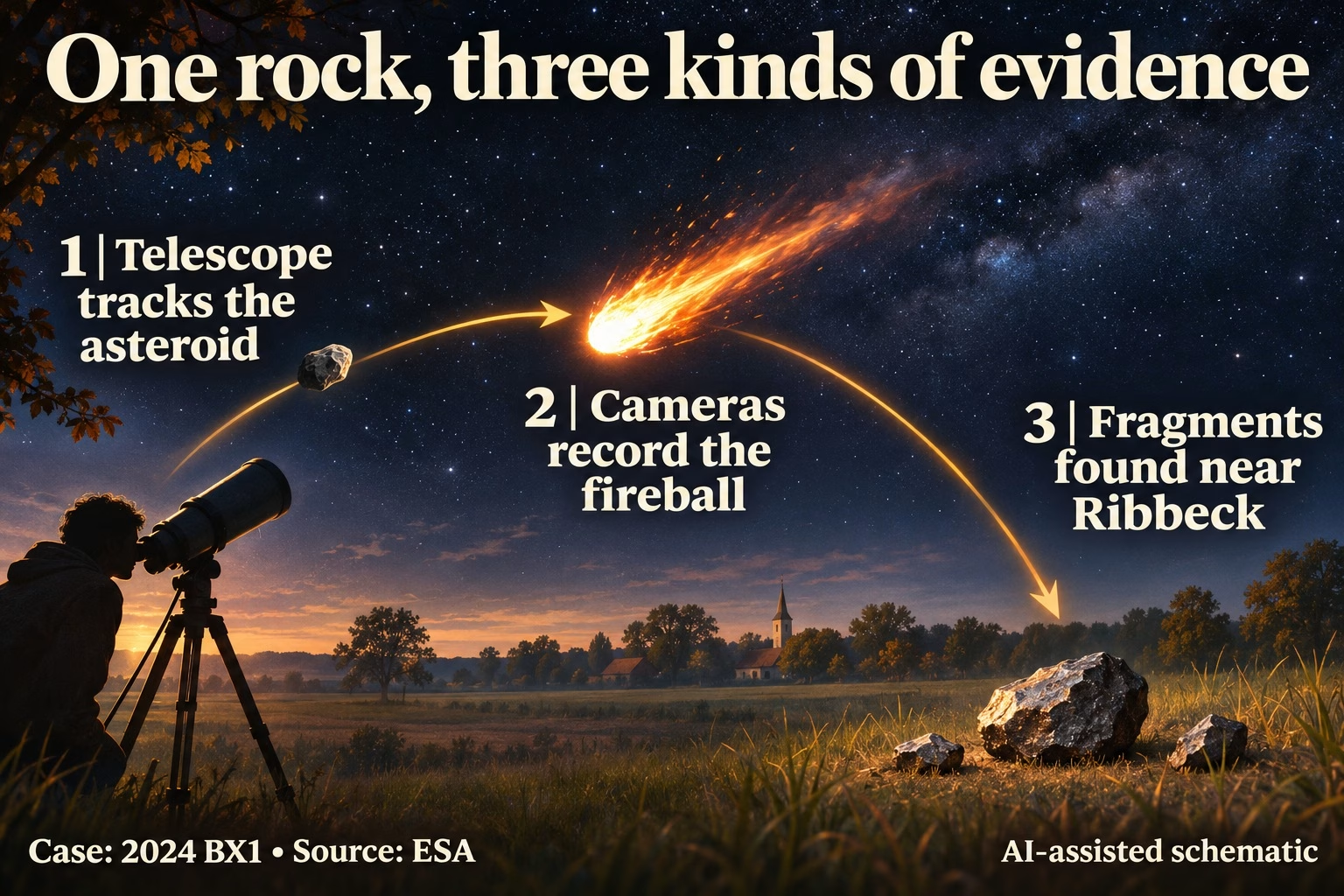
In the case of 2024 BX1, astronomer Krisztián Sárneczky first saw a moving point of light from Piszkéstető Observatory on 20 January. Other observers gathered more positions and shared them through the Minor Planet Center. Each new position helped constrain where the object was heading. ESA’s Meerkat system was among those that issued an impact alert. Astronomers expected atmospheric entry west of Berlin, and a fireball appeared over that region at about 00:32 UTC on 21 January. ESA’s account of the warning.
How cameras turn a streak into a path
A single camera records the direction of a bright streak from one position. From that recording alone, it can be difficult to tell how far away the light was. When cameras at known locations record the same event, their lines of sight can be compared to reconstruct a path through the atmosphere. Accurate timing can help researchers estimate the speed and see where the object slowed or flared.
Camera networks recorded the German fireball. Instruments that measure brightness and split the light into a spectrum detected it too. Other events may also be picked up by instruments that listen for low-frequency sound, or by radar. These observations cover different parts of the event. A pre-entry telescope measures where the rock was heading in space, while the fireball measurements capture what happened as it met the atmosphere. Atmospheric observations of 2024 BX1 and workshop talks on camera networks, radar and modelling.
Where does a fireball meteor leave fragments?
Once surviving pieces have slowed enough to stop glowing, their fall continues in darkness. Researchers call this part dark flight. Wind can push fragments away from the path marked by the visible streak. Small pieces slow quickly and can drift farther than heavier pieces. That is one reason a search team models a region where fragments might land instead of heading straight for the apparent end of a trail.
For 2024 BX1, researchers combined fireball observations with local wind data. The predicted fall area ran near Ribbeck. Searchers found the first meteorite on 25 January. Specialists classified the material as an aubrite, a type of stony meteorite. Laboratory analysis could then investigate the composition of an object that telescopes had tracked before it reached the atmosphere. ESA’s record of the Ribbeck meteorite recovery.
What a Taurid sighting can establish
The Southern Taurids peak around 5 November this year, according to NASA’s skywatching guide. An occasional fireball can stand out even when the shower’s overall rate is modest. However, the date alone cannot assign a flash to the Taurids. Researchers also look at its trajectory and speed, including whether it appears to come from the expected area of the sky. The 2024 BX1 event took place in January and serves here as a documented example of how an identification is built. NASA’s November 2026 skywatching guide.
If you witness a bright flash, the observation time and location, the directions where it started and ended, and any original footage can help people compare your report with other records. The same habit of recording a sighting before interpreting it also matters in our account of how pilots report unexplained observations.



latest video

news via inbox
Subscribe to our Cosmic newsletter to get notified when we have new articles.