
ORCA neutrino telescope tests relativity beneath the Mediterranean
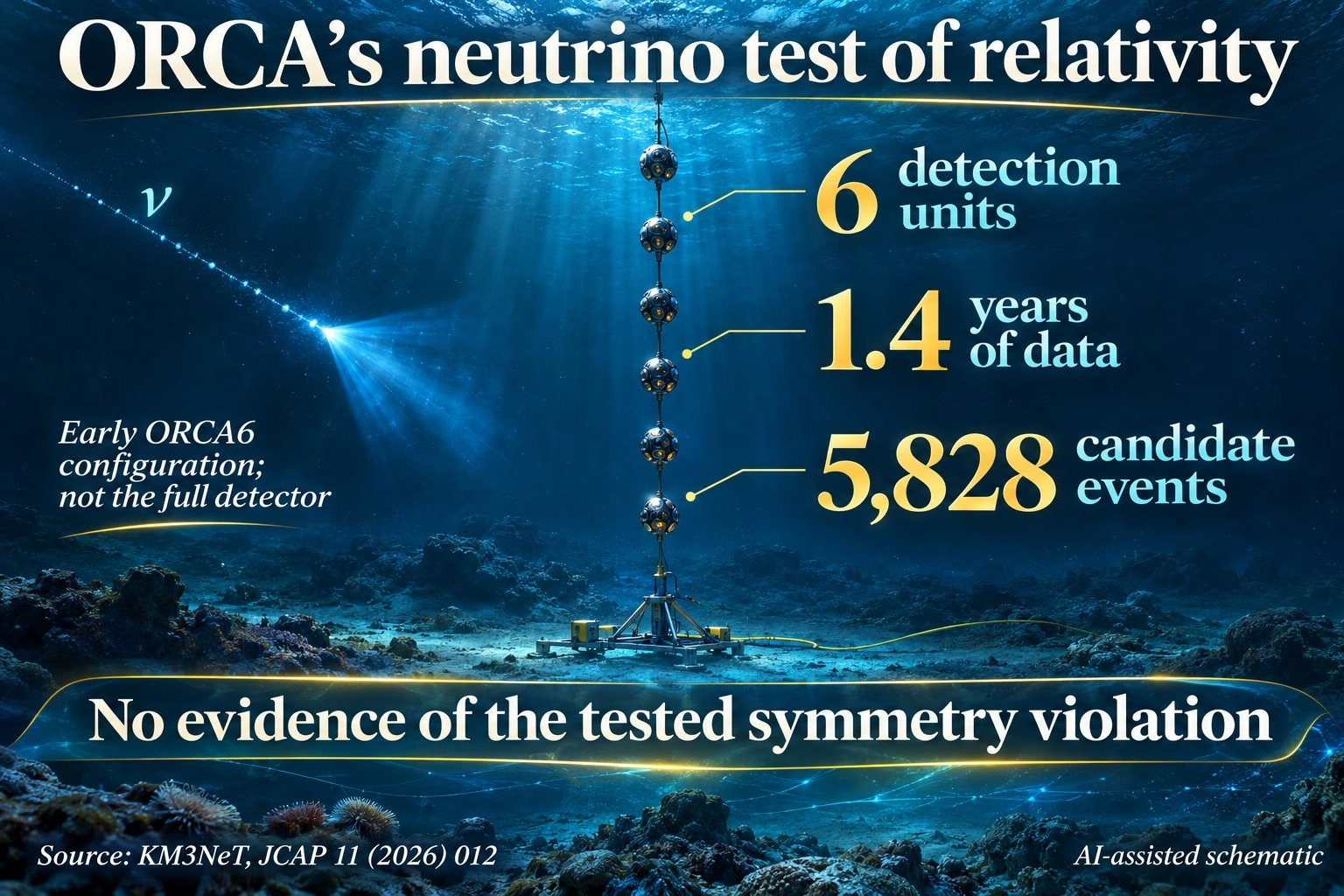
The ORCA neutrino telescope has used particles passing through Earth to test a symmetry at the heart of modern physics. The result found no evidence of the particular violation the team searched for. Even so, it sets useful limits on how strongly certain new effects could alter neutrino behaviour. Published on 4 November in the Journal of Cosmology and Astroparticle Physics, the analysis uses 5,828 selected atmospheric-neutrino candidate events from an early, six-unit version of the detector. The published research paper.
ORCA sits deep in the Mediterranean off Toulon, France. Its location supplies a large volume of clear water in which sensitive instruments can look for faint light. That light is the final link in a chain that begins with particles colliding in the atmosphere and ends with a statistical comparison between data and competing descriptions of nature.
How the ORCA neutrino telescope sees a particle
A neutrino does not arrive as a little glowing object. Most pass through matter without leaving an observable trace. When one interacts within or near the detector, it can produce charged particles that emit Cherenkov light in the water. The timing and distribution of those flashes help researchers reconstruct the event’s direction and energy.
KM3NeT’s optical modules place multiple light sensors inside pressure-resistant glass spheres. Each detection unit holds a vertical series of modules, anchored to the seabed and supported by buoyancy. Together, the units turn a volume of water into an instrument. Their sensor arrangement and timing information help reconstruct where a signal came from. KM3NeT’s optical sensors; the detection-unit design.
Natural light in the sea adds a background. Radioactive decays and living organisms can produce photons, so a useful event has to show a pattern consistent with particles passing through the detector. Instrument monitoring, trigger rules and reconstruction all contribute to that selection.
What does relativity have to do with neutrinos?
The study concerns Lorentz invariance, a symmetry underlying relativity and the Standard Model of particle physics. In broad terms, the physical laws should retain their form when observers describe them from different uniformly moving frames of reference. Physicists can look for small departures from that expectation in systems where a tiny change would accumulate into a measurable effect.
Neutrinos offer one such system. They occur in three flavours, associated with the electron, muon and tau. As they travel, the probabilities of detecting those flavours change through neutrino oscillations. Certain proposed symmetry-violating effects would modify that pattern. The ORCA analysis tested an isotropic set of possibilities, meaning the assumed new effect has no preferred spatial direction. The collaboration’s explanation of the search.
Why use neutrinos that crossed Earth?
The atmosphere produces a large background of other particles as well as neutrinos. For that reason, the team selected events reconstructed as travelling upward through the detector, using Earth to screen out atmospheric muons. Further classification helped reduce events whose directions had been reconstructed incorrectly. The analysis then compared the energy and direction distributions with simulations.
The distinction matters because 5,828 is a selected candidate-event count. Event reconstruction and background estimates are part of the measurement. Treating the sample as thousands of individually photographed neutrinos would give the wrong picture of how the result was obtained.
What the result establishes
The ORCA neutrino telescope analysis used 1.4 years of data from the early ORCA6 configuration. It found no evidence for the tested Lorentz-invariance violation and constrained several coefficients describing possible effects. The published paper also reports the first direct constraints on certain flavour-diagonal differences between the muon and tau sectors. These are specific statements about the models and parameters examined.
A limit gives theorists a boundary to work with. A proposed effect that would noticeably distort this dataset must fit within the allowed range. However, other possibilities require different measurements, more events or another energy range. The result therefore strengthens an experimental test while leaving a clear path for further work.
The ORCA neutrino telescope’s next measurements
KM3NeT uses two related detector designs. ORCA has a denser arrangement suited to lower-energy neutrinos, while ARCA is designed for high-energy cosmic neutrinos. The collaboration’s detector overview explains how the different spacing serves those goals. In addition, a larger ORCA dataset can support more sensitive tests than this early configuration. The ARCA and ORCA designs.
Detector design shapes the questions researchers can ask. Our article on the DUNE neutrino detector follows another approach to reconstructing these elusive interactions. ORCA’s new result shows what a relatively small early array could already measure through careful event selection and comparison.



latest video



news via inbox
Subscribe to our Cosmic newsletter to get notified when we have new articles.