Horbourg-Wihr burials reveal a fifth-century community in transition
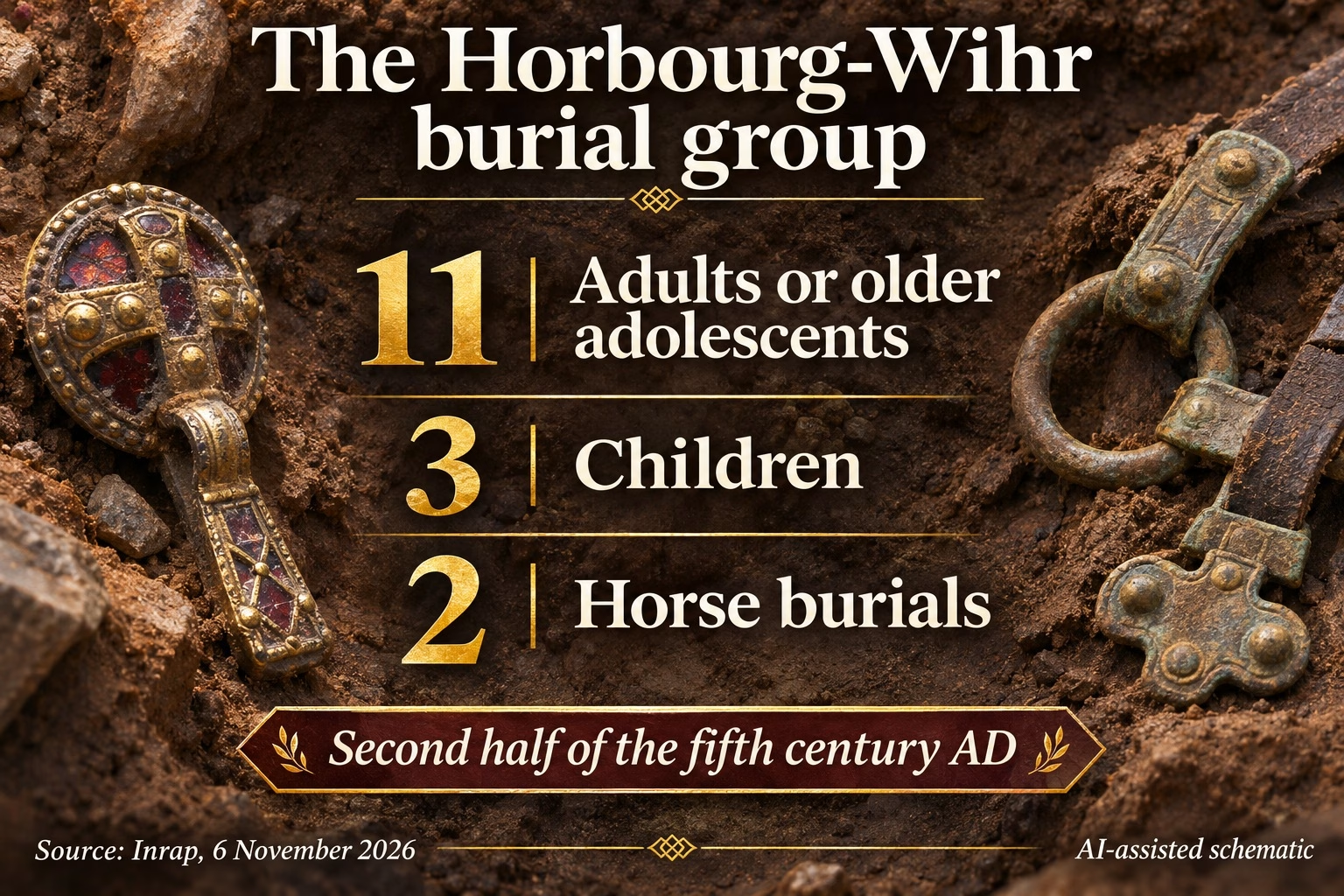
The Horbourg-Wihr burials place a small group of people and horses within a changing landscape at the end of Roman rule. Inrap’s newly published account describes fourteen human graves and two horse burials near Colmar in northeastern France. The funerary group dates to the second half of the fifth century AD. Weapons, jewellery and harness fittings make the discovery striking, while planned study of the bones may reveal more about the people in the cemetery. Inrap’s announcement of 6 November 2026.
The find comes from a preventive excavation before housing construction. Its interest extends beyond the finest objects. A cemetery records choices made about the dead: whom a community buried together, what accompanied them and how the graves occupied an older settlement. Those relationships give the objects a historical setting.
What the Horbourg-Wihr burials contain
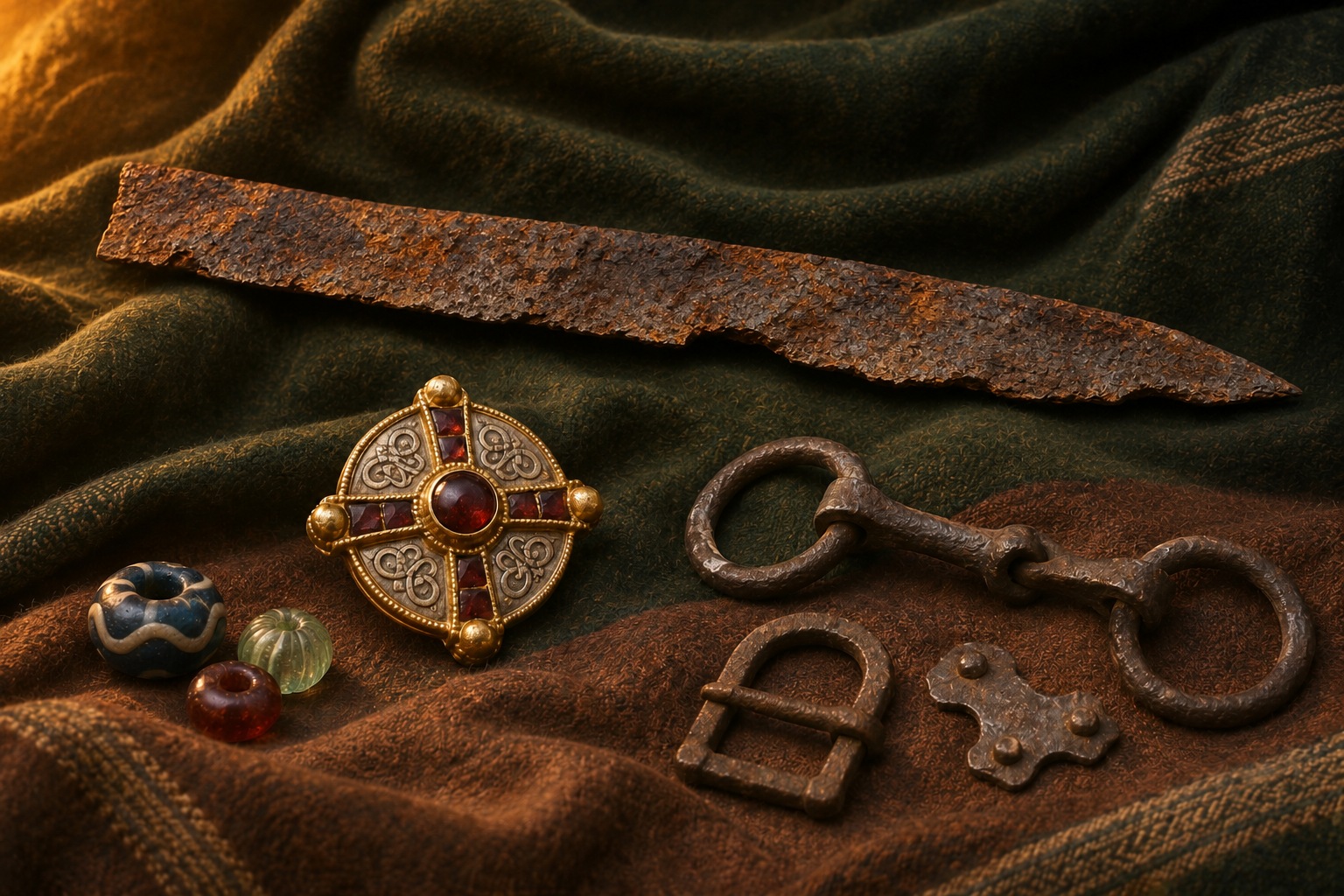
Inrap reports eleven graves of adults or older adolescents and three of children, alongside two equine burials with harness equipment. Two male burials contain especially rich weapon deposits, while other graves include dress fittings and ornaments. The archaeologists interpret the assemblage as evidence of privileged people, potentially connected with Germanic military elites or troops serving within the Roman military system.
That interpretation concerns the group’s material culture and social position. It does not provide the names of the dead or a complete account of their origins. The distinction matters in a period often described through broad labels such as “Roman,” “Germanic” and “Merovingian.” A useful next question is how different kinds of evidence might test the proposed connections.
A cemetery above an older town
Horbourg-Wihr already has a substantial archaeological history. At a separate project near the centre of the ancient settlement, Archéologie Alsace describes research beginning with a 2015 diagnostic and continuing through planned excavation from 2016. That work identified Roman-period buildings, a road and later burials. It provides context for the wider town, rather than an additional count of graves in the newly announced Inrap group. Archéologie Alsace’s account of the earlier project.
Placing the projects side by side suggests why a single excavation cannot tell the whole settlement’s story. Streets, houses and burial areas may each change at a different pace. A sequence of buildings in one trench and a cemetery in another must be connected through their dates and their positions before they become a shared history.
Reading objects that survived the burial
Cemeteries are a major source for understanding the early medieval period. Brussels’ Art & History Museum explains the problem through its displays of Merovingian graves from Harmignies in Belgium: clothing and wooden coffins have generally disappeared, while bones and objects made from materials such as metal, glass and bone can survive. The visible assemblage is therefore only part of what mourners originally placed in a grave. The museum’s explanation of burial evidence.
That is helpful context for the Horbourg-Wihr burials. An impressive ornament attracts attention, but its position relative to a body or another object can be just as informative. Likewise, the absence of an easily visible item needs to be assessed against preservation. The excavation record supplies relationships that a photograph of a cleaned object cannot show on its own.
What the Horbourg-Wihr burials may reveal
Inrap’s field observations include possible weapon injuries in two individuals. The team says forthcoming anthropological analysis will help confirm those observations. They are clues to investigate, rather than a finished reconstruction of a battle or the circumstances of each death.
The broader investigation continues after work in the trench. France’s Culture Ministry describes preventive archaeology as both a field phase and a post-excavation phase, when specialists study the material and prepare the operation report. Objects and documentation are then conserved for further research. How preventive excavation and subsequent study work.
For readers following this discovery, the next useful development will be the results of that analysis. How confidently can specialists characterise the injuries, and how does the burial group fit the surrounding settlement? Those questions retain the human importance of the find while keeping the evidence in view.
Our report on the Iron Age and Roman wells in Hampshire follows another place reused across different periods. At Horbourg-Wihr, the relationship between an older town and a later burial community offers its own way into a changing past.



latest video



news via inbox
Subscribe to our Cosmic newsletter to get notified when we have new articles.