A Lifeless Earth Model Helps Separate Habitable Worlds From Living Ones
A lifeless Earth model offers an unusual way to sharpen the search for aliens: start by building a planet with no organisms at all. Researchers can then ask how much of a seemingly welcoming world its geology, atmosphere and star could produce on their own.
The approach matters because a planet that could support life is not automatically a planet that does. Oceans, a temperate surface and an atmosphere would make a distant world compelling. They would not, by themselves, identify anything living there.
What the lifeless Earth model is for
In a 2 November research announcement, the University of Washington describes a lifeless Earth model that links the planet’s interior to its surface and atmosphere while leaving out biology. Lead author Samantha Gilbert-Janizek developed the work as a UW doctoral researcher and is now a postdoctoral researcher at UC Riverside.
The study appeared in The Planetary Science Journal on 18 September 2026. This week’s attention concerns the published model and its implications. It is not an announcement that a telescope has found a lifeless Earth twin, or evidence of life on another planet.
The lifeless Earth model builds a comparison case. Before interpreting an atmosphere as evidence of biology, scientists need a credible account of what nonbiological processes could create. In that sense, an imagined empty world can make the search for living ones more rigorous.
What the lifeless Earth model connects
A planet’s atmosphere does not evolve in isolation. Heat and material move through its interior. Geological processes exchange chemicals with the surface, while incoming starlight affects the energy available to the climate. As a result, a change in one part can affect the others.
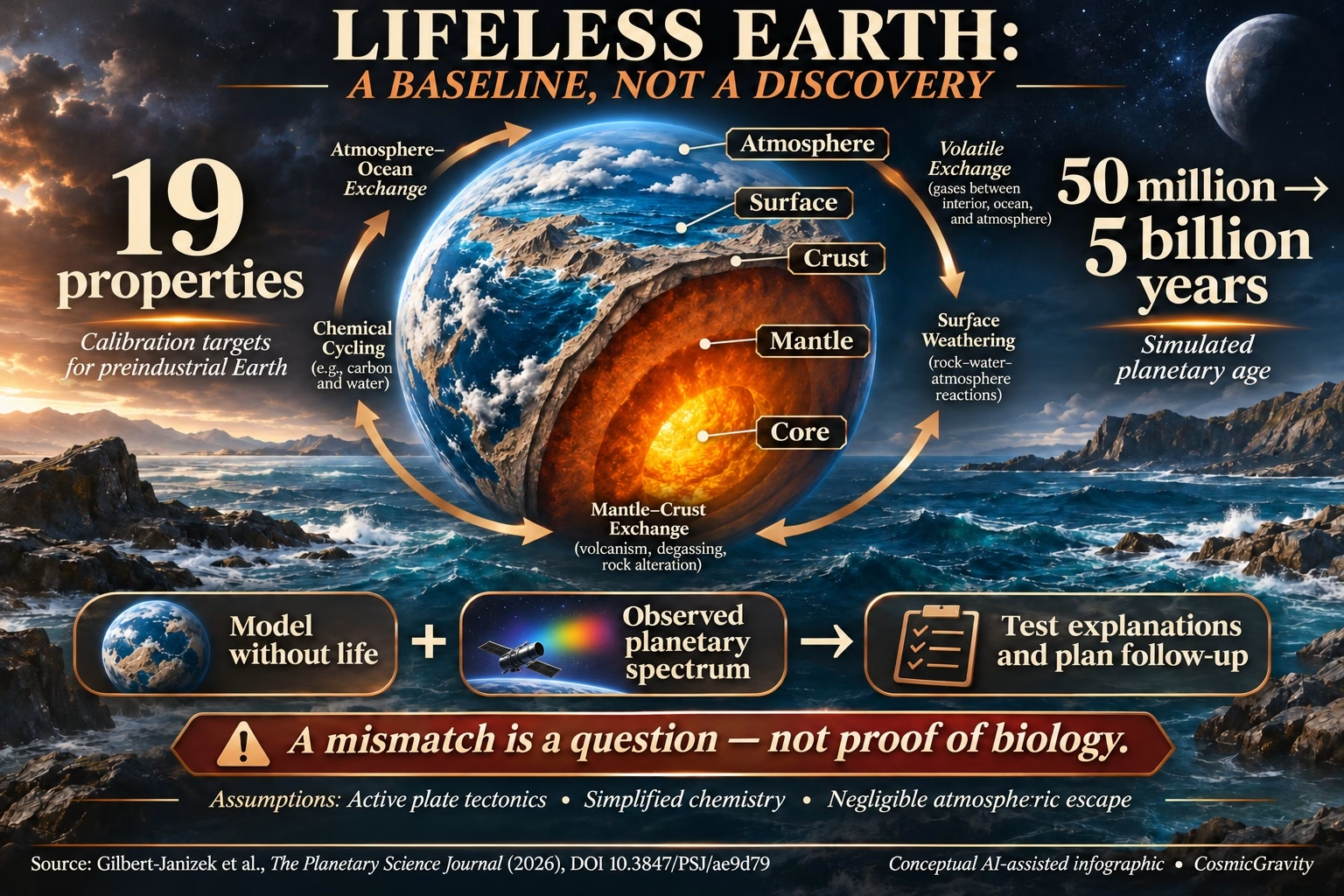
UW’s account explains that earlier modelling in Rory Barnes’s group covered interior processes and stellar radiation. Gilbert-Janizek added surface and atmosphere modelling to connect more of the planet’s chemical exchanges. That joins the core, mantle, crust, surface and atmosphere within one evolving system.
The published paper specifies a simulation spanning planetary ages of 50 million to five billion years. At an age of 4.5 billion years, it reproduces nineteen selected preindustrial-Earth properties within the authors’ estimated uncertainties. The paper also notes modest offsets in two ocean-chemistry parameters.
This is a calibration against particular targets, not a claim to reproduce every detail of Earth’s history. Its value lies in testing whether an internally connected, nonliving planet can reach broadly Earth-like geophysical and climatic conditions.
Habitable and inhabited are different conclusions
Consider a distant rocky world with evidence consistent with water and a climate that could permit liquid water at the surface. That would help answer a question about its environment. It would leave another question open: has life emerged, survived and altered that environment enough for us to notice?
The distinction is easy to lose when a headline turns a promising ingredient into a discovery. For example, water can be relevant to habitability without being a biological product. Carbon dioxide helps shape a climate without requiring a biosphere. Interpreting a combination of features requires context about the whole planet.
Our guide to exoplanet biosignatures and alien atmospheres explains the broader search. This new study adds a specific tool: an evolving geological comparison world against which a possible signal can be tested.
The lesson extends to chemical ingredients found closer to home. As our report on Ryugu’s nucleobases explains, material relevant to life and evidence of life are different findings.
What a planetary spectrum can and cannot say
UW highlights oxygen and methane as an example of why combinations of atmospheric gases can be interesting. On Earth, biological activity helps replenish gases that react with one another. An observer studying that mixture would need to ask what keeps supplying it.
That is a question about sources, sinks and persistence, rather than the mere presence of an unfamiliar feature. How quickly is a gas destroyed? What could replenish it? Could the star, rocks, ocean or measurement uncertainties account for the apparent result?
In this lifeless Earth model, atmospheric states can feed into calculations of reflected light, connecting a physical planet to a synthetic observation. The study compares the resulting nonliving atmosphere with an Earth-like biological case. It does not supply a universal checklist that decides whether every exoplanet is alive.
A model that matches an observation would show that a proposed nonbiological explanation remains possible. It would not prove that the real world contains no organisms. Conversely, a mismatch would invite investigation of the measurement, the model’s assumptions and other explanations. It would not automatically establish biology.
The assumptions that matter
The paper assumes active plate tectonics and negligible atmospheric escape, and uses simplified chemistry. Its comparison point is preindustrial Earth; the authors do not claim a validated reconstruction of the uncertain early Earth. These choices define the scope of the result.
For readers, the practical question is how the conclusion changes when researchers vary those choices. A world around another kind of star, or with a different geological history, may require a different comparison. Therefore, strong interpretations need to survive plausible alternatives, not just one successful run.
The research suggests that nonbiological processes may sustain habitable conditions over long periods. That leaves room for life to influence a planet profoundly. It simply separates the ability to maintain a suitable environment from the question of whether organisms must be present to do so.
How the lifeless Earth model helps future observations
Gilbert-Janizek’s work is relevant to planning future observations, including those of the proposed Habitable Worlds Observatory. UW notes that such models can help researchers think about the atmospheric differences future instruments would need to distinguish.
That planning involves a chain of questions. Which measurements discriminate among competing explanations? How accurately must an instrument measure them? Which follow-up observation would be most useful if an initial result looks unusual?
The lifeless Earth model strengthens the comparison side of that chain. It encourages researchers to ask how much an apparently promising planet can explain without biology before treating the remaining puzzle as evidence for life.
For anyone hoping to learn whether we are alone, that is useful progress. A convincing discovery will need more than a world that looks welcoming. It will need observations and explanations strong enough to show why life is the best account of what we see.



latest video



news via inbox
Subscribe to our Cosmic newsletter to get notified when we have new articles.