Bala Hissar Excavations Reveal the Layers Beneath Kabul’s Fortress
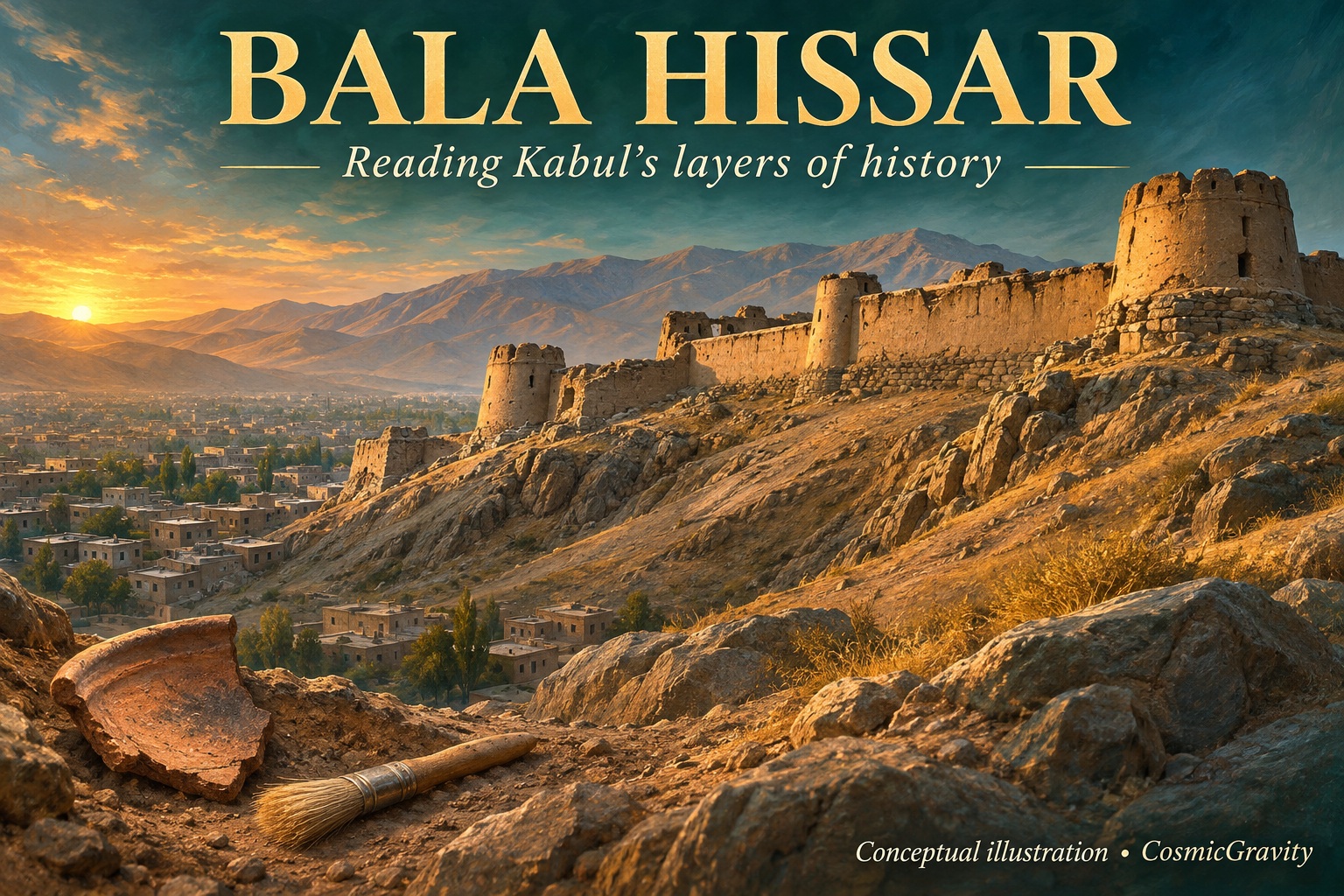
Bala Hissar excavations are revealing why Kabul’s great fortress cannot be understood from its surviving walls alone. Beneath the citadel lies a long sequence of occupation, rebuilding and everyday activity. The challenge is to read those layers while keeping the fragile monument standing.
A new field report has brought the project to wider attention. Yet the research extends well beyond this week’s headlines: an Afghan excavation account and a 2026 laboratory study already offer detailed ways to investigate the site.
Together, these sources show how the history of a fortress emerges from both conspicuous buildings and much less glamorous fragments of cooking pottery.
Why Kabul’s Bala Hissar matters
The Archnet site record places Bala Hissar on the Sher Darwaza hillside at the southern edge of old Kabul. Its position offered a commanding view while remaining low enough for wells. Kabul’s location on a corridor between Central Asia and India gave its citadel lasting strategic importance.
However, the visible ruin is not a single building preserved from one moment. The record connects it with the Mughal dynasty and the Anglo-Afghan wars, while noting the archaeological potential beneath areas whose later buildings have disappeared.
This is why a photograph of the skyline, however striking, can only begin the story. A wall’s appearance does not establish the date of every deposit underneath it. Researchers must work through the physical relationships between buildings, cuts, floors and accumulated material.
Our world megalithic atlas explores a different range of monuments, but the same reading principle applies: present appearance, construction history and the evidence for a date need separate attention.
What the Bala Hissar excavations have recorded
A 9 November Associated Press report from Kabul describes continuing conservation by the Aga Khan Trust for Culture. Interviewed researchers discuss Buddhist remains, Mughal palace features and the aim of creating a public archaeological park. These are results from a continuing project, rather than discoveries all made on the day of publication.
For a closer look at field methods, Sarwar Hedayat’s fourth-season excavation report records work in 2024 in Zone 2. It identifies Trenches 4, 8 and 10 and describes photography, digital registration, pottery study and drawing.
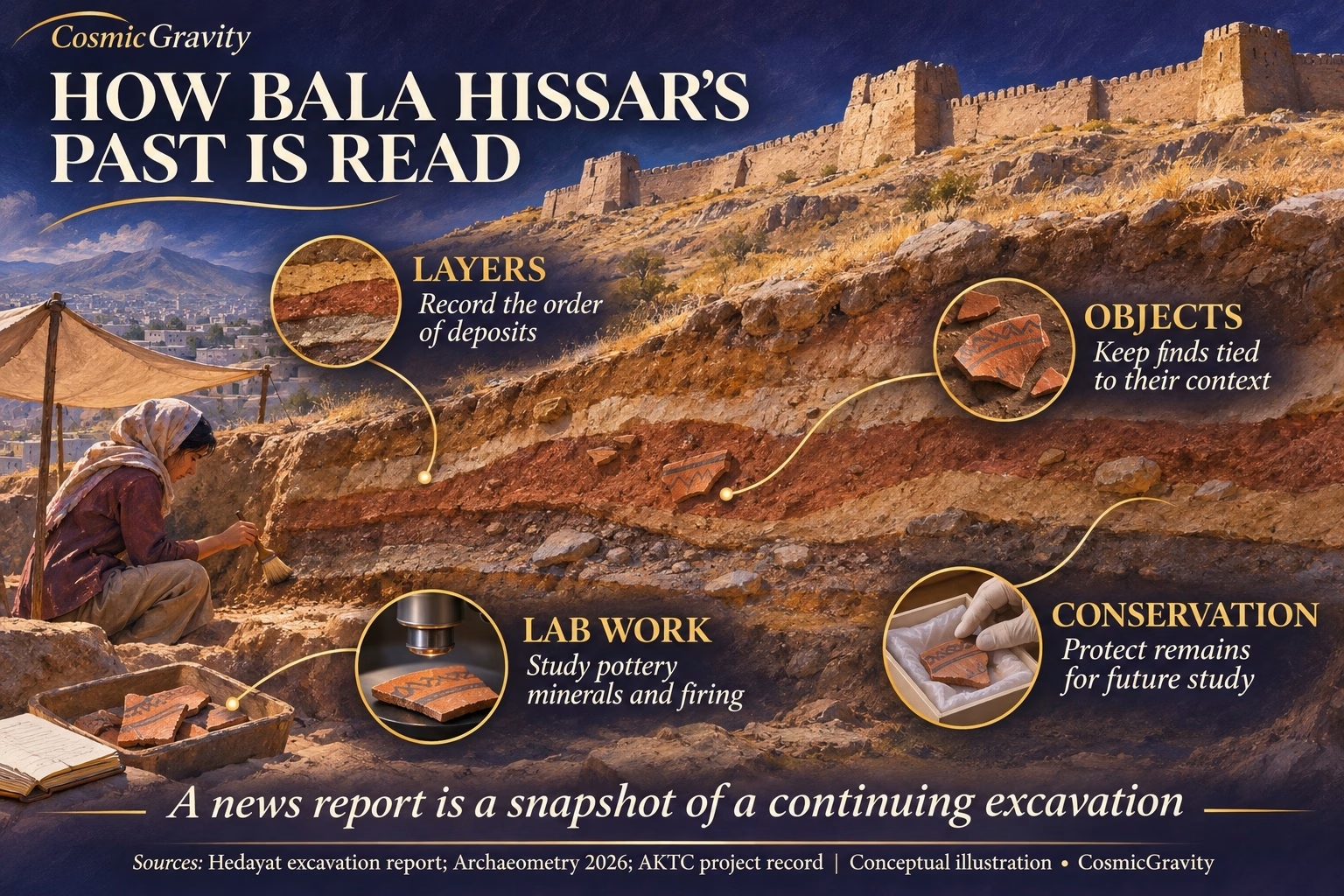
Trench 10 reached a reported depth of 14 metres and revealed 27 stratigraphic layers. Its finds included pottery, stone objects, metal and bone material; walls and floors provided architectural context. Elsewhere, work around the Kashi Gate investigated the course of defensive structures.
Those measurements belong to that named trench and season. They should not be applied to every excavation at the citadel. Similarly, preliminary assignments of pottery to historical periods remain open to refinement as comparative and scientific work develops.
Cooking pots add a different kind of evidence
The paper “Talc-Tempered Pottery From Bala Hissar, Kabul: An Analytical Study”, first published on 16 August 2026 in Archaeometry, examines cooking-ware fragments with microscopy, chemical and mineralogical techniques.
The team identifies talc-rich material in the pottery and argues that a likely source was the Lalandar deposits, roughly 20 kilometres southwest of the site. The mineral evidence suggests firing above 700°C. These are the authors’ interpretations of the samples, not direct observations of an ancient kiln in operation.
The study’s samples came from Trench 3 in Zone 2. Its architectural sequence covers approximately the fifth to sixteenth centuries CE, while other areas preserve earlier occupation. Therefore, this trench’s chronology should not be mistaken for the beginning of the entire fortress site.
A cooking pot can help connect a settlement to practical choices about materials and manufacture. However, a plausible local mineral source does not prove the route taken by every vessel. Combining laboratory results with well-recorded excavation contexts is what gives the interpretation its strength.
Conservation is part of the investigation
The Aga Khan Historic Cities Programme project record describes emergency stabilisation during 2018 and 2019, including work on the vulnerable northeast tower and adjoining walls. It also sets out archaeological investigation and future visitor facilities as parts of a longer programme.
That record treats a heritage park as a goal. Readers should therefore distinguish plans for public access from confirmation that every proposed facility is open. Research, structural repairs and visitor management do not necessarily finish on the same schedule.
In addition, an August 2026 media item carried by AKDN reports an official visit and a request for fuller documentation of the citadel’s history. Publication matters here: catalogues, photographs and accessible records help people understand what conservation is protecting.
Our examination of pyramid scanning claims and the ScanPyramids evidence addresses a very different setting. Yet both stories reward the same question: which part is an observation, which part is an interpretation, and what material can others examine?
What to watch as the Bala Hissar excavations continue
The most useful next developments would be fuller architectural plans, securely associated dates and additional publication of finds. These are editorial questions for following the research, not a list of announced discoveries.
For example, a spectacular room becomes more informative when its construction, alterations and abandonment can be linked to a clear sequence. A modest sherd becomes more informative when its original position and material composition can be studied together.
Bala Hissar’s importance is therefore larger than a collection of impressive objects. It offers an opportunity to investigate how people repeatedly used the same strategic place, while a conservation programme protects the physical record needed to test that history.

latest video



news via inbox
Subscribe to our Cosmic newsletter to get notified when we have new articles.