NOAA UAP Files and the Evidence Behind a Weather Balloon Match
In April 2023, a Pentagon investigator asked the US weather service how a radiosonde falls after its balloon bursts. He also asked whether two balloons might share a payload and how to use an archive of upper-air observations. Those questions survive in the NOAA UAP files. They show what investigators have to learn before a balloon becomes a convincing explanation for an object someone saw in the sky. NOAA’s released email correspondence.
What the NOAA UAP files contain
The US National Oceanic and Atmospheric Administration’s reading room collects documents released under the Freedom of Information Act. The balloon exchange is a 17-page email thread involving NOAA staff and the Department of Defense’s All-domain Anomaly Resolution Office, or AARO. The archive also contains a separate worksheet with angle and size columns. The correspondence documents questions and technical advice. An identification of a reported object would require evidence connecting a specific balloon to the observation. NOAA’s UAP and AARO reading room · Balloon worksheet.
One reply explains why a descent can be faster high in the atmosphere, before the parachute fully opens, and slower lower down. That difference matters if the description comes from a camera. A changing rate of descent could reflect the phase of a balloon flight. Apparent movement across the picture also depends on how far away the object was and whether the camera itself moved. The general explanation helps define a test. A description alone rarely supplies all the measurements to run it.
Can weather data help identify a UFO?
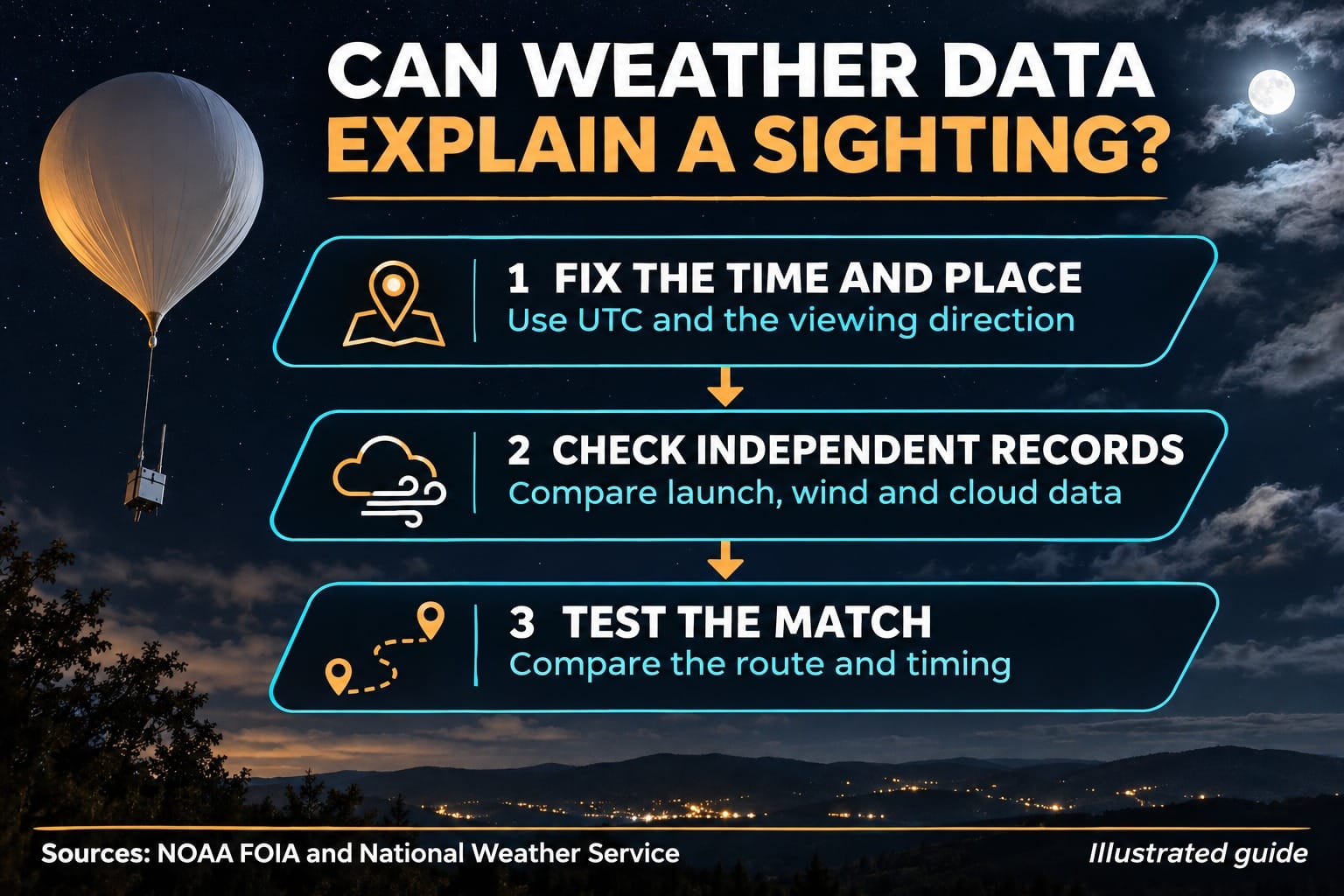
Start with the observation. A date, time zone and reasonably precise location are more useful than a clip labelled only with a city and day. Convert the time to UTC and record the direction of view if it can be determined. Preserve the original recording, since a repost can lose timing details and crop out landmarks that would help establish the camera’s direction.
Then check what actually launched. The National Weather Service normally takes coordinated upper-air observations around 00:00 and 12:00 UTC, and can add launches when conditions warrant. Those are standard observing times. The relevant comparison is a record for the station and date, supplemented by any position and wind data that survive. A balloon drifts with winds that change with altitude. A line drawn from the closest station is only a starting point. National Weather Service upper-air programme · NOAA’s US radiosonde archive.
What would make a match convincing?
Suppose a recorded launch could have drifted east of a witness at the right time. If the witness’s camera was pointing west throughout the clip, the proposed match has a problem. If the direction and timing agree, check whether the plausible altitude, angular motion and duration fit too. A measured flight track makes these comparisons stronger. With only a rough time and a bright dot, several candidates can fit the same observations.
Cloud and satellite products can add context about visibility. They are designed to measure conditions over an area and have their own spatial and timing limits. A clean match with the weather picture is worth considering alongside other independent observations, especially if there is a second camera with a known location. National Weather Service guide to satellite observations.
The published exchange is a record of investigators asking better questions. Its practical lesson is to make the explanation predict something that can be checked, such as where the object should appear from a known viewpoint at a given time. Our guide to the UK UFO files follows the same distinction between what a public record contains and what can be established from it.



latest video



news via inbox
Subscribe to our Cosmic newsletter to get notified when we have new articles.