M87 Black Hole Image: How an Independent Method Tests the Ring
The M87 black hole image became famous in 2019. A newer result asks a different question: does an independent reconstruction approach recover the same basic ring from the telescope measurements?
A CSIRO team led by Samuel Lai reports that it does. The work appeared in Nature, with a CSIRO announcement dated 12 November 2026. The result strengthens confidence in the ring-like geometry. It should be understood as an independent analysis of existing observations, rather than a new telescope independently photographing the black hole.
What the M87 black hole image represents
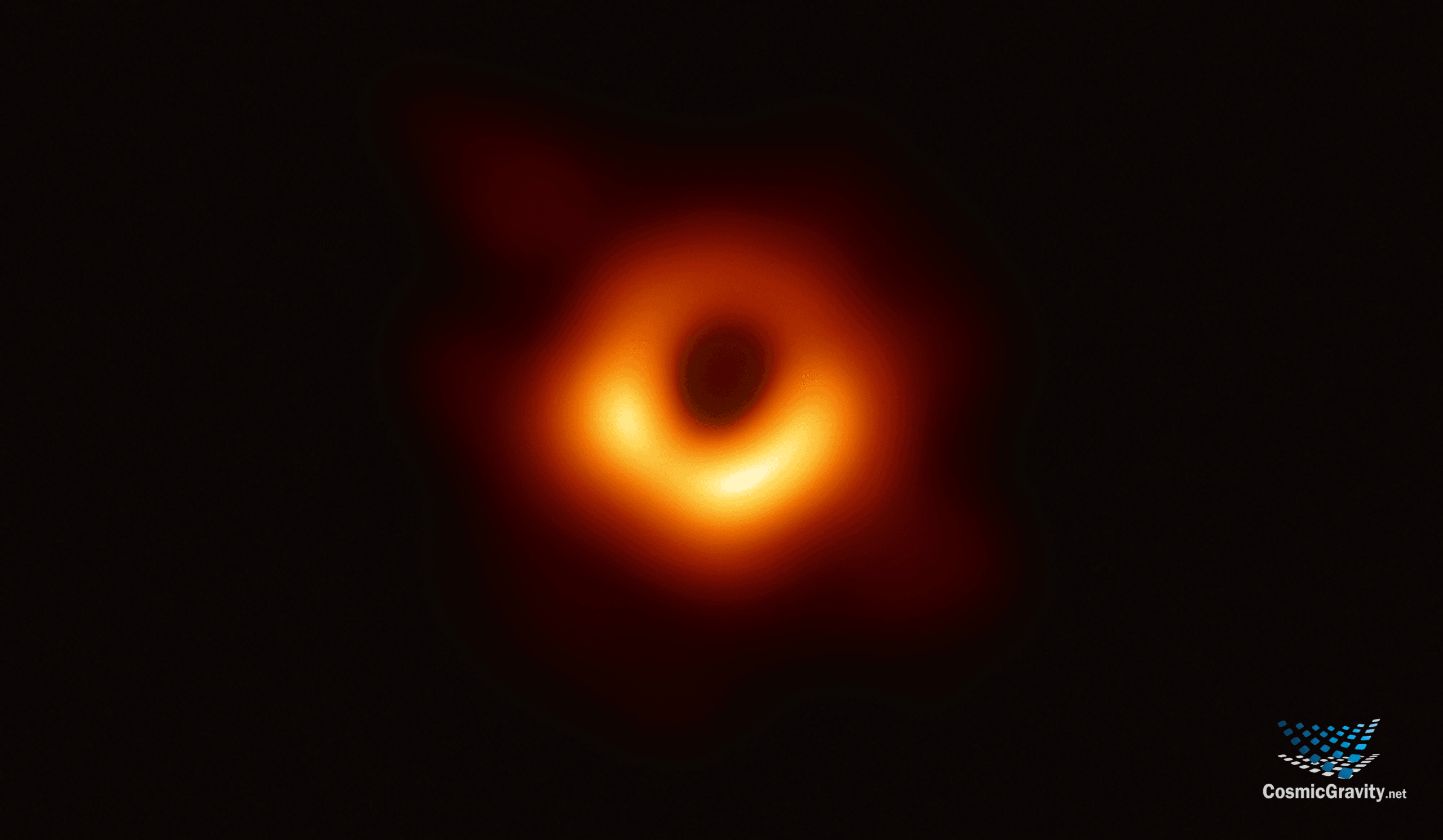
The original EHT image release, distributed by ESO, explains how a worldwide radio-telescope network observed at a wavelength of 1.3 millimetres in 2017. Precisely timed recordings were brought together to create the effective resolving power of a planet-scale instrument. The image was reconstructed from those measurements.
The bright ring traces emission near the central black hole, shaped by strong gravity. The dark central feature is its shadow. The visible ring should not be confused with a photograph of a solid surface, nor should the shadow’s diameter be treated as identical to the event horizon’s diameter.
That distinction helps explain why image reconstruction deserves its own scrutiny. The picture is an inference from measurements. Its scientific strength depends on how well the data constrain it and how robust it remains when the analysis changes.
Testing the M87 black hole image another way
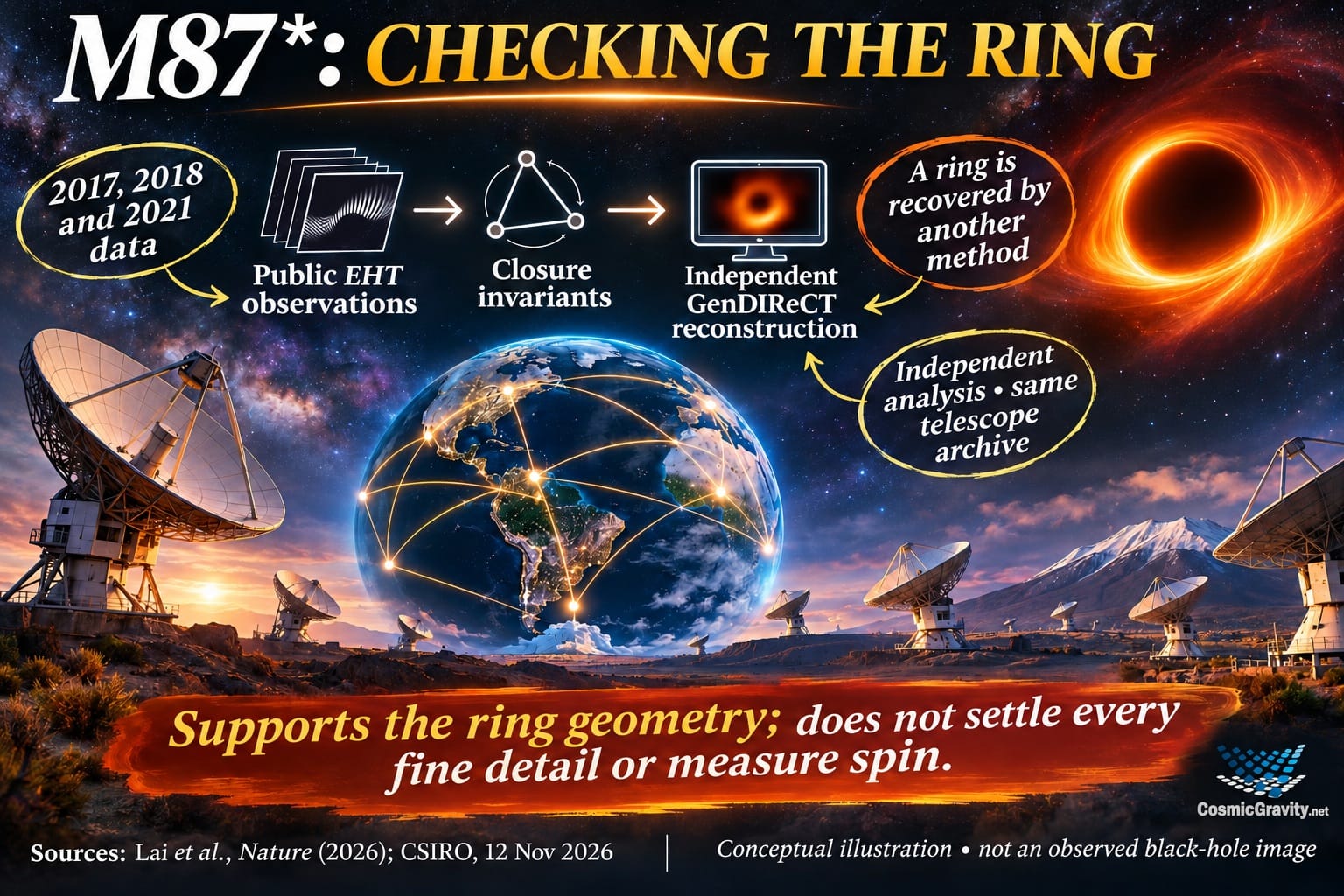
The open research manuscript describes GenDIReCT, a generative reconstruction framework using quantities called closure invariants. These encode information about source morphology while eliminating certain station-based calibration effects. The researchers applied the method to public EHT data from 2017, 2018 and 2021.
The approach recovers compact ring-like structure across the observation sets, with the clearest reconstructions coming from higher-quality data. It avoids prescribing a black-hole-shaped starting image. It still uses a learned statistical prior and choices such as field of view, which the paper discusses and tests.
These qualifications are useful. “No prescribed black-hole template” is a more precise statement than “no assumptions.” A scientific method can be less dependent on one set of choices while remaining a method with identifiable limits.
Independent method, shared archive
Suppose two analysts study the same measurements using substantially different tools. Agreement can show that a result survives a methodological change. It cannot be counted as a second independently collected data set.
Both kinds of independence are valuable, but they test different vulnerabilities. New observations can challenge a result with fresh measurements. Reanalysis can reveal whether the conclusion depended too strongly on one processing pipeline. Here the particularly important question is whether the ring is introduced by reconstruction choices.
CSIRO describes the technique as reducing calibration effects and subjective processing decisions. Its recovery of a similar overall size and shape supports the interpretation that the ring is a real feature of the measured source, rather than simply a favoured drawing imposed on sparse observations.
What remains open
The paper distinguishes stable broad geometry from more difficult fine-scale structure. Some lower-quality data sets yield less clear individual reconstructions. It also states that the image-domain analysis does not constrain the black hole’s spin magnitude.
For a different proposed route to a spin measurement, see our explainer on S301’s orbit around Sagittarius A*. That concerns another black hole and a different observable, so it should not be combined with the M87 result as though the measurements were interchangeable.
The advance here is specific and substantial: another analysis framework finds the characteristic ring in the public radio archive. It reinforces the observational foundation while leaving room for better data, sharper images and further tests.


latest video



news via inbox
Subscribe to our Cosmic newsletter to get notified when we have new articles.