The Roman intaglio from Redesdale and the name scratched into a bowl
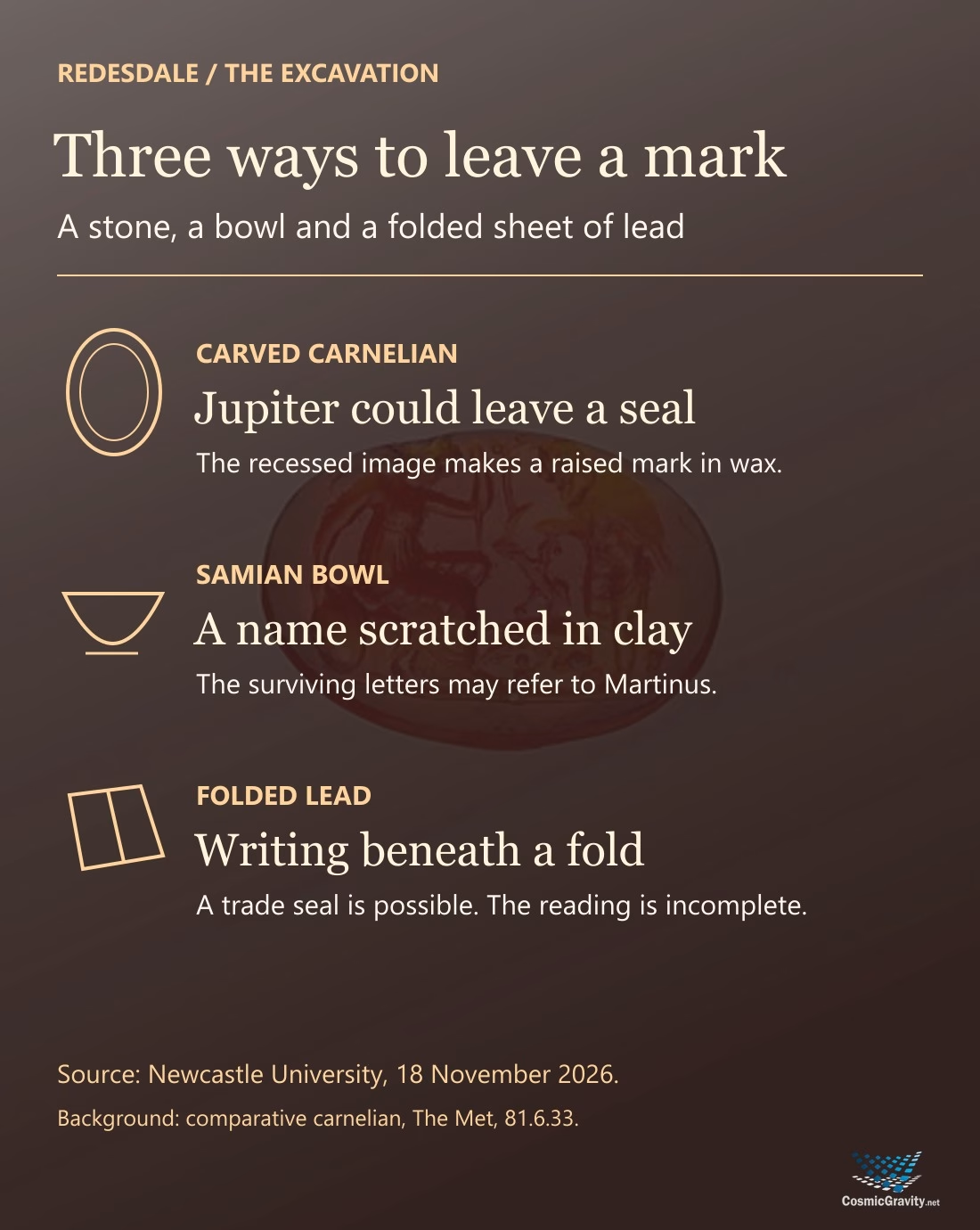
Maisy Watmough and Zoe Yuill were in the last week of a summer excavation in Redesdale, Northumberland, when they found a small orange stone. Cut into its face was Jupiter, holding a sceptre in one hand and a miniature Victory in the other. At his feet sat an eagle. A Roman intaglio like this could leave a recognisable impression in wax long after its wearer had walked away.
The dig produced another kind of personal mark, this time scratched into a bowl. Someone may even have left their name. Read together, the two finds raise an unusually intimate question about life on Rome’s northern frontier. How did people show that a vessel, a parcel or a piece of correspondence belonged to them? Newcastle University’s field report and photographs.
How a Roman intaglio worked
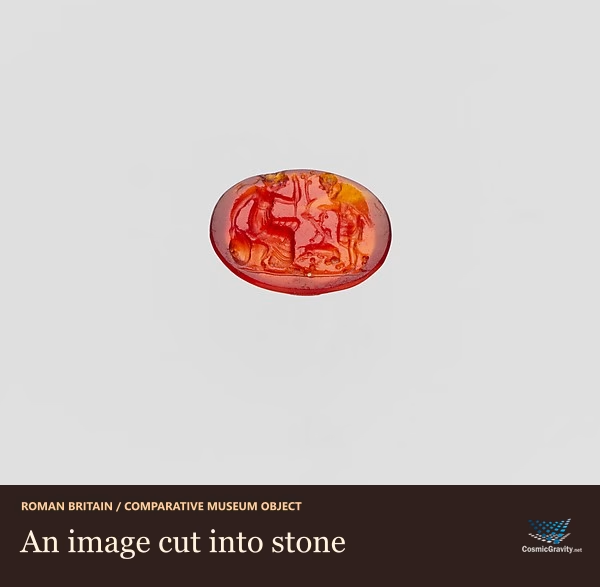
Imagine pressing a ring into warm wax and lifting it straight up. An engraver has cut the design below the face of the gem. The wax fills those hollows and comes away with the image raised and reversed. One carefully worked stone can produce the same mark many times. That repeatability matters more to a seal than the material’s monetary value.
Jupiter gave the Redesdale gem a subject a Roman viewer could recognise. He was a familiar figure in military and civilian life. Even the attributes vary from one carving to another. A first-century carnelian catalogued in Baltimore, for instance, shows Jupiter beside an eagle, carrying a thunderbolt. The small Victory helps distinguish the Redesdale design. Neither carving supplies the name or occupation of the person who wore it. The Walters Art Museum’s Jupiter intaglio.
The name on the bowl
The lettering on a fragment of Samian ware, a fine Roman tableware, presents a different problem. Newcastle gives two readings, MARTIN[I] and MARTIN[US]. The square brackets show where a modern reader has supplied an ending. Both point toward the name Martinus. One reading could give the sense “of Martinus”, an economical way to mark a possession.
More sherds may preserve the same name. That possibility makes the object worth revisiting when the fragments have been studied together. Several vessels marked by the same person would tell us something about a set of belongings. Several sherds from one vessel would tell a smaller story. The university’s initial report leaves that distinction open.
What is inside the folded lead?
Another student, Shannon Wood, recovered a folded piece of lead with cursive Latin visible on its surface. The excavators favour a commercial seal. Goods moved through the frontier supply network, and a seal could help identify or control a consignment. But lead could also carry a private message or a written curse. The fold hides some of the lettering that might settle the question. A guide to Roman everyday writing.
The Roman intaglio was the fourth engraved gem recorded at the site, following two finds in 2025 and one in the nineteenth century. Its owner is anonymous. On the bowl we have almost the opposite situation, a possible name and very little else. There is no known link between Martinus and the gem. Their value together is the glimpse they give of two everyday gestures, pressing a seal and scratching a name, that still make sense nearly two thousand years later.
For another example of how much the placement of small belongings can tell archaeologists, read about the objects found in a Pompeii cupboard.
Feature image: Comparative photograph. This Roman carnelian in The Metropolitan Museum of Art depicts the she-wolf with Romulus and Remus. The Redesdale gem depicts Jupiter. The Met, gift of John Taylor Johnston, 1881, 81.6.33. Public domain. View the original.



latest video



news via inbox
Subscribe to our Cosmic newsletter to get notified when we have new articles.