What the stucco faces of El Mirador once looked out on
The first clue to the El Mirador stucco faces was a scatter of fragments on the ground. During survey work in 2012, researchers encountered pieces of modelled plaster on the south side of a building east of La Danta, the great pyramid complex in Guatemala’s Petén. The building itself measured only about 17 by 10 metres at the base. Its decoration would prove far more elaborate than its size suggested. The excavators’ illustrated field paper.
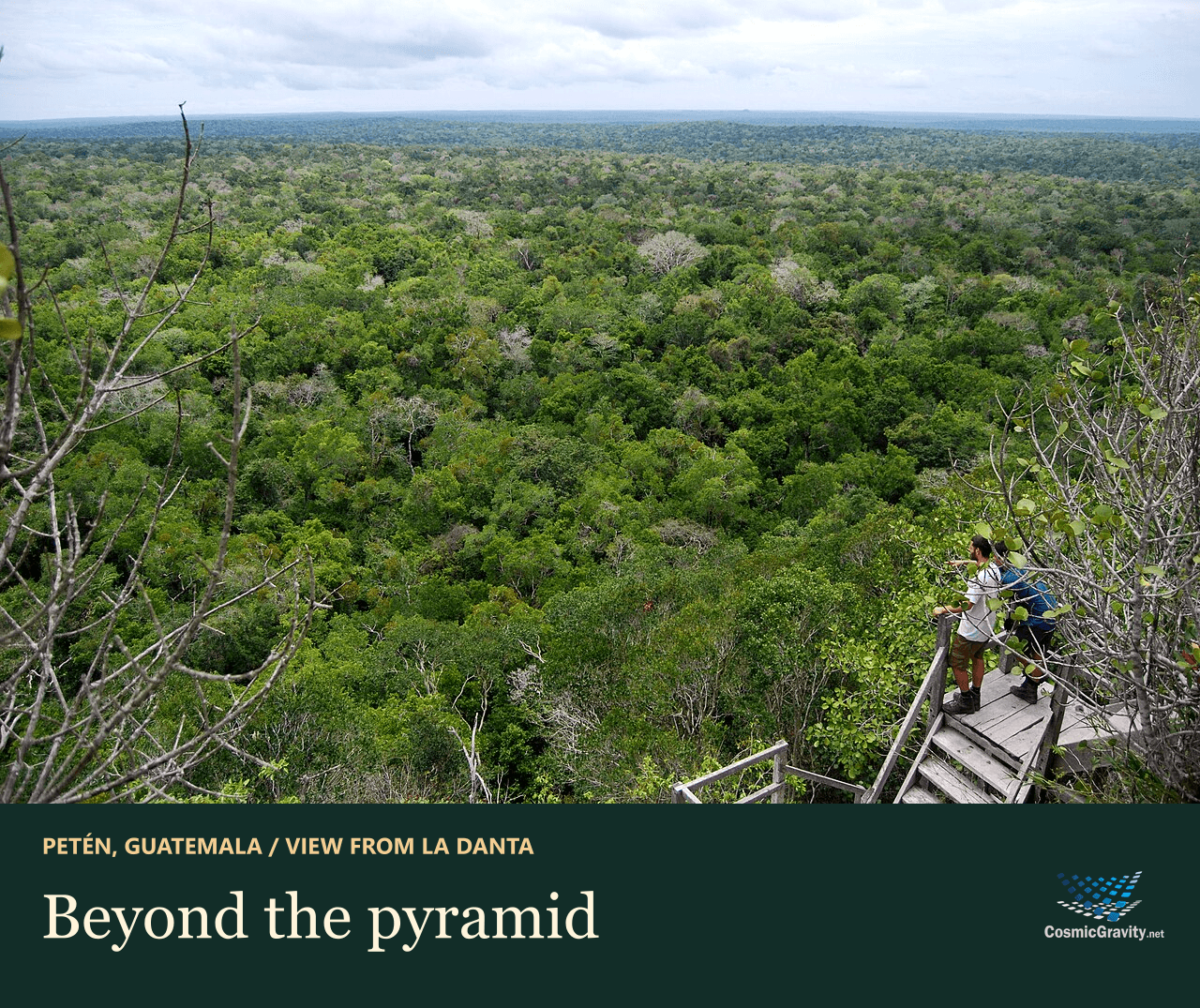
Feature image: View from La Danta at El Mirador, April 2010. Photograph by Geoff Gallice, CC BY 2.0. The photograph shows the landscape around the excavation. Editorial frame added. View the original. Licence.
On November 18, 2026, the Mirador Basin project and Guatemala’s tourism institute presented work from the region. Archaeologist Douglas Mauricio Martínez described roughly three sculptures recovered during the 2026 season. His figure of more than 30 sculptures from this one structure covers years of work. Readers looking at the photographs from the announcement are seeing part of a much longer excavation. Mauricio Martínez’s account and photographs · Guatemala’s account of the presentation.
How the El Mirador stucco faces attached to a building
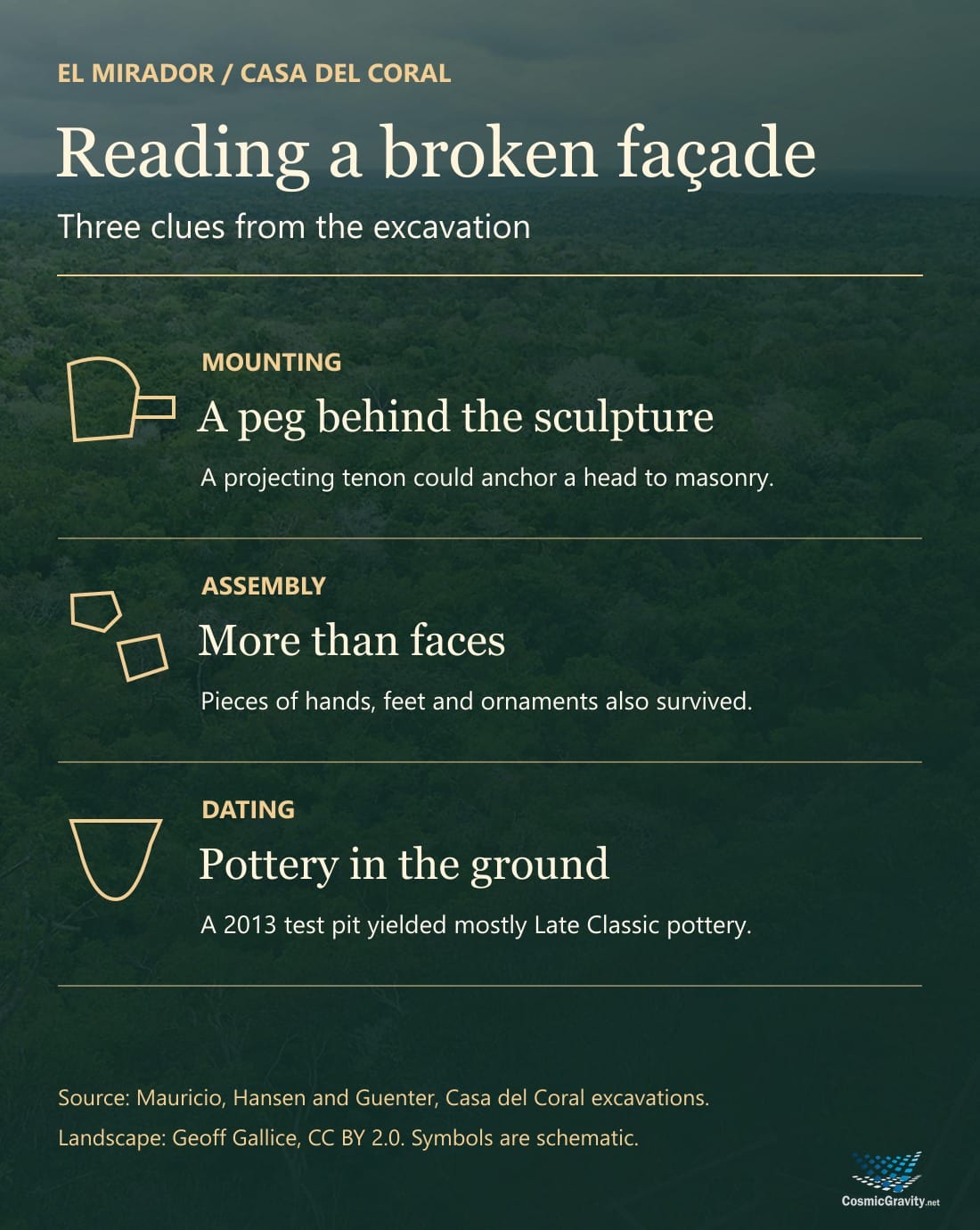
At Casa del Coral, a face could carry evidence on both sides. From the front, shaping and paint picked out eyelids, teeth, jewellery or a headdress. On the back of some pieces a projecting peg, or tenon, offered a way to anchor the sculpture. The excavators also described courses on the south façade where they think decorations may have fitted. A projecting head set into masonry would have met a visitor’s gaze quite differently from a flat painted portrait.
The positions in which the pieces turned up complicate the reconstruction. Looters had cut trenches into the building before the excavators arrived. Fragments lay in disturbed earth as well as in excavated deposits. Knowing that a piece came from the south side is valuable. Placing it back in a particular row, beside a particular neighbour, demands more evidence.
Why the pottery matters as much as the paint
El Mirador is famous for its Preclassic monuments. Casa del Coral also preserves a later chapter. In an early test pit beside the southern trench, the excavators assigned more than 90 percent of the sampled pottery to three Late Classic ceramic groups. That finding helps place activity at this building within the city’s long history. The figure applies to that sample. It cannot date every loose fragment in the surrounding earth.
Fragments of hands, feet and ornaments encouraged the researchers to propose a larger scene of complete figures. One headdress takes the form of a jaguar. Another piece preserves facial paint and worked teeth. Colour and costume can bring a sculptor’s choices within reach across centuries. Identifying the depicted person, deity or ancestor is a further question. The original report presents several of those identifications as possibilities.
What conservation can still reveal
Some earlier finds are still being restored. That matters when comparing reports from different years: a head can be recovered in one season, become recognisable after conservation, and go on public view much later. A join between two broken pieces could change the interpretation of a gesture or reveal that two apparent ornaments belonged to one figure.
From the top of La Danta, the forest makes a canopy of the surrounding landscape. The discoveries at Casa del Coral draw attention back to a single wall below it. Archaeology works at both scales, but it was a surveyor noticing plaster underfoot that opened this particular story. For another case where the identity of a Maya figure depends on the evidence preserved, read about the royal tomb at Caracol.

latest video



news via inbox
Subscribe to our Cosmic newsletter to get notified when we have new articles.