A moonlet’s shadow crosses Didymos in Hera’s new pictures
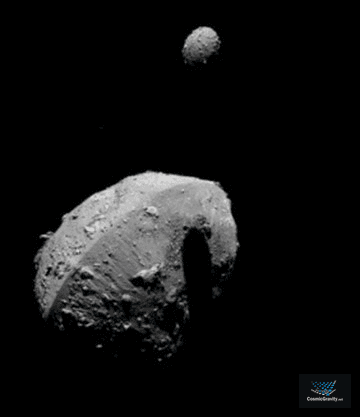
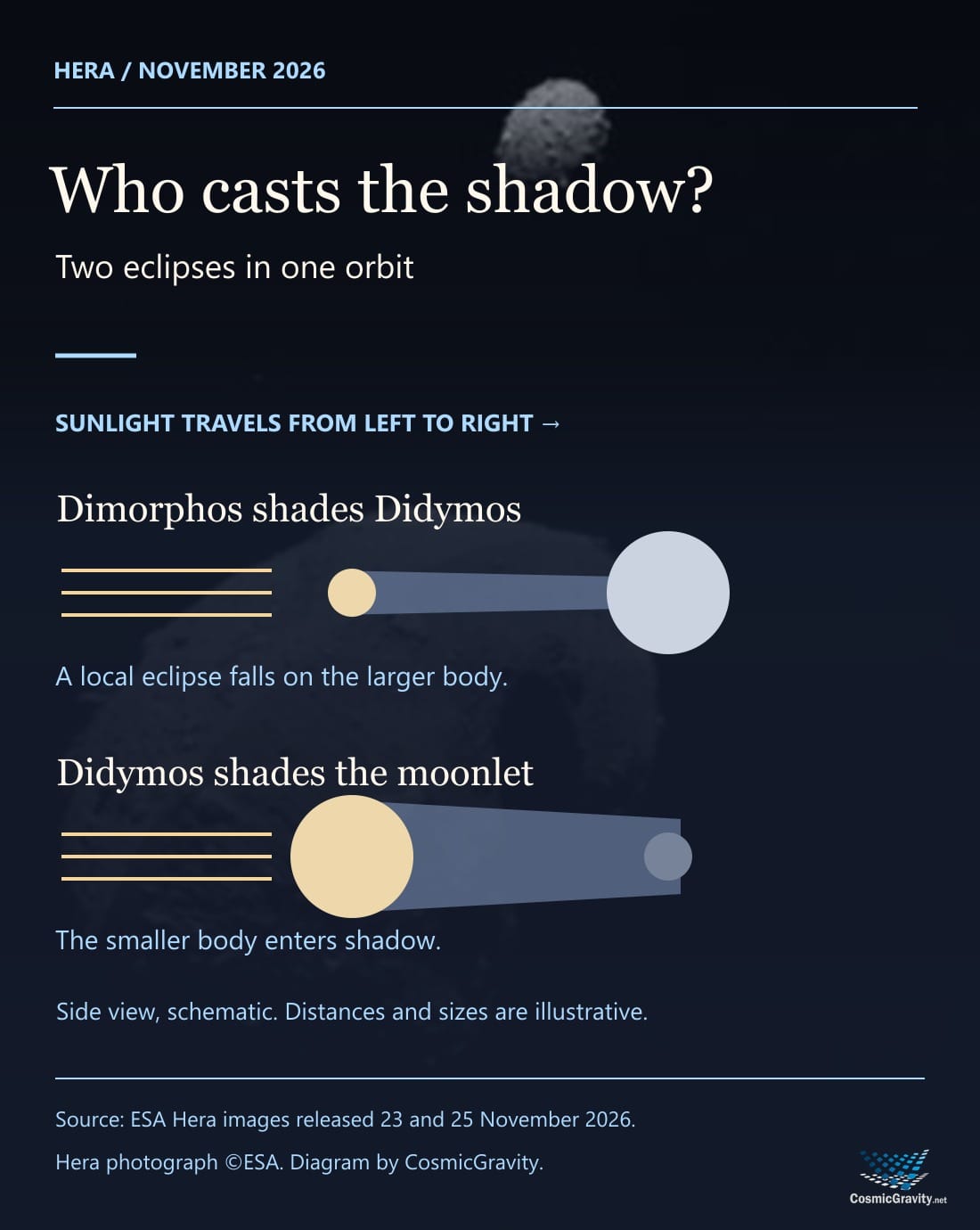
For a patch of ground on the asteroid Didymos, the Sun briefly went out. The European Space Agency’s Hera spacecraft photographed the eclipse on Didymos. Its November 23 release shows the shadow of Dimorphos, the asteroid’s small moon, falling across the larger body. Two days later ESA released a sequence in which you can watch the moonlet take a turn on either side of an eclipse.
Feature image: An eclipse on Didymos, photographed by Hera and released by the European Space Agency on November 23, 2026. Image ©ESA. Original image. Image licence.
Open Hera’s movie of one orbit and watch the smaller rock first. It slips briefly into shadow. Follow the larger asteroid later in the sequence and a patch of its surface darkens as Dimorphos passes on the sunward side. The camera recorded a new image every two minutes. The motion on screen stitches those separate exposures together.
How to read the shadow of Dimorphos
Stand, in imagination, on the sunlit side of Didymos. For the moonlet to blot out the Sun where you’re standing, it has to come between you and the Sun. An observer on the spacecraft gets a different view. From off to one side, Hera can see the moonlet and the surface where its shadow lands. For the reverse event, Didymos itself stands between the Sun and Dimorphos. The light reaching the moonlet fades.
It helps to pick a landmark. ESA points to the large impact crater as a marker on Dimorphos. Its changing aspect in the sequence makes the moonlet’s tumble easier to follow. Compare that feature, carried round on the smaller rock, with the dark patch travelling over the larger one. Only one of those features will still be in the same place on the surface after the Sun has moved on.
What astronomers could see from Earth
In September 2022 NASA’s DART spacecraft struck Dimorphos. To find out how much its orbit had changed, observers on Earth could monitor the light from the pair. When the bodies pass in front of or shade each other, the combined light can dip. The time between repeating events gives astronomers a clock even when a telescope cannot separate the two rocks in detail. NASA reports that the impact shortened the moonlet’s orbital period by about 33 minutes.
Hera now shows a piece of the geometry behind that observation. ESA puts the larger asteroid at about 730 metres across and the moonlet at around 151 metres, with roughly a kilometre between their centres on average. The effect is intimate enough that one rocky body can darken part of the other, and large enough for a camera tens of kilometres away to see it happen.
What one picture can tell us
The shape of a dark patch in a single frame depends on the ground beneath it as well as on the positions of the Sun and both asteroids. Measuring the moonlet’s diameter from that patch alone would be a poor bargain. Following the sequence is more rewarding. The surface turns, the moonlet moves and the lighting changes. A mark that might pass for a dark hollow in one picture reveals its origin in the next.
Compare ESA’s eclipse photograph with its view of the impact site and NASA’s account of the orbit measurement. Our Hera mission guide explains the measurements that brought the spacecraft here.

latest video


news via inbox
Subscribe to our Cosmic newsletter to get notified when we have new articles.