How fast was the object in the Navy’s Go Fast UAP video?
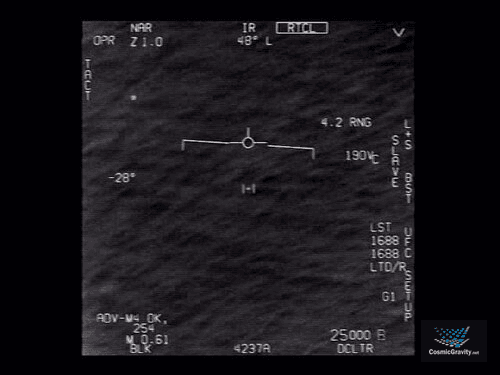
The ocean makes a convincing speedometer in the Go Fast UAP video. A small, bright object stays near the middle of the frame while the textured water races behind it. Watch the 34 seconds with the sound on and it’s easy to share the aircrew’s surprise. But where, exactly, would you put the object between the camera and the waves?
Feature image: Still from the U.S. Navy’s January 2015 Go Fast recording, publicly released by the Department of Defense in 2020. Public-domain U.S. government imagery. Original image.
That question changes how you read the clip. In January 2015 a U.S. Navy crew recorded the scene off Florida. The Defense Department released the footage in 2020. When the Pentagon’s All-domain Anomaly Resolution Office (AARO) published its case report on February 6, 2025, its most consequential finding was an altitude. The object was roughly 13,000 feet above the Atlantic.
How the ocean supplies the illusion of speed
Imagine looking out of a train at a fence post with a field behind it. Keep your eye on the post. The field seems to swing past even though everything outside the window is standing still. A camera tracking an object from a moving aircraft creates much the same problem. A patch of water sliding across the screen measures motion in the image. Turning it into miles per hour requires distances.
The Navy display supplied several of them indirectly. Investigators could read the aircraft’s altitude, the angle at which the camera looked down and the distance to the object. Together those put the target well above the water and below the aircraft, which was flying at about 25,000 feet. The camera could keep a slowly moving object centred while the jet carried the viewing position rapidly past the ocean beyond it.
Why the Go Fast UAP video yields two speed ranges
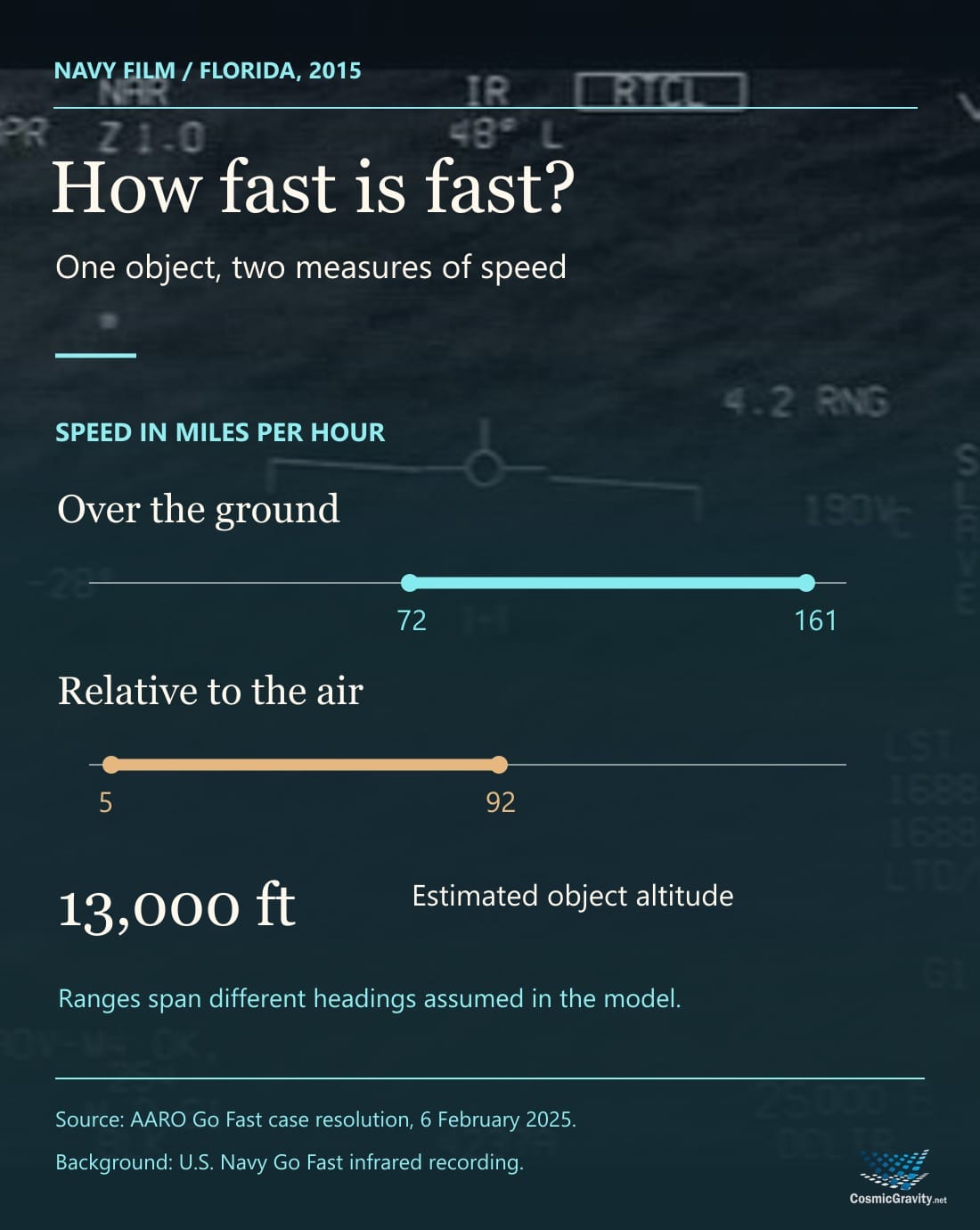
AARO had a harder time recovering the direction the jet was flying. Its compass heading was missing from the public display, and the original recording and associated metadata were unavailable. The investigators therefore varied the heading in their calculations and consulted historical winds. At the object’s estimated height, the wind was blowing at roughly 69 mph.
Depending on the assumed heading, the object could have been moving at about 72 to 161 mph over the ground. Relative to the surrounding air, the estimate ran from about 5 to 92 mph. Those figures answer different questions. A passenger in a drifting balloon can cover ground quickly while feeling little wind. The balloon illustrates the distinction, although the recording does not establish what the crew saw.
What the investigation settled
The endpoints represent different possible circumstances. The clip does not show the object accelerating from one end of a range to the other. AARO found no need for exceptional speed and expressed high confidence on that point. Identity remains open. Knowing how fast something could have been travelling buys surprisingly little information about what it was made of or who, if anyone, put it there.
Watch the released Navy video, then compare your impression with AARO’s illustrated case report. For other ways a camera can shape a sighting, read our guide to parallax and sensor effects in UAP videos.



latest video



news via inbox
Subscribe to our Cosmic newsletter to get notified when we have new articles.