Reading an eclipse forecast on the Antikythera mechanism
The Antikythera eclipse dial had room for an entire forecast inside the space of a single month. A few engraved characters told the reader whether to watch the Sun or the Moon and gave an hour. The lettering is so economical that two millennia later scholars are still revising their readings. Yet enough of the dial survives to follow a forecast from the bronze to the sky.
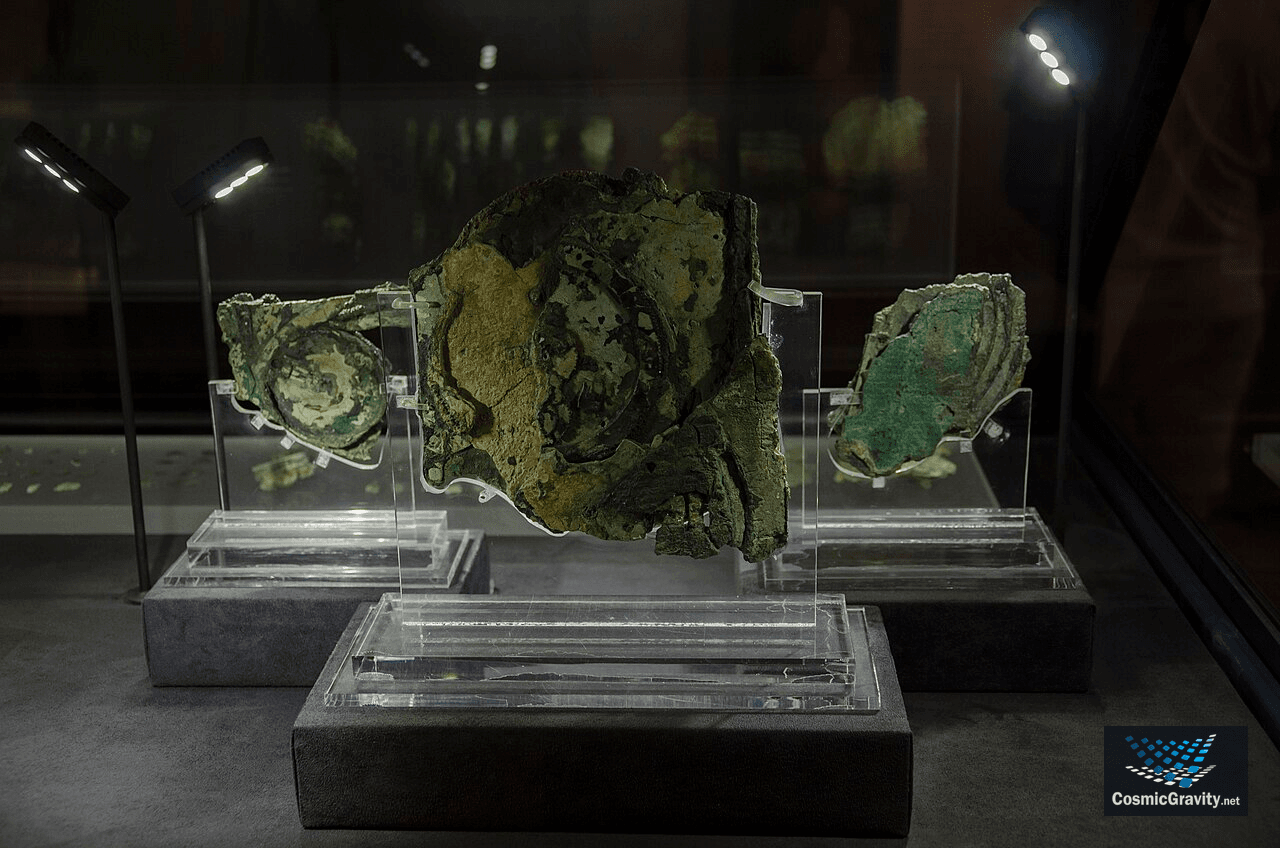
Feature image: Fragments of the Antikythera mechanism in Athens. Photograph by Peulle, 2017, via Wikimedia Commons. Cover branding and infographic adaptation by CosmicGravity, CC BY-SA 4.0. Original image. Image licence.
A spiral of 223 lunar months
The instrument’s eclipse predictions occupied the lower of two large spiral scales on the back. Its four turns made room for 223 divisions, one apiece for the months reckoned from new moon to new moon. Read forward around the spiral and you followed one Saros, a stretch of about 18 years, 11 days and eight hours. The layout gave a reader several years to a turn without shrinking a whole month to an illegible scratch.
Why 223? A new moon usually passes above or below the Sun in our sky because the Moon’s orbit is tilted. Eclipses happen near the places where that orbit crosses the plane of Earth’s orbit. After one Saros, the Moon has very nearly the same phase, lies near the same crossing and has returned to a similar distance from Earth. Those three near coincidences bring back a similar eclipse.
Reading the letters on the Antikythera eclipse dial
Imagine advancing the pointer to a marked month. A Greek eta referred to Helios, the Sun. Sigma referred to Selene, the Moon. Some months carried both indications. A number supplied an hour, and an index letter pointed to a longer inscription on the back plate. The short mark on the dial and the text beside it worked together in much the way a map symbol and its legend do.
Only about a third of the scale survives. In 2019 researchers published revised readings of the back plate, including a disputed index letter that connects a paragraph to a particular glyph. Change such a reading and you can change which circumstances the instrument attributes to a given solar eclipse. That is one reason modern working models can agree on the length of the cycle yet differ in the finer details.

Why the little correction dial mattered
Consider an eclipse at noon. A whole number of days later, local noon would come around again. But a Saros includes about a third of a day extra. Earth turns roughly another 120 degrees in those eight hours. The next solar eclipse in that series generally sweeps much farther west. A forecast can be good and still send an observer outside under a perfectly ordinary sky.
The mechanism’s smaller Exeligmos dial kept track of the time correction over three successive Saros cycles. Think of adding zero, eight or sixteen hours to the indicated hour according to the cycle. After the third stretch, the accumulated extra time comes close to one full day. That brings the hour back near the starting point. It still leaves a reader without a street address from which to see totality.
See the 2008 reconstruction of the dials, the revised reading of the back plate and NASA’s explanation of eclipse recurrence. Our guide to the whole Antikythera mechanism shows where this forecast fitted into the instrument.

latest video



news via inbox
Subscribe to our Cosmic newsletter to get notified when we have new articles.