The Hessdalen Lights: Forty Years of Observations Without a Final Answer
In a quiet Norwegian valley, unusual lights have appeared often enough that local people stopped treating them as rare stories. Some hover above the landscape. Others move slowly, accelerate or divide. Their colours range from white and yellow to red.
The Hessdalen lights have been photographed, tracked and studied for more than forty years. Many individual sightings probably have ordinary explanations, but the recurring phenomenon has produced enough instrumented observations to remain scientifically interesting.
It is not proof of extraterrestrial craft. It is also not a legend unsupported by evidence.
The wave of the early 1980s
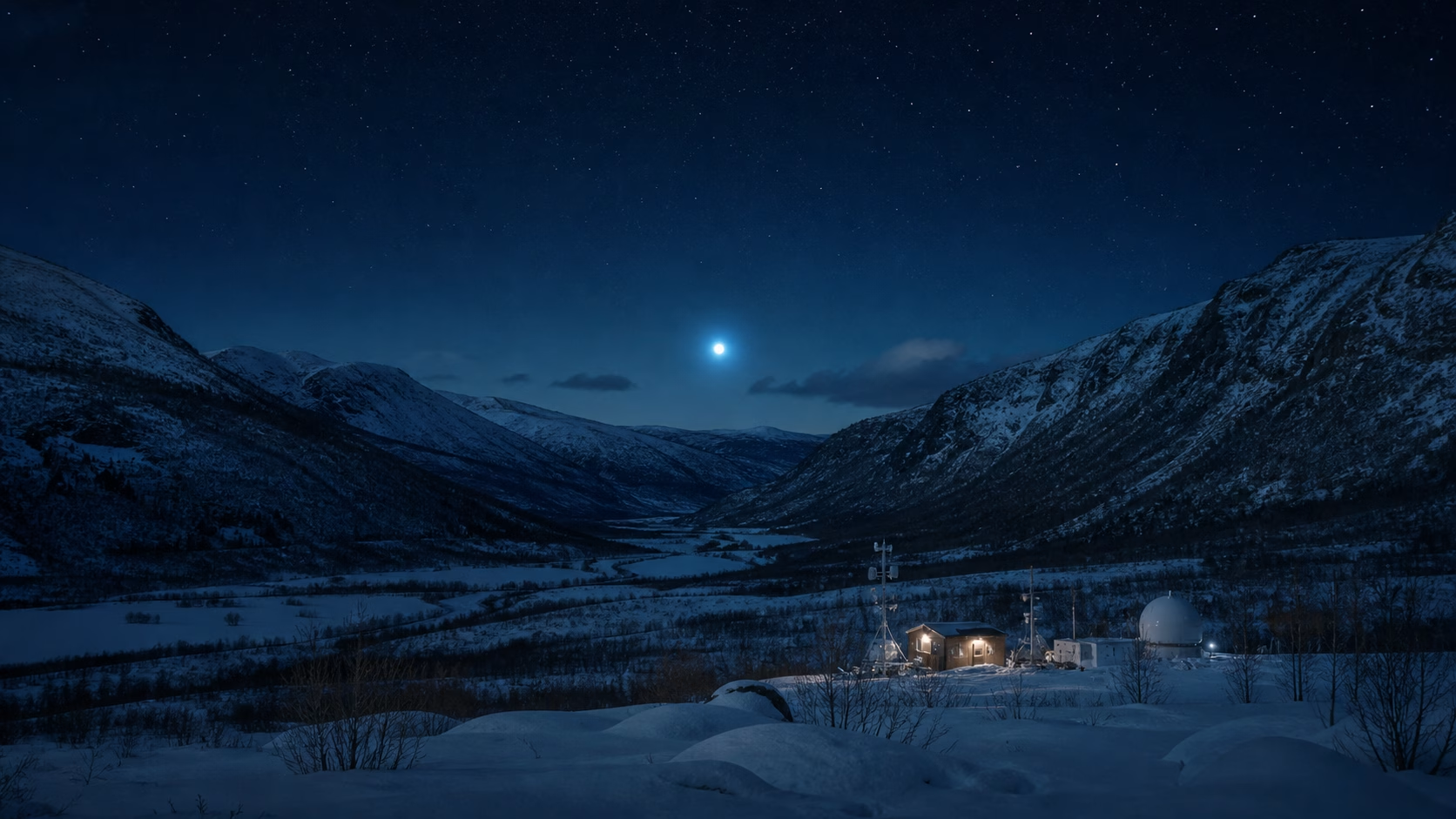
Hessdalen is a narrow valley in central Norway. Residents had reported strange lights before, but activity increased dramatically between 1981 and 1984. At the peak, observers sometimes reported several events in one week.
The lights appeared above ridges or within the valley, occasionally remaining visible for minutes. The frequency attracted investigators who established Project Hessdalen in 1983.
During a field campaign in early 1984, volunteers used cameras, radar, magnetometers, spectrum equipment and other instruments. They documented multiple events rather than relying only on memory.
What observers actually report
Descriptions fall into several broad types. The most familiar is a bright white or yellow light, sometimes with a reddish tone, that hovers or moves through the valley.
Other observations involve brief flashes or several lights maintaining relative positions. Apparent size and distance are difficult to estimate at night, especially against mountains without scale.
Some events have been photographed simultaneously from different locations, which provides stronger information. Radar detections have also been reported, although not every visual light produces a radar return and not every radar target is unusual.
Why ordinary explanations matter
Hessdalen lies beneath air routes and has roads, farms and settlements. Aircraft, vehicle headlights, stars, planets and satellites can all create mistaken reports.
Atmospheric refraction can make distant lights appear elevated or distorted. Camera movement and long exposures can turn a point into a streak.
Researchers must remove these events before describing a residue as unexplained. The recurring nature of the phenomenon does not guarantee that every photograph has the same cause.
The plasma hypothesis
One leading family of explanations involves ionised gas or plasma. Under particular electrical and atmospheric conditions, a luminous region might form and persist above the valley.
The local geology contains mineral deposits, and researchers have proposed that chemical or electrical processes involving rock, groundwater and air could generate charge differences.
Laboratory plasmas can glow, move and respond to fields, but translating that behaviour to large outdoor lights is difficult. A hypothesis must explain duration, brightness, energy source, spectrum and motion together.
Dust and combustion models
Another proposal involves clouds of dust containing metals such as scandium, which might burn or produce luminous reactions in the atmosphere.
Some researchers have suggested that radon decay ionises air and helps form charged dust structures. Others point to piezoelectric effects in stressed rock.
These ideas offer mechanisms for light without requiring a solid craft. None has yet reproduced the full range of observations under verified valley conditions.
What spectral measurements can reveal
A spectrum separates light by wavelength. Bright emission lines can identify excited elements, while a smoother spectrum may suggest hot material or reflected light.
Reported spectra of Hessdalen phenomena have sometimes indicated broad continuous emission and, in other observations, features associated with particular elements. The data remain limited because the events are unpredictable and often faint.
Better calibrated spectroscopy is one of the clearest paths forward. Chemistry should leave a measurable signature.
The value of continuous monitoring
An automated measurement station was established in the valley in the late 1990s. Cameras and sensors can react when unusual light appears, reducing dependence on a researcher being outside at the right moment.
Modern equipment could improve this approach with synchronised high-resolution cameras, thermal imaging, all-sky monitoring, weather instruments and passive radar.
Observations from multiple known locations would provide triangulated distance and true speed. Without distance, extraordinary movement remains difficult to prove.
Is Hessdalen a UAP hotspot?
In the broad meaning of unidentified anomalous phenomena, yes: recurring aerial or atmospheric observations remain unidentified at the time of detection.
That does not imply one origin. Some lights are likely traffic or astronomy. Others may be rare natural phenomena. A small remainder could involve objects or processes not represented in current models.
Calling the valley a hotspot is useful only if it encourages better measurement rather than automatic conclusions.
Why the case deserves respect
Hessdalen occupies an unusual middle ground. It has witnesses, photographs and instrument campaigns, but no universally accepted mechanism. The phenomenon is recurrent enough to study and inconsistent enough to resist easy replication.
Its greatest contribution may be methodological. Instead of arguing from isolated images, researchers can place instruments in a location and wait. If the lights are natural, that approach can discover new atmospheric physics. If some are structured objects, multisensor data can demonstrate it.
The valley does not promise the answer people want. It offers something more valuable: a place where the unknown may be observed again.
Related reading

latest video

news via inbox
Subscribe to our Cosmic newsletter to get notified when we have new articles.