The Antikythera Mechanism: A Computer Before Its Time
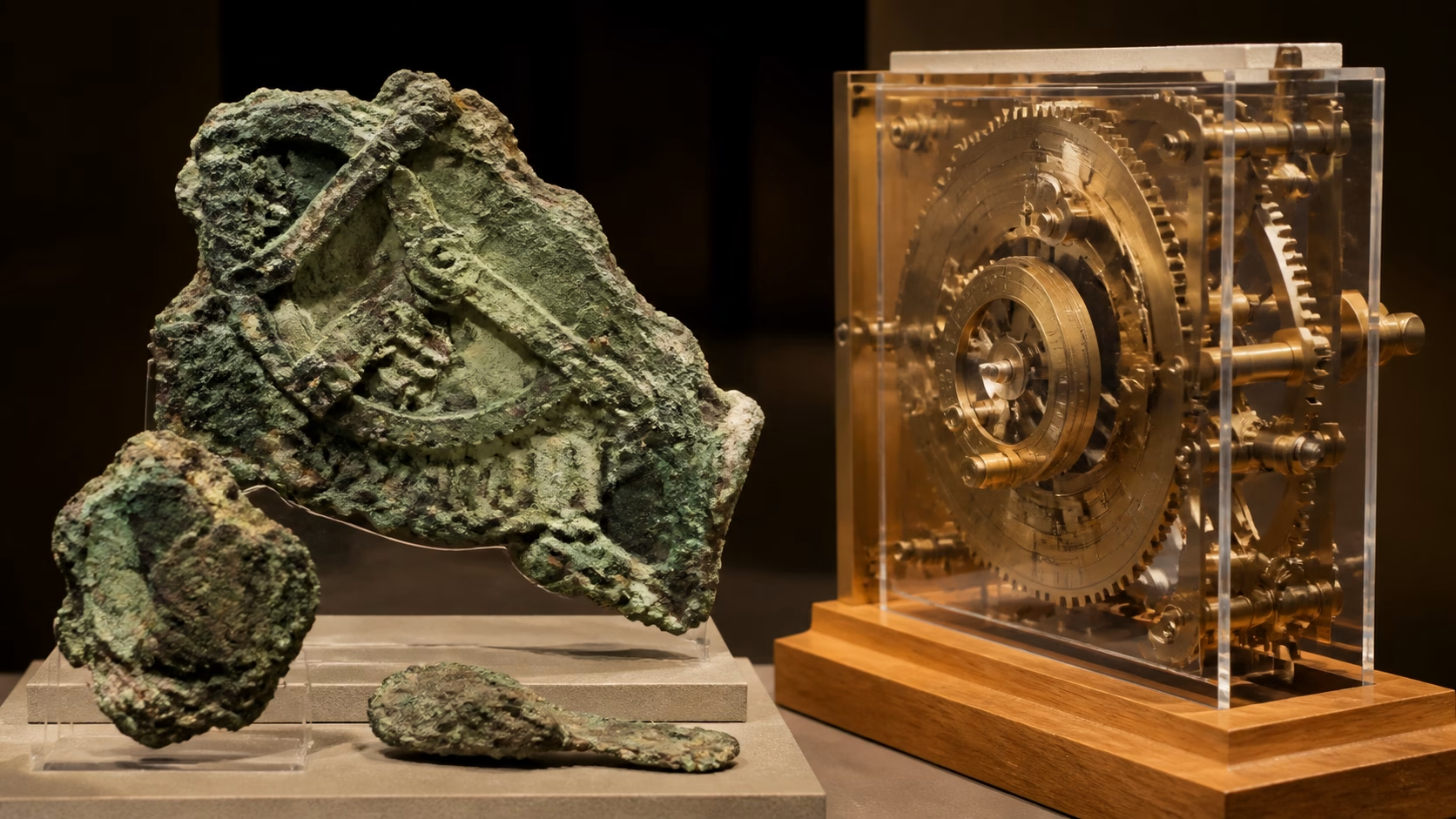
When divers recovered a corroded lump of bronze from an ancient shipwreck, nobody expected it to contain a model of the heavens. Its gears were almost invisible beneath marine deposits. Several fragments looked more like broken stone than precision machinery.
More than a century of study has revealed something remarkable. The Antikythera mechanism was a hand-operated astronomical calculator built in the Greek world more than 2,000 years ago. Its interlocking bronze gears tracked celestial cycles, predicted eclipses and displayed calendar information.
Calling it the first computer is imperfect, but understandable. The Antikythera mechanism explained through its function is a machine that accepts an input, processes it through a programmed gear system and produces several calculated outputs.
A shipwreck full of surprises
The wreck was discovered near the Greek island of Antikythera around 1900. Sponge divers brought up statues, ceramics, coins and other luxury cargo from a vessel that sank in the first century BCE.
Among the finds was a wooden box containing badly corroded bronze fragments. In 1902, archaeologist Valerios Stais noticed a gear embedded in one piece. That observation opened a mystery that would take generations to solve.
The mechanism is incomplete. Many parts were lost to the sea or remain hidden inside mineralised fragments. Researchers must reconstruct its design from surviving teeth, inscriptions, shafts and circular scales.
What the machine displayed
A user probably turned a handle to select a date. The gear train then moved pointers on the front and back faces.
The front displayed the Sun’s and Moon’s positions in the zodiac. A rotating black-and-white sphere represented lunar phases. Additional pointers may have shown the known planets, although the exact reconstruction remains debated.
The rear contained spiral dials. One followed the 19-year Metonic cycle, after which lunar phases return to approximately the same calendar dates. Another tracked the Saros cycle, used to predict eclipses.
The mechanism also included a calendar of major athletic festivals, linking celestial time with civic and religious life.
How gears modelled the Moon
The Moon does not move at a constant apparent speed. Its elliptical orbit makes it seem to accelerate and slow during the month.
The mechanism reproduced this variation with an ingenious pin-and-slot arrangement connected to offset gears. As the gear turned, the pin moved inside a slot and created a changing rate of rotation.
This is not merely skilled craftsmanship. It is a physical mathematical model. The builder translated an astronomical theory into metal teeth and moving axes.
How modern technology revealed the inscriptions
Early investigators could inspect only exposed surfaces. Radiography later showed gears concealed inside the fragments. Modern X-ray computed tomography produced three-dimensional views of individual teeth and revealed inscriptions hidden beneath corrosion.
Those inscriptions function partly as labels and partly as an operating manual. They describe displays, astronomical events and calendar divisions.
Imaging has allowed teams to propose detailed gear counts and reconstruct missing sections. The process remains active because a new reading of a few letters or one gear tooth can change the design.
Was the knowledge unique?
The mechanism is the only surviving device of its complexity from antiquity. That does not mean it was the only one built. Ancient writers described mechanical celestial models, including devices associated with Archimedes.
Bronze was valuable and routinely recycled. Delicate mechanisms rarely survive burial, and even fewer survive seawater. The Antikythera wreck may have preserved one example of a craft tradition that otherwise disappeared.
Its construction required collaboration among astronomers, mathematicians and metalworkers. Someone calculated the cycles; someone designed the gear ratios; someone cut teeth fine enough for the system to work.
Did it use impossible technology?
No unexplained material or manufacturing process is required. Bronze gears can be cut with ancient tools, and Greek astronomy supplied the mathematical cycles.
What surprises us is not an impossible technique but the concentration of known techniques in one compact device. The mechanism exceeds the simple picture many people hold of ancient engineering.
It is tempting to solve that discomfort with a lost super-civilisation. Doing so takes credit away from the people whose knowledge is visible in the object.
Where was it made?
The exact workshop is unknown. Researchers have proposed Rhodes because the island was an important centre of astronomy and mechanical craft. Connections have also been suggested with traditions linked to Archimedes and Syracuse.
Calendar names and inscriptions provide clues, but the mechanism may have travelled before reaching the ship. Its route, owner and intended destination remain open questions.
The wreck’s cargo suggests it was valuable. It may have belonged to a wealthy individual, a scholar or a public institution.
Why reconstruction is difficult
Only about a third of the original device may survive. Corrosion distorted the pieces, and gear teeth are missing. Several reconstructions can sometimes fit the same physical evidence.
The planetary display is the largest area of debate. Researchers agree on much of the lunar and eclipse machinery, while proposed front arrangements vary.
A responsible reconstruction distinguishes surviving evidence from plausible engineering. A beautiful working model is not automatically the original design.
A different view of ancient intelligence
The Antikythera mechanism compresses astronomical observation, mathematics and metalworking into a box small enough to carry. It shows that ancient technology did not progress in a simple straight line toward the present.
Knowledge can flourish, become specialised and disappear when workshops, patrons and texts vanish. Centuries later, geared astronomical clocks would re-emerge in a different cultural setting.
The mechanism was not magic and not modern machinery misplaced in time. It was something more meaningful: the product of ancient people who understood the sky well enough to make bronze imitate its cycles.
Related reading


latest video



news via inbox
Subscribe to our Cosmic newsletter to get notified when we have new articles.