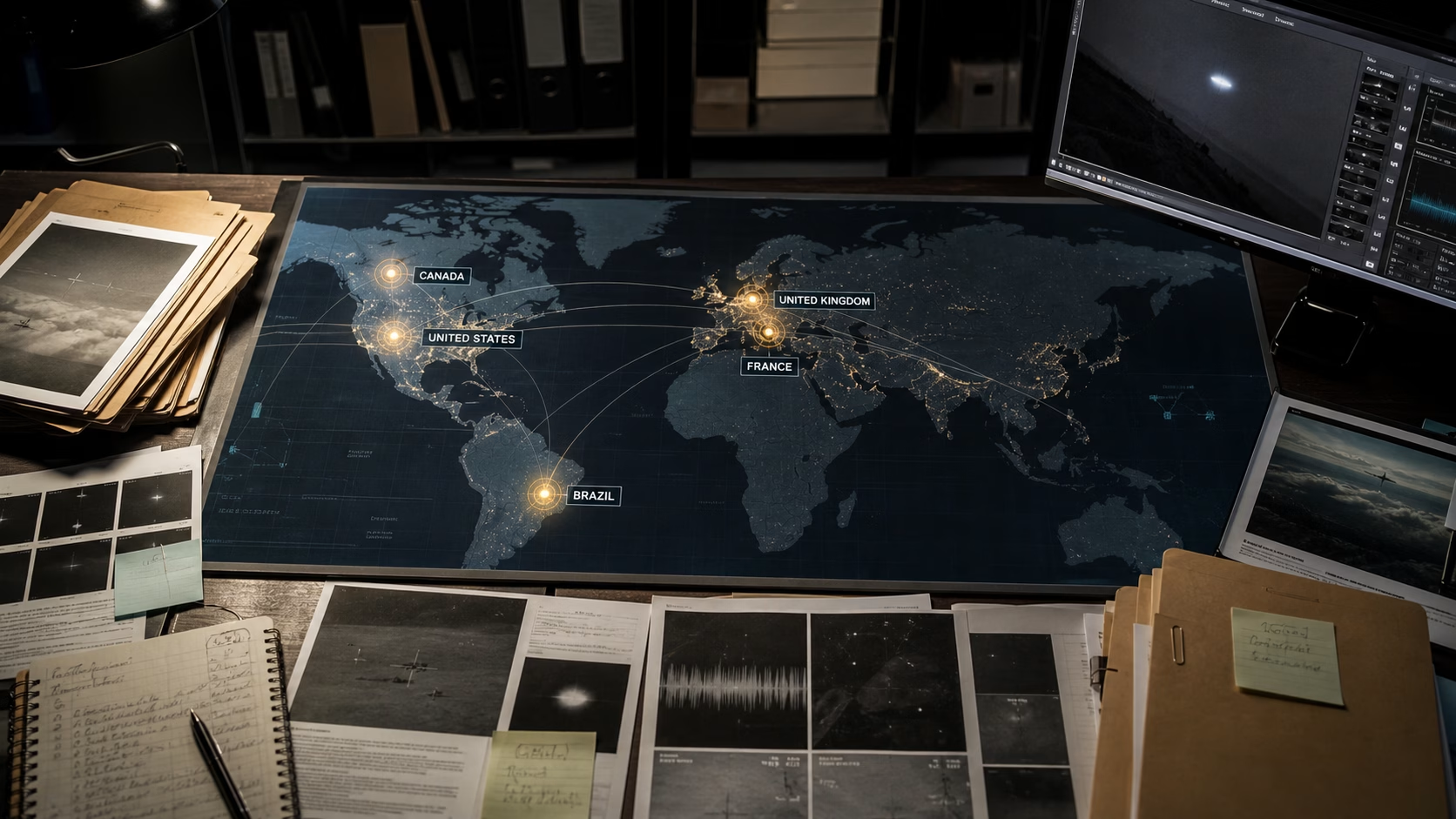
The Global UAP Transparency Tracker: What Five Governments Actually Release
UAP transparency is often discussed as if it were a single disclosure process centred on Washington. The real picture is international and uneven. Some governments publish searchable case databases, others release historical files, and some still lack a clear route for civilians to report what they see.
This global UAP transparency tracker compares five official models: the United States, France, Canada, the United Kingdom and Brazil. The comparison shows that releasing documents, investigating current cases and publishing usable data are three different things.
United States: the largest new release pipeline
The United States now has two important public channels. AARO publishes selected case reports, imagery and information papers, while the National Archives is building Record Group 615 as a permanent UAP collection.
Record Group 615 receives material from agencies on a rolling basis. Listed contributors include the FAA, NRC, ODNI, Office of the Secretary of Defense, NSA, State Department and FBI. This creates a durable legal and archival structure rather than a one-time document dump.
The weakness is fragmentation. Case summaries may lack raw sensor data, and classification can prevent independent analysts from checking decisive details. A record can be officially public while still being scientifically incomplete.
Our earlier overview of the National Archives UAP collection explains how that rolling transfer works.
France: the most mature public case database
France’s GEIPAN operates within the national space agency CNES. It accepts reports, investigates cases and publishes files with classifications ranging from identified to unexplained after investigation.
Its dynamic statistics dated 25 June 2026 list 3,368 published cases. About 28.0% are identified, 38.8% probably identified, 30.1% lack enough data and 3.1% remain unidentified after investigation.
That final 3.1% is small but important. It represents cases that survived a formal process, not proof of one common exotic origin. France’s strength is methodological continuity: the public can see both explanations and residual unknowns.
Canada: a transparency plan without a central desk
Canada’s Sky Canada Project examined how public reports are handled rather than trying to prove or disprove extraterrestrial visitation. Its final report found a fragmented system in which no single government organisation consistently collects and analyses civilian UAP reports.
The project recommended a dedicated service, standardised reporting, open data where possible and better international cooperation. Canada estimates roughly 600 to 1,000 sightings may be reported each year, yet many witnesses do not know where to send them.
This is a transparency gap of infrastructure rather than secrecy alone. If reports enter unrelated police, aviation or defence channels with different rules, no complete national dataset exists to release.
United Kingdom: extensive history, limited continuity
The UK National Archives provides a research guide to Ministry of Defence UFO reports, public correspondence, policy papers and parliamentary records. Many files from 1950 onward are available digitally or through the catalogue.
There is a major historical loss: until 1967, Ministry of Defence policy was to destroy UFO files after five years. Since 1970, most surviving files have been reviewed for eventual release because of public interest.
The British model is therefore strong as a historical archive but no longer resembles France’s continuously operating public investigation service. Researchers can study how officials responded, but a released policy file is not the same as a modern sensor database.
Brazil: military records preserved in a national archive
Brazil’s National Archive holds an official UFO collection transferred from the Air Force. A published overview described 743 records including reports, questionnaires, correspondence, photographs, drawings, video, audio and press clippings.
The archive’s updated collection description says the material spans reports from 1952 through 2019. Brazil’s openness is valuable because it preserves different media and aviation material across decades.
Language, catalogue navigation and uneven digitisation can still limit international use. Transparency is more effective when files are searchable, machine-readable and supplied with standard metadata.
What should a real transparency log contain?
A useful release should record the date of publication, originating agency, incident date and location, classification status, redactions, available media and whether raw files exist. It should also preserve later revisions: a case can move from unresolved to identified when new data arrive.
Global comparison requires shared fields. Time zones, coordinates, sensor types and explanation categories should be standardised. Otherwise two archives may describe the same kind of event in ways that cannot be combined statistically.
Unresolved does not mean unimportant
Most investigated cases with adequate data receive ordinary explanations. That should improve confidence in the process, not end interest in the remaining cases.
The cumulative record still contains trained observers, multi-sensor detections and reports that resist explanation after review. Those cases deserve preserved evidence and independent study. At the same time, lack of data must not be confused with confirmed extraordinary performance.
The new scientific framework discussed in the Naval Postgraduate School UAP issue shows what future collection needs: calibrated sensors, accessible metadata and methods that can be challenged.
The next step is interoperability
No country currently offers a complete model. The United States has a large release pipeline but heavy classification. France has structured casework. Canada has a reform blueprint. Britain and Brazil preserve valuable historical collections.
Global UAP transparency will become more meaningful when these systems can exchange comparable data. A worldwide phenomenon cannot be understood through national archives that never speak to one another.
Disclosure is not measured only by the number of PDFs online. It is measured by whether evidence can be searched, verified, compared and corrected.
Sources: GEIPAN statistics, June 2026, Sky Canada Project, UK National Archives UFO guide, and Brazil’s National Archive UFO collection.



latest video


news via inbox
Subscribe to our Cosmic newsletter to get notified when we have new articles.