Euclid Finds the Oldest Quasars Ever Seen
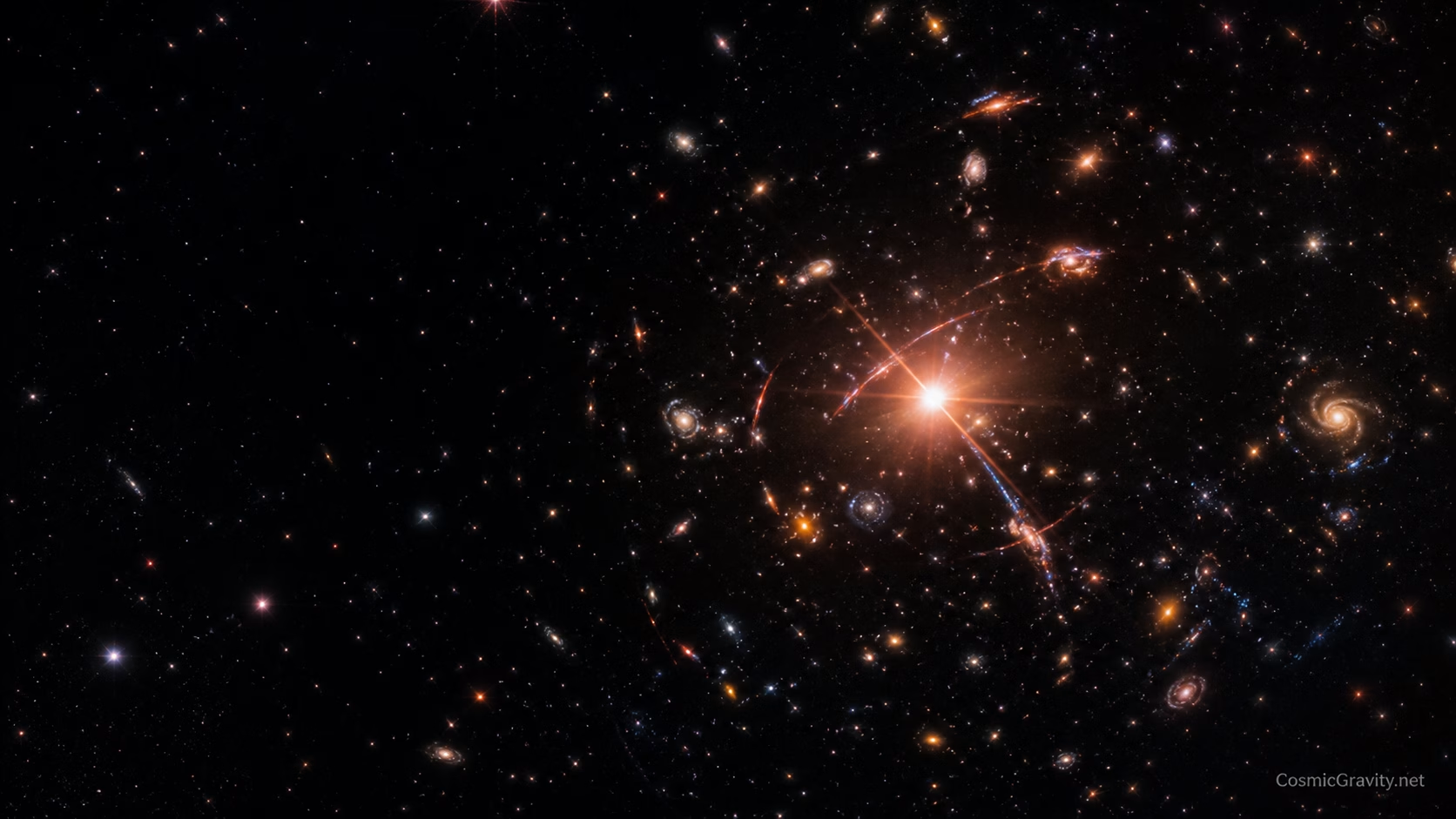
ESA’s Euclid telescope has found 31 quasars from the Universe’s first billion years, more than doubling the known population at these extreme distances. Two are older than any quasar previously confirmed. Their light began travelling when the Universe was only about 670 million years old—roughly five percent of its present age.
A quasar is not a kind of star. It is the violently bright centre of a galaxy where gas falls toward a supermassive black hole. The puzzle is how black holes became so massive so soon after the Big Bang.
Why Euclid is unusually good at finding rare quasars
Quasars this distant are faint in ordinary visible light because the expansion of the Universe stretches their radiation toward infrared wavelengths. They are also rare, so a telescope needs both sensitivity and a huge field of view.
Euclid was built to map dark matter and dark energy across billions of galaxies. That same wide, sharp infrared survey makes it a powerful early-quasar finder. Webb can then study individual targets in deeper detail.
Cosmic time machine
Today: the Universe is about 13.8 billion years old.
Light travel: we see the Euclid quasars as they were more than 13 billion years ago.
At emission: stars and galaxies had existed for only a short cosmic interval, yet black holes were already powering beacons as bright as a trillion Suns.
The black-hole seed problem
A black hole made by a collapsing star starts relatively small. Even if it feeds efficiently, growing to hundreds of millions or billions of solar masses in a few hundred million years is difficult.
One possibility is that some seeds were born much heavier when enormous primordial gas clouds collapsed directly. Another is that early black holes experienced short episodes of feeding faster than the conventional limit. The new Euclid sample gives astronomers enough objects to test whether one route dominated.
What the host galaxies look like
Follow-up observations indicate that at least some quasars live in dusty, gas-rich galaxies forming stars rapidly. Measuring the relationship between black-hole mass and host-galaxy mass can reveal which grew first.
This question connects directly to our earlier explainer, How did ancient quasars grow so fast?. The difference now is statistical power: Euclid is turning a handful of curiosities into a population.
Why the discovery matters beyond records
The first quasars affected the gas between galaxies. Their intense radiation contributed to the long transition that ionised neutral hydrogen across the early Universe. Counting them helps determine how large that contribution was.
Euclid will survey far more sky. The current 31 objects are an opening chapter, not a final census. Some of the most informative targets may be less luminous quasars that better represent the underlying population.
Sources and further reading


latest video

news via inbox
Subscribe to our Cosmic newsletter to get notified when we have new articles.