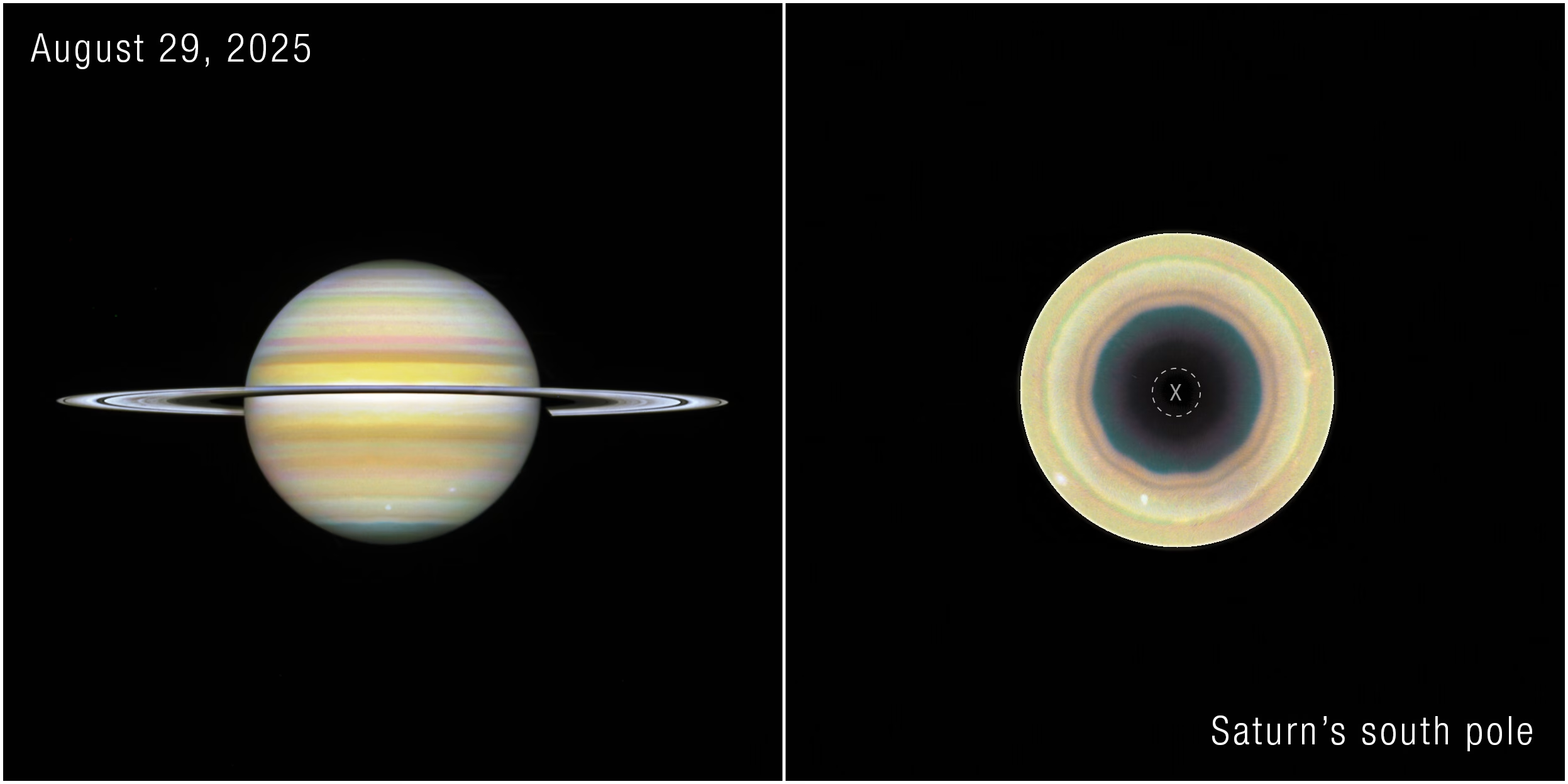
Saturn Has a New Ten-Sided Storm Pattern. Why a Decagon?
CosmicGravity · News & analysis · September 5, 2026
Saturn already had the Solar System’s most famous hexagon. Now the opposite end of the planet has produced something stranger: a vast, ten-sided pattern in its clouds.
The Saturn south pole decagon, announced by the Hubble team on September 2, is a wave in a jet stream, not a solid structure. It is also changing. That makes it a valuable counterpart to the remarkably persistent six-sided pattern in the north.
What Hubble actually saw
Researchers led by Agustín Sánchez-Lavega examined Hubble’s regular observations of the outer planets alongside images from skilled amateur astronomers. Subtle signs appear in 2023 observations; subsequent views made the southern pattern easier to recognize. The team reports that its appearance varies between wavelengths, which probe different atmospheric levels. ESA/Hubble’s discovery report explains the observations and their limitations.
Calling it a decagon describes the large-scale shape. It does not mean Saturn has ten straight walls, or that ten separate storms have joined together. Think of a current that develops a repeating sideways meander as it circles the pole.
Why compare it with the northern hexagon?
Voyager first recorded Saturn’s northern hexagon in the early 1980s. Cassini later followed its jet stream in far greater detail. The Cassini observations show a moving atmosphere maintaining a recognizable pattern: the clouds travel, while the overall geometry can endure.
The southern discovery gives planetary scientists a second example to test. A useful explanation must account for both the familiar northern form and a southern wave with a different number of bends. It must also explain why one pattern is so durable while the other appears more variable.
That comparison is more revealing than asking whether the planet has acquired a new geometric curiosity. Does the wave change with the jet’s speed? Does it look different higher in the atmosphere? Which conditions keep a shape intact?
What we still cannot date
Cassini did not record a comparable persistent southern decagon during its Saturn mission. But gaps in our view mean there is no observed birthday for the new wave. Further monitoring with Hubble and Webb should help establish whether it settles down, changes shape or fades.
A photograph is a moment. Weather is a sequence. Saturn’s next few portraits may therefore matter as much as the image that first brought the decagon to public attention.
For more on what different telescopes reveal, explore our guide to Webb discoveries and the geometry behind planetary alignments.
COSMICGRAVITY · EXPLORE THE EVIDENCE
Read the shape, not just the headline
Tap a heading to open the explanation.
Observation
A ten-lobed cloud-wave pattern is visible in southern polar observations. The image is real; it is not evidence of a built structure.
Interpretation
The research identifies an atmospheric wave associated with a jet stream. Different filters help reveal its vertical structure.
Next test
Repeated observations can establish how the shape and motion evolve. One striking frame cannot tell that whole story.
Lead image: Hubble’s August 29, 2025 observation and a polar projection, released with the September 2026 discovery. NASA, ESA, STScI, A. Sánchez-Lavega (University of the Basque Country), A. Simon (NASA-GSFC), M. Wong (UC Berkeley); Image Processing: A. Pagan (STScI). CC BY 4.0; resized for display. Image source and usage information.
Editorial note: Reporting checked September 5, 2026. Linked sources distinguish the underlying observations from interpretation. Future plans and preliminary results may change.


latest video


news via inbox
Subscribe to our Cosmic newsletter to get notified when we have new articles.