Can a photon prove where a reply came from? Inside NIST’s 195-metre test
Two stations in a research building in Boulder, Colorado, sat 195 metres apart. Between them was a device asked to answer a question about a single particle of light. The researchers cared about the answer, but they cared just as much about where it had been produced. Their quantum position verification experiment, published in Nature on November 18, narrowed the region from which a valid reply could have come. Read the experiment by Gautam Kavuri and colleagues.
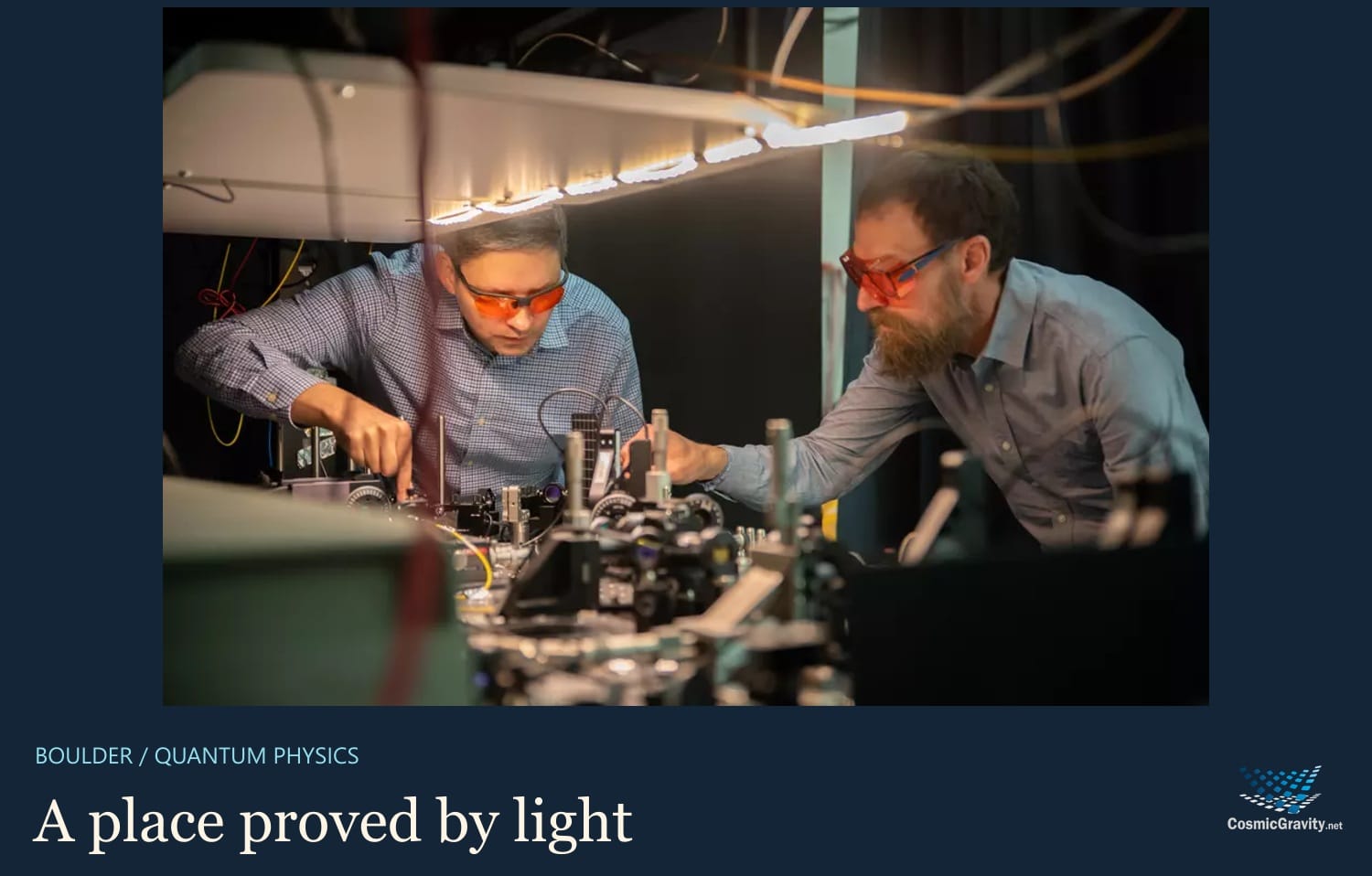
Feature image. Krister Shalm and Marty Stevens guide entangled photons into an optical fibre in Boulder. Photograph by Riley Wilson/NIST. Image source.
That task differs from finding your own position with a phone. In Boulder the people asking the question already had a place in mind. They wanted the distant equipment to supply evidence that the measurement happened there. A person’s name, a password and the name of a building would each answer a different question.
What the clocks contribute
Imagine standing between two people with stopwatches. Each sends you part of an instruction. You can start work only once both parts reach you. If your reply must get back to both people before a deadline, a position too far to either side will make you late. Real stations use precisely timed electrical and optical signals. The time light takes to travel sets the underlying limit.
Timing alone leaves room for uncertainty. Signals take time to move through equipment, and several positions can satisfy the deadlines. It also matters whether the device really did the work it was asked to do. A reply consisting of a lucky guess might arrive impressively early. The physicists wanted a check on the physical measurement itself, one they could repeat often enough to distinguish a pattern from luck.
What the photons contribute
One verifier prepared pairs of entangled photons. It retained one photon and sent the other towards the test region. Both stations sent fresh random instructions timed to arrive together there. Combined, those instructions specified how to measure the incoming photon’s polarization, a property related to the orientation of light’s electric field. The result had to get back to the stations in time. NIST describes the equipment and the sequence.
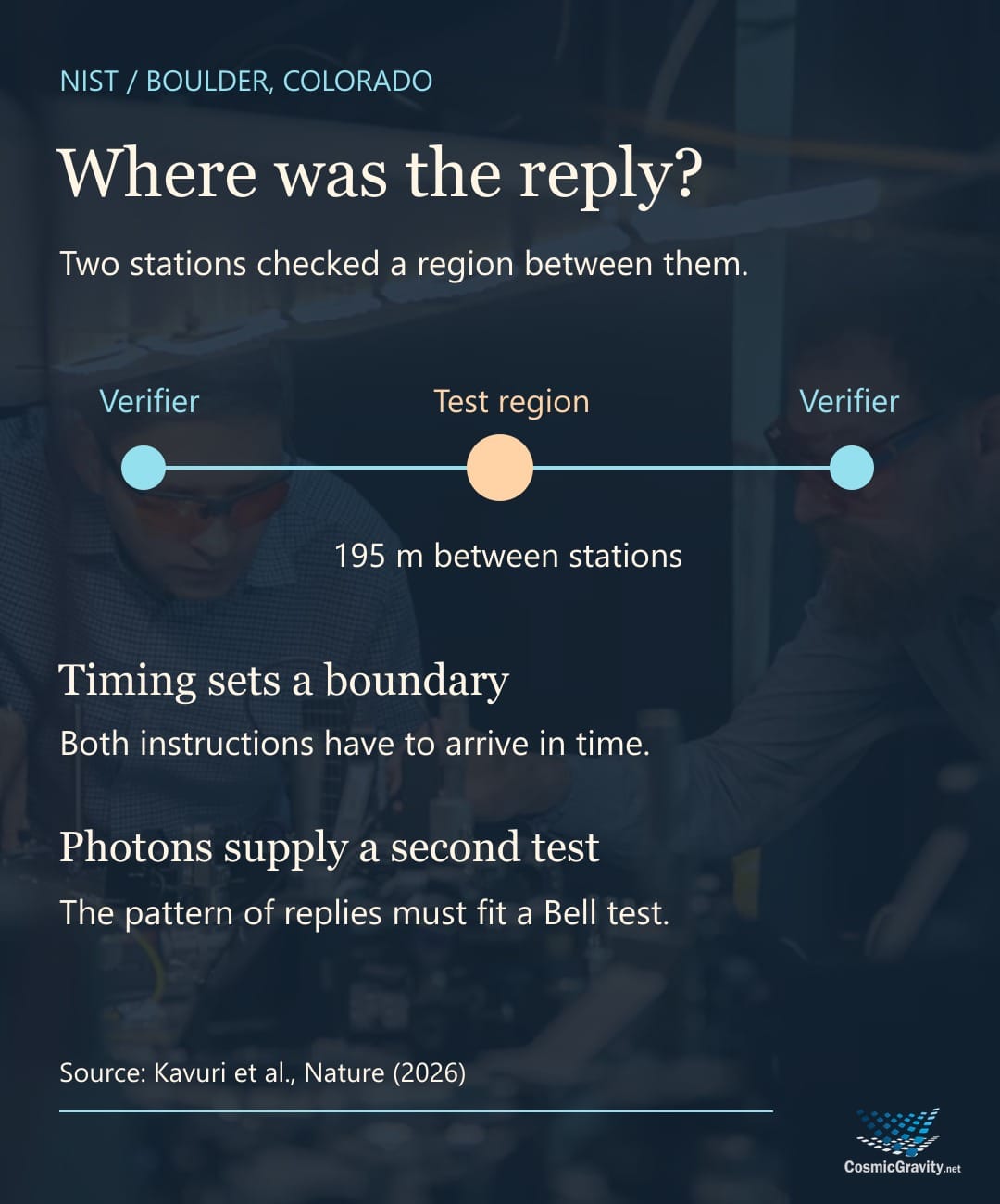
Over many trials the researchers compared the reported results with their measurements of the retained photons. A Bell test checks how strongly the two sets of results correlate across different measurement choices. Quantum mechanics allows correlations stronger than a pair of devices could produce from local, prearranged answers under the conditions of the test. A single agreement proves little. The strength comes from the statistics, and from counting trials with care. For a different experimental test of what fixed answers can explain, see CosmicGravity’s account of the quantum magic square.
How precisely did quantum position verification locate the reply?
The paper reports two comparisons. Along one dimension the certified region was about 2.47 times smaller than in the best classical comparison, which requires a non-remote arrangement. For classical protocols with the same delays, the quantum experiment narrowed the volume by a factor of about 4.53. Length and volume answer different questions, and the classical baselines differ as well. Quoting either figure as a general improvement in GPS accuracy would lose what the team actually measured.
The result also comes with an important condition. In the version tested in the laboratory, potential participants outside the target region could share only limited entanglement with each other before each trial. The researchers describe more general versions with different resource bounds. They also needed efficient detectors, carefully calibrated timing and repeated measurements. The clocks still do their work at ordinary signal speeds. Entanglement helps establish what happened within those limits. The authors give the assumptions and timing geometry in their technical account.
A future network might want evidence that a sensitive instruction originated inside a particular facility. A location check could contribute one part of that decision. It would still take other evidence to establish who issued the instruction and whether they were authorized. For now the accomplishment fits inside a laboratory building. Two stations could put a tighter boundary around the origin of a reply by asking a question that required a photon to answer.


latest video

news via inbox
Subscribe to our Cosmic newsletter to get notified when we have new articles.