The unfinished wall that reveals how Pompeii’s builders mixed Roman concrete
One of the most revealing samples of Roman concrete at Pompeii had never been put into a wall. In a house under renovation when Vesuvius erupted in AD 79, the builders had left a pile of dry material ready for work. Nearby stood walls at different stages of completion. Nearly two thousand years later, researchers could compare the contents of the pile with what had set hard a few steps away. Usually a materials scientist has to work that sequence out backwards from a ruin.
The construction site lies in Regio IX, one of the districts archaeologists use to map Pompeii. The excavation team described the building work in 2024. A chemical and microscopic study published in December 2025 took the investigation down to the level of individual grains. The question was simple enough to ask in any builder’s yard. At what point did the workers add the water? Read the excavation report and the subsequent materials study.
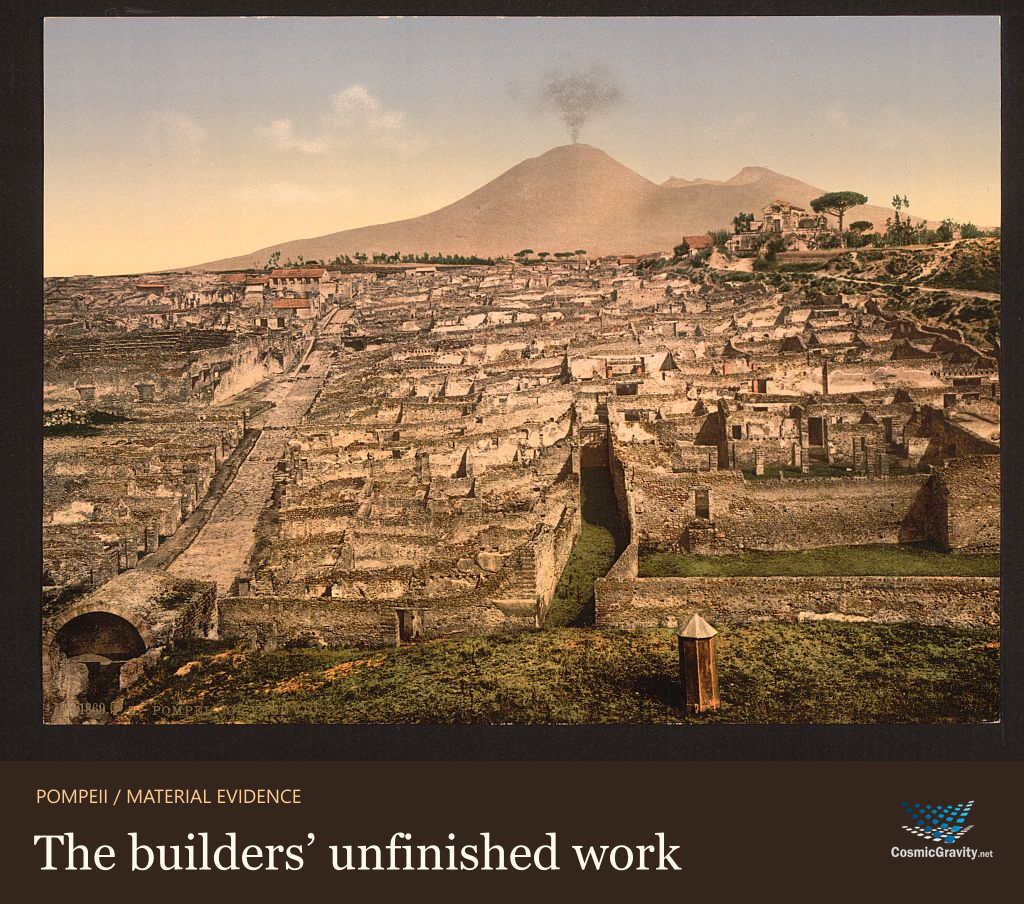
Feature image. Pompeii and Vesuvius in a photochrom print made around 1890–1900. Library of Congress, Prints and Photographs Division, LC-DIG-ppmsc-06584. This is a general view of the ancient city. Image source.
The ingredient hiding in the dry pile
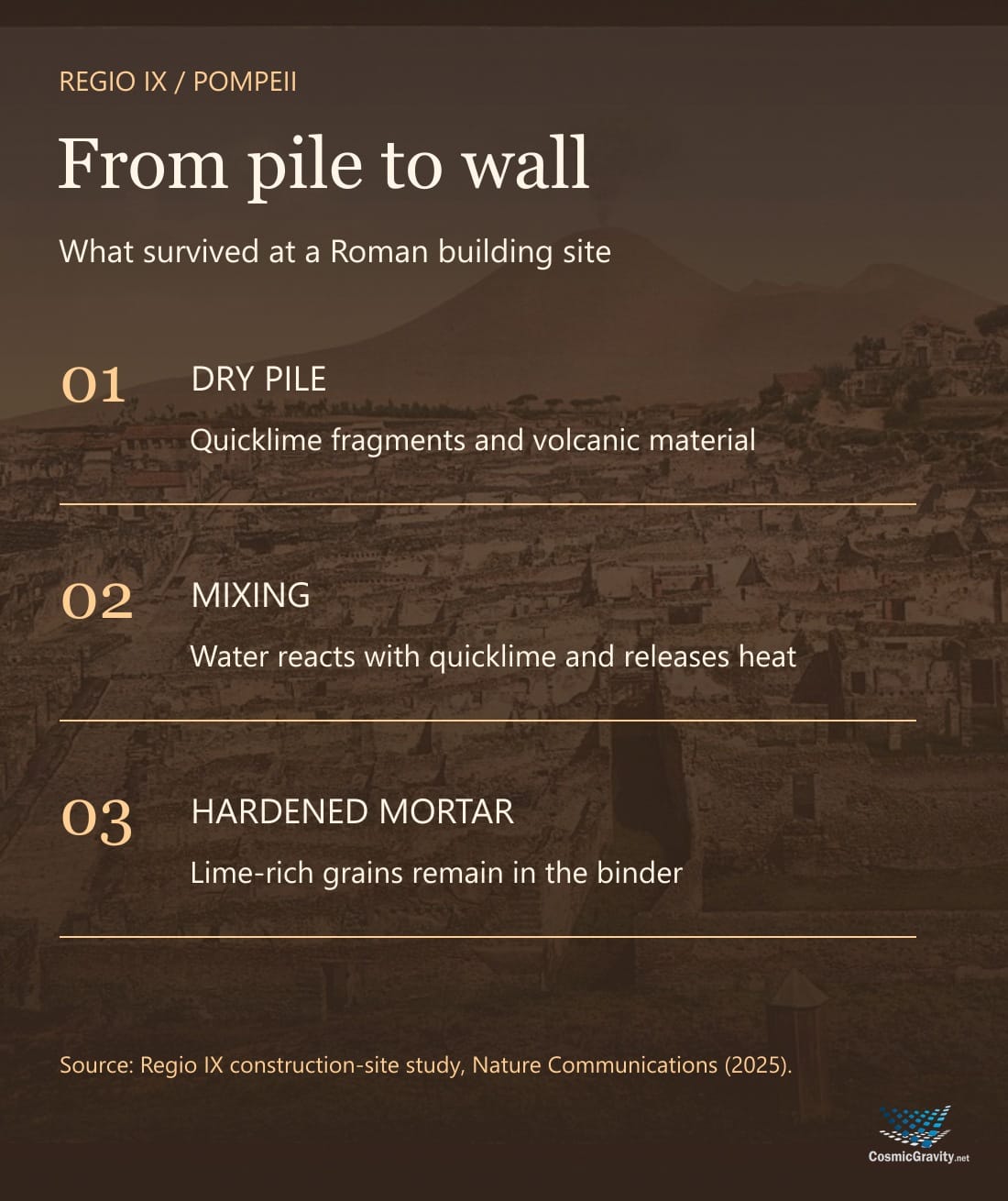
Limestone changes when heated in a kiln. It gives up carbon dioxide and leaves quicklime, a substance that reacts with water and releases heat. Builders can add water first and let that reaction run before combining the slaked lime with other ingredients. They can also combine quicklime with dry volcanic material and let the reaction take place inside the mixture. In that second sequence the mortar itself becomes hot. This is the process researchers call hot mixing.
The finished product gives an imperfect account of which route a builder took. Mortar hardens, reacts with the air and changes again as water passes through it. A pale lump visible in an old wall might invite several explanations. The pile at Pompeii preserved fragments of quicklime already mixed with the dry volcanic material. It caught the builders at an earlier stage, when the order of operations was easier to read. MIT’s research team describes the samples and what they contained.
Following the Roman concrete from pile to repair
The researchers sampled the dry pile, masonry under construction and mortar used to repair an existing wall. Under a microscope they could see the lime-rich grains and the material immediately around them. Chemical mapping let them follow changes at the edges of volcanic particles. Stable isotope measurements added another line of evidence about how the lime had reacted. A fleck of white in the wall was a starting point. The case for hot mixing came from finding related evidence in several samples from one worksite.
Take the volcanic component. Pumice is full of tiny cavities. In the repair mortar, the team found evidence that the grains had continued to react with liquid in those pores. New minerals appeared where the volcanic particles met the surrounding binder. The wall had become firm enough to use long before all of its chemistry was over. That helps explain why the material scientists wanted samples from repairs as well as fresh construction.
What does “self-healing” mean here?
The claim has an experimental history of its own. In work reported in 2023, researchers deliberately cracked test pieces of hot-mixed concrete and ran water through them. Calcium-bearing material dissolved and minerals formed in the cracks. In the specimens described by the team, the water stopped flowing within two weeks. It kept flowing through comparison pieces made without quicklime. The endpoint in that experiment was a sealed water pathway. Recovering a wall’s original load-bearing strength would require a different test. MIT explains the earlier crack-sealing experiment.
The two studies answer different questions that often get folded together. The modern specimens show how mineral growth can block a small crack under the tested conditions. The Pompeii samples show that ancient builders at this particular house used a sequence capable of producing reactive lime grains. Neither finding tells us how every wall in the Roman world was mixed, or whether the workers themselves described the purpose in those terms.
What the eruption preserved is unusually ordinary and unusually informative. Someone was going to return to that pile and use it. Because the work stopped there, archaeologists could recover a decision that would otherwise have vanished into the fabric of the house. Another Pompeian discovery turned on the survival of objects in their original setting. Read what excavators found in a household cupboard.



latest video



news via inbox
Subscribe to our Cosmic newsletter to get notified when we have new articles.